
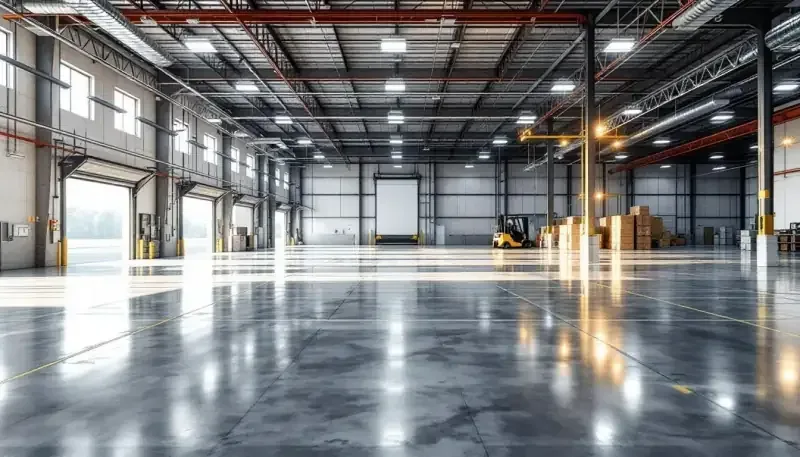
Warehouse & Industrial Floors in Olathe, KS
From the Great Plains Commerce Center to the Olathe Industrial Park off I-35, we build warehouse floors that handle the punishment of NAFTA corridor freight traffic — day after day, shift after shift.
What's Happening Beneath Your Warehouse Floor Along 175th and I-35?
Drive south on I-35 past the 175th Commerce Centre and you'll see Olathe's logistics backbone in action. Trucks loaded with freight roll off the NAFTA superhighway and into distribution centers that depend on concrete floors built for relentless weight. If your facility sits in this corridor, you already know what a failing floor costs — damaged forklifts, slowed pick rates, and safety incidents that put your operation at risk.
Olathe's industrial growth has been explosive. Newer facilities near 175th Street went up between 2020 and 2024, but many warehouse buildings along the older Olathe Industrial Park date back decades. Those slabs are showing it. Joint deterioration, surface dusting, and random cracking are common in buildings that have outgrown their original floor specs. Your operation has evolved, but the concrete underneath hasn't kept up.
Since 2015 we've completed 377+ projects across the Kansas City metro, and Olathe warehouse floors are some of our most requested work. Our crew understands the specific demands of Johnson County commercial construction — from permitting requirements to the soil conditions that make subbase prep critical. We build floors that perform under real loads, not theoretical ones.
Industrial-Grade Concrete Floors Built for Olathe's Freight and Fulfillment Economy
Olathe warehouse floors face a unique combination of stressors. Heavy truck traffic from I-35 feeds directly into local distribution centers. Forklifts run double shifts across narrow aisles. Point loads from multi-tier racking systems concentrate thousands of pounds on small contact patches. We engineer slabs with the right PSI, reinforcement schedule, and joint layout to handle all of it — not just on day one, but for the full lifecycle of your building.
Our industrial floor work covers new construction pours, full-depth tear-out and replacement, and targeted section repairs. We pour slabs ranging from 5 inches for light-duty storage to 8 inches or more for heavy distribution and manufacturing. Fiber reinforcement, welded wire fabric, and rebar configurations are selected based on your actual loading data, not rules of thumb. Every project gets a custom mix design suited to Olathe's soil and climate profile.
We also install vapor barriers, joint sealants, surface densifiers, and chemical-resistant toppings as part of a complete floor system. If your facility near Olathe Pointe or the Great Plains Commerce Center needs a floor that resists chemical spills, abrasion from steel-wheeled carts, or thermal cycling from dock doors opening in January, we spec the right system and execute it on schedule.
Olathe-Specific Warehouse & Industrial Floors Considerations
Johnson County's Expansive Clay and What It Means for Your Subbase
Olathe sits on heavy clay soils that expand when wet and shrink when dry. For a warehouse floor, this movement is the enemy. An improperly prepared subbase leads to slab settlement, cracking, and joint failure — sometimes within the first two years. We excavate to stable material, install granular subbase in lifts, and compact to 95% Modified Proctor density. On sites in the Olathe Industrial Park where fill material is inconsistent, we probe and test before pouring a single yard of concrete.
Heavy I-35 Truck Traffic and Dock-Area Slab Performance
Facilities along I-35 and US-169 see constant trailer traffic. The approach slabs and dock aprons in these buildings take a beating from loaded trailers, dock leveler cycling, and turning movements from yard tractors. We pour these high-wear zones with 5,000+ PSI concrete and thickened edges. Joint placement is coordinated with your dock leveler positions so you don't end up with cracks radiating from every pit. This is detail work that protects the most expensive square footage in your building.
Johnson County Permitting and Commercial Inspection Requirements
Johnson County and the City of Olathe enforce specific commercial building codes for structural concrete. Interior floor replacements typically require a building permit, and inspections are scheduled through the city's Development Services department. We handle the permit application, submit engineered drawings when required, and coordinate inspection timing so your project doesn't stall waiting on an inspector. Our crew knows the Olathe inspection cadence and builds the schedule around it.
What to Expect During Your Olathe Warehouse Floor Project
The process starts with a site visit to your facility. We walk the existing floor, identify failure patterns, and discuss your operational requirements — racking layout, forklift types, load weights, chemical exposure, and any planned equipment changes. We measure elevations, check drainage, and assess the condition of the existing subbase if a tear-out is involved. You'll get a detailed proposal within a week that includes mix design, reinforcement specs, joint layout, and a day-by-day schedule.
On pour day, concrete trucks access your facility from whatever route minimizes disruption. For buildings near the Great Plains Commerce Center off K-7, trucks typically stage on adjacent service roads and rotate in one at a time. Our crew sets up a laser screed for flatness control and manages the pour in sections if your operation needs to keep running in adjacent bays. Expect noise from vibration equipment and power trowels — we'll coordinate timing with your shift schedule.
Johnson County inspections happen at specific milestones: subbase compaction, vapor barrier installation, rebar or reinforcement placement, and the final pour. We call in inspections ahead of time so there's no idle gap in the schedule. You won't need to manage any of the inspector coordination — that's on us. After the pour, we wet-cure the slab for a minimum of seven days and apply any specified surface treatment once the concrete reaches design strength.
Final walkthrough includes flatness testing with a floor profiler, visual inspection of all joints and edges, and a written report documenting the installed floor specifications. We leave you with mix design certifications, compaction test results, and warranty documentation. Most Olathe warehouse floor projects from tear-out to turnover run three to six weeks depending on square footage and phasing requirements.
40,000 Square Feet of New Slab at a Great Plains Commerce Center Distribution Facility
A distribution company operating out of a 2002-era building near the Great Plains Commerce Center off K-7 was losing productivity to a failing warehouse floor. The original 4-inch slab had been spec'd for light storage but was now supporting five-high selective racking with point loads exceeding 8,000 pounds per baseplate. Cracks radiated from nearly every column, joints had spalled to the point that forklift operators were reporting constant jolts, and dust accumulation was contaminating product packaging. The facility manager needed a new floor but couldn't shut down receiving operations for more than two weeks at a time.
We designed a phased tear-out and replacement plan that split the 40,000-square-foot floor into four zones. Each zone was demolished, excavated to 12 inches below finish grade, and rebuilt with compacted limestone subbase, a 15-mil vapor barrier, and a 6-inch 5,000 PSI slab reinforced with number 4 rebar on 18-inch centers both ways. Joint layout was coordinated with the existing column grid and the new racking plan so no joint fell under a baseplate. We poured each zone in a single day using laser screed equipment to hit FF 35 / FL 25 flatness numbers.
The project ran five weeks total. The facility kept three of its eight dock doors operational throughout the process. Johnson County inspections passed on first call at every milestone. Six months after completion, the facility manager reported zero new cracks, no dusting, and a measurable improvement in forklift travel speed across the floor. That's 377+ projects worth of experience showing up where it matters — under real loads, on real schedules.
How Much Does Warehouse & Industrial Floors Cost in Olathe?
| Type | Cost / Sq Ft | Project Dependent |
|---|---|---|
| Standard Industrial Slab | $3–6 | Varies by scope |
| Polished Concrete | $5–10 | Varies by scope |
| Epoxy / Coating System | $4–8 | Varies by scope |
Olathe industrial floor pricing typically ranges from $6 to $12 per square foot installed, depending on slab thickness, reinforcement, and surface treatment. Projects requiring deep subbase correction — common in older sections of the Olathe Industrial Park with inconsistent fill — will land on the higher end due to excavation and material costs.
Warehouse & Industrial Floors FAQ for Olathe, KS
Does Olathe require permits for warehouse floor work inside an existing building?
Yes. The City of Olathe requires a building permit for structural concrete work inside commercial buildings, including full-depth floor replacement. The permit process runs through Olathe Development Services and typically takes five to ten business days for approval. We submit the application and engineered plans on your behalf. Inspections are required at subbase, reinforcement, and final pour stages. We build inspection windows into the project schedule so there's no downtime waiting on the city.
What PSI concrete should my Olathe warehouse floor have?
Most Olathe warehouse floors we pour use a minimum 4,500 PSI mix design, and we frequently spec 5,000 PSI or higher for facilities handling heavy distribution loads. The right PSI depends on your racking point loads, forklift types, and whether the floor sees impact from dropped pallets or steel-wheeled equipment. For cold storage facilities or docks exposed to freeze-thaw cycling from open overhead doors, we add air entrainment to the mix design to prevent surface scaling. We size the concrete to your actual use case, not a generic standard.
How do you phase the work so our warehouse stays operational?
We divide the floor into pour sections based on your racking layout and traffic patterns. Typically we isolate one bay or zone at a time using barricades, allowing operations to continue in the rest of the building. Material staging and truck access are routed away from active work areas. For facilities near I-35 with multiple dock doors, we can sequence pours so you always have at least half your docks available. Each phase cures independently before we move to the next section.
How long before we can run forklifts on the new floor?
Light foot traffic is allowed after 24 to 48 hours. Rubber-tired forklifts can typically operate on the floor after seven days. For cushion-tire or steel-wheeled equipment, we recommend waiting a full 14 days to allow the concrete to reach adequate compressive strength. If you're installing racking, anchor bolts should not be drilled until the slab hits 28-day design strength. Rushing this timeline risks surface damage and joint failures that void the warranty. We provide a written curing and loading schedule specific to your project.
What causes the white dust on our current warehouse floor and will the new floor have the same problem?
That white dust is called efflorescence and surface dusting. It's caused by a weak surface layer — usually from improper finishing, low-quality mix design, or inadequate curing on the original pour. It's extremely common in Olathe buildings from the 1990s and early 2000s. Your new floor won't have the same issue. We use a properly proportioned mix, machine trowel to a dense finish, and apply a lithium silicate densifier that chemically hardens the surface. The result is a floor that resists dusting and abrasion for the life of the slab.
Other Concrete Services in Olathe, KS
Warehouse & Industrial Floors in Nearby Cities
Schedule a Site Consultation at Your Olathe Facility
We'll walk your floor, assess the damage, and discuss your operational constraints on-site. Most Olathe consultations take about an hour and you'll have a detailed proposal in hand within a week.