
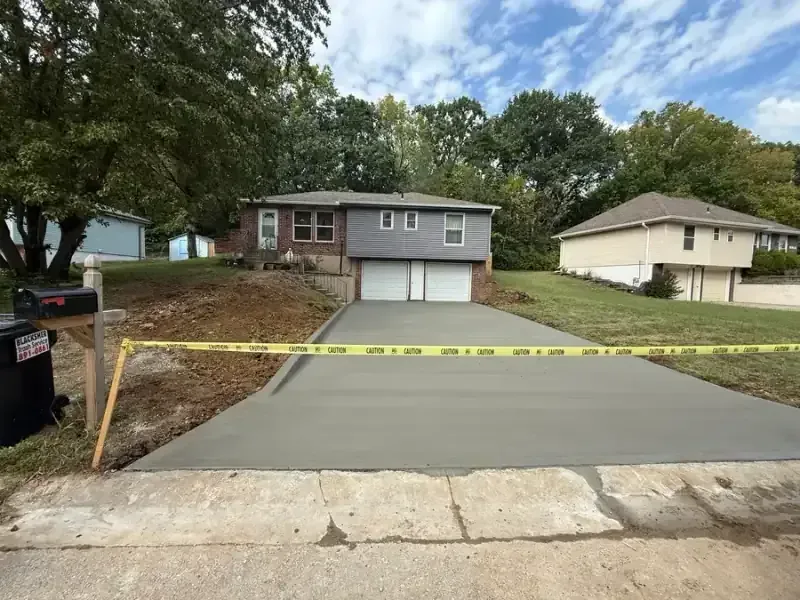
Concrete Driveways in Olathe, KS
A straight answer on what a new concrete driveway actually costs in Olathe — and what you're paying for when the soil, the weather, and the details all matter.
So What Does a Concrete Driveway Really Cost in Olathe?
Let's skip the runaround. A standard two-car concrete driveway in Olathe runs between $4,800 and $9,500 depending on size, thickness, and site conditions. That range is wide on purpose. A straightforward tear-out and repour in Brougham Village hits different numbers than a sloped lot in Persimmon Hill that needs subgrade correction and extra drainage work. We quote after seeing your property — never before.
Why does Olathe cost what it costs? Johnson County labor rates sit above the metro average. Ready-mix concrete trucks dispatched from local batch plants carry fuel surcharges tied to diesel prices. And the clay-heavy soil across much of southern Olathe demands proper subgrade prep that cheaper bids often skip. That prep is the difference between a driveway that lasts 30 years and one that cracks in five.
Material costs have shifted since 2022. Rebar, fiber mesh, and ready-mix prices all climbed. We buy in volume and maintain supplier relationships that keep your per-yard cost competitive. But we refuse to cut corners on mix design. Every driveway we pour uses air-entrained concrete rated for Kansas freeze-thaw cycles — the same D-cracking you see in aging slabs near Black Bob Road happens when that spec gets ignored.
The real cost question isn't the pour. It's the total value over 25 to 30 years. Asphalt needs resealing every two to three years. Pavers shift and settle in Olathe's expansive clay. A properly installed concrete driveway needs minimal maintenance, boosts curb appeal, and holds up under the daily SUV and truck traffic that defines Johnson County driveways. Since 2015, we've completed 377-plus projects across the metro, and our 13 five-star Google reviews reflect that long-term thinking.
What Goes Into an Olathe Concrete Driveway That Actually Lasts
Olathe sits on silty clay loam that expands when wet and contracts when dry. That seasonal movement puts enormous stress on rigid slabs. We start every project with subgrade evaluation. If the existing soil is too soft or inconsistent — common in neighborhoods built during the 1990s housing boom near 119th and Black Bob — we excavate deeper and bring in compacted Class 5 aggregate base. This prevents the settlement cracking that plagues older driveways across the city.
Our standard residential pour is four inches thick with a six-inch thickened edge. For homeowners in Cedar Creek or Heatherstone who park heavier vehicles — work trucks, trailers, RVs — we recommend a five-inch slab with rebar reinforcement on 18-inch centers. Control joints are saw-cut at proper intervals within 12 hours of the pour. Joint spacing matters more than most contractors admit. Too far apart and random cracks form. We calculate spacing based on slab thickness and ambient temperature at pour time.
Finish options range from standard broom finish to exposed aggregate and stamped patterns. Broom finish gives you reliable traction in winter and costs the least. Exposed aggregate hides tire marks and complements the stone-and-brick exteriors common in Olathe's newer subdivisions. Every driveway gets a liquid membrane cure compound applied immediately after finishing, followed by a recommended penetrating sealer application 30 days later.
Olathe-Specific Concrete Driveways Considerations
HOA Design Standards Across Olathe Subdivisions
Many Olathe neighborhoods enforce strict HOA guidelines on driveway appearance, width, and even concrete color. Subdivisions like Heatherstone and Persimmon Hill often require approval before construction begins. We handle this regularly. Our crew provides dimensioned site plans and finish samples your HOA board can review. If your association mandates a specific broom direction, integral color, or bordered edge treatment, we build to that spec. Skipping the approval step can mean tearing out a brand-new driveway — we make sure that never happens.
Utility Line Conflicts and Right-of-Way Setbacks
Olathe's rapid growth means underground utility corridors are dense across the city. Gas, fiber optic, and stormwater lines frequently run under or alongside existing driveways — especially in neighborhoods near K-7 and US-169. Before any excavation, we call 811 and verify locate markings ourselves. The city also enforces right-of-way setbacks that affect how close your driveway can extend toward the street. In older areas along Santa Fe Street, the setback line may surprise you. We confirm these dimensions during the estimate visit so the scope stays locked in.
What Your Concrete Driveway Timeline Looks Like in Olathe
Day 1: Demolition and Removal. Our crew arrives early to saw-cut and break out the old slab. A standard two-car driveway generates 12 to 15 tons of debris. We haul everything to a Johnson County recycling facility the same day. By afternoon, your lot is cleared and the subgrade is exposed. You'll lose driveway access starting now — plan to park on the street or in front of a neighbor's house for about a week total.
Days 2–3: Subgrade Prep and Forming. We excavate to the required depth, remove soft clay pockets, and bring in compacted aggregate base. Forms are set to grade with laser-checked elevation. If your lot drains toward the garage — common in Havencroft and parts of Brougham Village — we build slope into the forms to direct water toward the street. The Olathe building department typically processes residential driveway permits within two to four business days, so we submit the application during the estimate phase to keep the schedule tight.
Day 4: Concrete Pour. Trucks arrive from the batch plant between 7 and 8 a.m. A typical two-car driveway takes four to six cubic yards. Our crew places, vibrates, screeds, and floats the slab in a single continuous pour. Control joints are saw-cut the same afternoon or early the next morning depending on temperature. Spring and fall are the best pour windows in Olathe — summer pours above 90 degrees require extra hydration management, and we avoid pouring below 35 degrees entirely.
Days 5–7: Curing and Protection. The slab cures under membrane compound for a minimum of seven days. We place barricades and caution tape to keep foot traffic and pets off the surface. Light foot traffic is safe after 48 hours. No vehicles for a full seven days — ten days in cooler weather. We'll give you an exact date based on forecast conditions.
Day 8 and Beyond: You're back on your driveway. We return for a final walkthrough, check joint quality, and review sealer timing. Most Olathe homeowners apply their first penetrating sealer around the 30-day mark. Total project time from demolition to driving on it: eight to ten days for a standard driveway, up to two weeks for larger pours or projects requiring city inspection holds.
A Heatherstone Driveway That Had Been Patched One Too Many Times
A homeowner on 153rd Terrace in the Heatherstone subdivision called us about a driveway that had been patched four separate times over a decade. The original slab was poured in 1997 during the subdivision's initial build-out. Settlement cracks ran diagonally from the garage apron to the street. Previous patch jobs used mismatched materials that looked terrible and hadn't stopped the cracking. Water pooled along the north edge and froze into a sheet of ice every winter.
We tore out the entire 480-square-foot slab and discovered the original builder had poured directly on uncompacted clay fill — no base material at all. We excavated eight inches deep, installed compacted limestone aggregate, and set forms with a consistent 2-percent slope toward the street. The pour used 4,000 PSI air-entrained concrete with fiber mesh reinforcement. Control joints were saw-cut at five-foot intervals by 6 p.m. that evening.
The finished driveway eliminated the pooling issue entirely. The homeowner went from dreading every rainstorm to not thinking about drainage at all. Six months later, we got a call asking us to pour a matching side parking pad — same spec, same finish, seamless connection to the original slab. That's the kind of result we build every project around.
How Much Does Concrete Driveways Cost in Olathe?
| Type | Cost / Sq Ft | Typical 600 Sq Ft |
|---|---|---|
| Standard Gray (Broom Finish) | $8–12 | $4,800–$7,200 |
| Colored / Stained | $10–15 | $6,000–$9,000 |
| Exposed Aggregate | $10–16 | $6,000–$9,600 |
| Stamped / Decorative | $12–18 | $7,200–$10,800 |
Johnson County ready-mix prices and labor rates run 8 to 12 percent above the broader Kansas City metro average. Olathe's clay subgrade often adds a half-day of excavation and base prep that flat-rate bids from out-of-area contractors frequently miss — ask what's included before you compare numbers.
Concrete Driveways FAQ for Olathe, KS
Does the City of Olathe require a permit for replacing a residential driveway?
Yes. Olathe requires a right-of-way permit for any driveway work that connects to a city street, and a building permit if you're changing the footprint or dimensions. Permit turnaround from the Olathe Development Services department typically takes two to four business days for straightforward residential replacements. We handle the application, fee payment, and any required inspections so you don't have to visit city hall. If your project includes a new curb cut or apron modification, the review may take slightly longer.
How do Olathe's clay soils affect the driveway installation process?
Olathe sits on expansive silty clay that swells with moisture and shrinks during dry spells. This movement creates heaving and settlement beneath slabs. We mitigate it by over-excavating the top layer and replacing it with six inches of compacted Class 5 limestone aggregate. This stable base absorbs the clay's movement without transferring stress to the slab. Skipping this step is the number-one reason driveways crack prematurely in Johnson County. We check subgrade compaction with a plate compactor and verify density before setting forms.
Can you pour a driveway if my house is on a cul-de-sac or narrow street in Cedar Creek?
Absolutely. Our concrete supplier runs both standard and short-wheelbase mixer trucks. Tight cul-de-sacs in Cedar Creek, Persimmon Hill, and parts of Heatherstone are common on our schedule. We coordinate truck routing in advance and sometimes stage pumping equipment for lots where the truck can't back directly to the forms. We also lay plywood sheeting to protect your lawn and your neighbor's lawn from tire ruts.
What's the difference in cost between a plain broom finish and stamped concrete?
A broom-finished driveway in Olathe typically runs $7 to $10 per square foot installed, including tear-out and base prep. Stamped concrete adds $4 to $7 per square foot on top of that, depending on the pattern complexity and whether integral color or release agents are used. Stamped driveways also require periodic resealing every two to three years to maintain the color and texture. Broom finish needs less maintenance overall. Both options perform equally well against freeze-thaw cycling when the mix design and cure are done right.
My driveway meets the sidewalk at an awkward angle near the street — can you fix that transition?
Yes, and it's more common than you'd think in Olathe's older sections near Santa Fe Street and downtown. The street apron — the section between the sidewalk and the curb — is technically in the city right-of-way. Replacing or modifying it requires a separate right-of-way permit. We handle that paperwork and pour the apron to city spec, which usually means a six-inch-thick reinforced section sloped for drainage. The result is a clean, flush transition that eliminates the lip or dip you're dealing with now.
Will winter deicing products hurt a new concrete driveway during its first year?
Chemical deicers — especially magnesium chloride and calcium chloride — can cause surface scaling on concrete that hasn't fully cured and hardened through its first winter. We recommend avoiding all chemical deicers during the first cold season. Use sand or kitty litter for traction instead. After the first full year, a quality penetrating sealer provides strong protection against salt and chemical damage. Our air-entrained mix design already resists the internal pressure from freeze-thaw cycling, but surface chemistry matters too. We walk through first-winter care during your final walkthrough.
Other Concrete Services in Olathe, KS
Get Your Free Olathe Driveway Estimate This Week
We'll visit your property, evaluate your subgrade, measure the full scope, and hand you an honest number — typically within 48 hours of your call. Serving every Olathe neighborhood from Brougham Village to Cedar Creek and everywhere along I-35.