
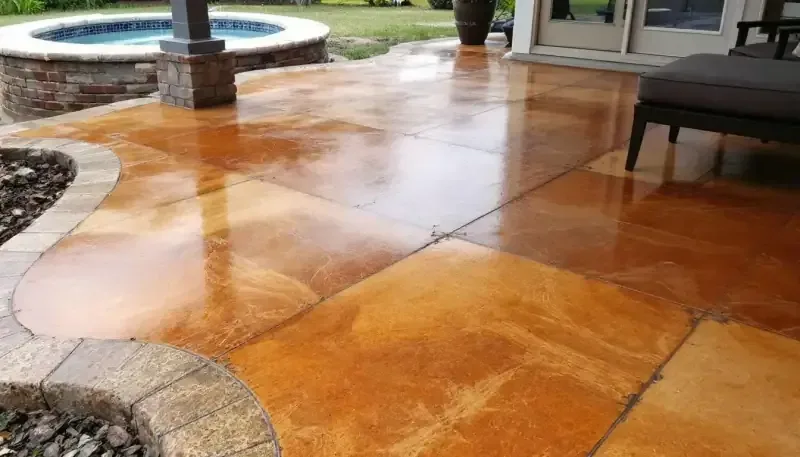
Stained & Colored Concrete in Olathe, KS
Your Olathe home deserves more than gray. We turn plain concrete into rich, lasting color that holds up through Johnson County winters and hot Kansas summers alike.
That Faded Gray Slab Is Dragging Down Your Whole Backyard
You step out onto your patio in Persimmon Hill and the first thing you notice is the chalky, washed-out gray surface staring back at you. It clashes with the landscaping you spent thousands on. The concrete is structurally fine — no major cracks, no settling — but it looks like it belongs at an industrial park off 175th Street. Every neighbor's cookout invite reminds you that your outdoor space feels unfinished. That dull slab is the weakest link in an otherwise beautiful property.
Stained and colored concrete solves exactly this problem. Instead of ripping out a perfectly good slab and starting over, we transform what you already have. Acid stains react with the minerals in your concrete to produce deep, translucent earth tones. Water-based stains open the palette to blues, greens, and terracottas. Integral color goes into fresh pours for uniform hue from surface to core. Each approach gives you a different look, and we help you pick the right one for your Olathe home.
Since 2015, we have completed 377+ projects across the Kansas City metro, and a growing share of that work lands in Johnson County. Olathe homeowners are upgrading patios, driveways, pool decks, garage floors, and front porches with custom color. Our 13 five-star Google reviews reflect what happens when a crew shows up on time, communicates clearly, and delivers results that look better than the sample swatch.
The City of the Trails has grown fast. Homes built during the 1990s boom along the Black Bob Road corridor are hitting the age where exterior upgrades make the most financial sense. Newer builds in Cedar Creek and Heatherstone often come with builder-grade gray slabs that beg for personality. Stained and colored concrete fits both scenarios — and the cost is a fraction of a full replacement.
How Stained & Colored Concrete Works on Olathe Properties
Acid staining uses a chemical reaction between metallic salts and the lime content in cured concrete. The result is a mottled, variegated finish with depth you cannot get from paint. Colors range from warm ambers and russet browns to cool blue-greens. Every slab reacts slightly differently, which means your patio in Brougham Village will have a one-of-a-kind pattern. We control the intensity by adjusting concentration, application layers, and dwell time before neutralizing and rinsing.
Water-based stains penetrate the concrete surface without a chemical reaction. They offer a broader color range and more predictable results. If you want a consistent terracotta on your front walkway or a charcoal tone on your garage floor, water-based stains deliver that control. We often combine both methods on a single project — acid stain for the main field and water-based accents for borders or saw-cut patterns.
Integral color is mixed directly into fresh concrete before it is poured. This means the color runs all the way through the slab. It is ideal for new driveways, patios, and pool decks where you want uniform tone with zero maintenance beyond standard sealing. We source pigments rated for UV stability so that the rich hue you choose holds strong under the Kansas sun. Paired with a quality sealer, integral colored concrete in Olathe can look vibrant for 15 years or more.
Olathe-Specific Stained & Colored Concrete Considerations
Olathe's Alkaline Soil and Stain Reactivity
Johnson County sits on limestone-derived soils with high alkalinity. Concrete poured on this subgrade tends to have elevated calcium hydroxide content. That is actually good news for acid staining — more lime means a stronger chemical reaction and richer color saturation. Our crew tests the slab's porosity and pH before selecting stain concentrations. Slabs in Havencroft poured in the early 2000s often react beautifully because they have cured long enough to stabilize while retaining plenty of reactive lime. We adjust our approach slab by slab, not project by project.
HOA Color Standards in Johnson County Subdivisions
Many Olathe neighborhoods — Persimmon Hill, Cedar Creek, Heatherstone — operate under homeowner association guidelines that regulate exterior modifications. Some HOAs require pre-approval of stain colors or limit the palette to earth tones. We provide physical samples and mock-up swatches you can submit to your HOA board before we begin work. We have navigated this process dozens of times in Johnson County and know what documentation boards expect. Getting approval upfront means no surprises and no wasted money.
Existing Surface Coatings and Sealers on Older Slabs
If your patio or driveway along Santa Fe Street has been previously sealed, painted, or coated, stain cannot penetrate until that barrier is removed. Older Olathe homes built during the 1990s growth wave often have acrylic sealers that have partially degraded. Our crew uses diamond grinding or chemical stripping to open the pores before staining. We test a small area first to confirm the stain bonds properly. Skipping this step is the number one reason DIY stain jobs fail. We never skip it.
From First Call to Finished Stained & Colored Concrete
Your journey starts with a phone call or online form. We ask basic questions — slab age, square footage, location, and what you are hoping to achieve. Within a few days, one of our contractors visits your Olathe property. During the site visit, we inspect the concrete for cracks, previous coatings, efflorescence, and surface porosity. We note sun exposure, drainage patterns, and how the slab connects to your landscaping. If you are in Brougham Village with a shaded backyard patio, we steer you toward stain tones that pop in low light. If your Heatherstone driveway bakes in full sun off K-7, we discuss UV-stable options.
After the assessment, we present a written proposal with color recommendations, stain method, surface preparation steps, sealer type, and a firm price. You pick colors from physical samples — not just a screen image. We encourage you to take samples home and view them against your siding, stone, and trim at different times of day. Once you approve, we schedule the work around weather. Olathe's spring and fall offer ideal temperatures for staining, but we work through summer mornings and mild winter windows too.
On project day, our crew arrives early. We pressure wash and strip the slab, then let it dry completely. Stain goes down in controlled passes using sprayers and brushes. Acid stains get 4 to 24 hours of dwell time depending on the color depth you chose. We neutralize, rinse, and let the surface dry before applying two coats of high-performance sealer. The entire process typically takes two to three days for a standard patio, including dry time.
The reveal is the best part. Colors deepen and clarify once the sealer cures. That gray slab in your backyard is gone. In its place is a surface with warmth, dimension, and character that ties your outdoor space together. We walk the finished project with you, point out care instructions, and leave you with a maintenance guide specific to Johnson County weather cycles.
A Heatherstone Patio Gets a Second Life
A homeowner on West 148th Terrace in the Heatherstone neighborhood called us about a 600-square-foot backyard patio poured in 2004. The concrete was sound — no major cracks, no heaving — but two decades of Kansas weather had left it chalky and stained with rust marks from old patio furniture legs. The homeowner had tried concrete paint twice. Both times it peeled within a year. They were ready to tear the whole thing out until a neighbor mentioned staining.
During the site visit, we found remnants of the old paint trapped in low spots and saw-cut joints. Our crew spent the first day grinding the surface to remove every trace of paint and open the pores. We applied a cola-brown acid stain in two coats, letting the first coat dwell overnight. The limestone-rich concrete reacted strongly, producing deep amber and chocolate tones with natural variation that mimicked flagstone. We followed with a water-based charcoal accent along the saw-cut borders for contrast.
After two coats of solvent-based acrylic sealer with non-skid additive, the patio looked like it belonged in a design magazine. The homeowner hosted a graduation party the following weekend. The rust stains were invisible. The peeling paint was a memory. Total project cost came in at less than a third of what a full tear-out and re-pour would have run — and the work was done in three days.
How Much Does Stained & Colored Concrete Cost in Olathe?
| Type | Cost / Sq Ft | Typical 300 Sq Ft |
|---|---|---|
| Acid Stain (Existing Concrete) | $4–8 | $1,200–$2,400 |
| Water-Based Stain (Existing) | $3–6 | $900–$1,800 |
| Integral Color (New Pour) | $10–15 | $3,000–$4,500 |
Stained concrete in Olathe typically runs $4 to $10 per square foot depending on stain type, surface prep requirements, and design complexity. Properties near the Black Bob corridor with older sealed slabs may need additional grinding, which adds roughly $1 to $2 per square foot.
Stained & Colored Concrete FAQ for Olathe, KS
Can you stain the concrete around my pool deck near Lake Olathe without making it too slippery?
Absolutely. We add a non-skid aggregate to the final sealer coat, which creates a textured surface that stays safe when wet. The aggregate is fine enough that it does not feel rough under bare feet, but it provides reliable traction around pool edges and steps. This is standard practice on every pool deck we stain in Johnson County.
How do I know if my 1990s-era patio slab in Havencroft is a good candidate for staining?
Most slabs from that era are excellent candidates. We check for previous sealers, paint, or heavy efflorescence during the site visit. We also test porosity by sprinkling water on the surface — if it absorbs within a few seconds, the concrete is open enough for stain. Older Olathe slabs that have weathered naturally tend to accept acid stain especially well because surface pores have opened over time. Minor hairline cracks are fine. Deep structural cracks should be addressed first, and we handle that as part of the prep work.
Will stained concrete clash with my home's exterior if I decide to repaint later?
Earth-tone stains are versatile and pair well with most siding colors. If you are considering a future exterior repaint, we recommend choosing a stain in the warm brown, amber, or gray-green family. These tones complement everything from the cream siding common in Cedar Creek to the darker stone facades in Persimmon Hill. We bring samples to your property specifically so you can see how they look against your current and planned exterior palette.
What is the difference between acid stain and water-based stain in terms of durability?
Both last equally long because the sealer is what protects the color from wear and UV exposure. Acid stain physically bonds through a chemical reaction, so it will never peel or flake. Water-based stain penetrates the pores and deposits pigment, which also remains permanent once sealed. The real difference is aesthetics. Acid stain gives a mottled, natural stone look. Water-based stain delivers more uniform, consistent color. We often recommend water-based for driveways and garage floors where uniformity matters, and acid stain for patios and porches where character is the goal.
Do you pour new colored concrete for driveways in Olathe subdivisions?
Yes. Integral colored concrete is one of our most popular options for new driveway pours. We mix the pigment into the concrete at the batch plant so the color runs through the full depth of the slab. This means chips or surface wear will not reveal a different color underneath. For Olathe driveways that face heavy use and occasional road salt from I-35 or K-7 commute routes, integral color combined with a penetrating sealer gives you lasting results with minimal upkeep.
My Brougham Village patio has some old outdoor carpet adhesive on it — can it still be stained?
It can, but the adhesive residue needs to come off first. Carpet glue blocks stain from reaching the concrete pores. We use mechanical grinding and chemical stripping to remove it completely. In some cases, the adhesive leaves ghost patterns on the slab that actually create interesting variation once stained. We test a small section before committing to the full application so you can see how the concrete responds. Most adhesive removal adds about half a day to the project timeline.
Other Concrete Services in Olathe, KS
Stained & Colored Concrete in Nearby Cities
Schedule Your Free Olathe Property Assessment
We will inspect your slab's condition, test porosity, check for previous coatings, and recommend the right stain method and colors for your specific Olathe property — all before you spend a dollar.