
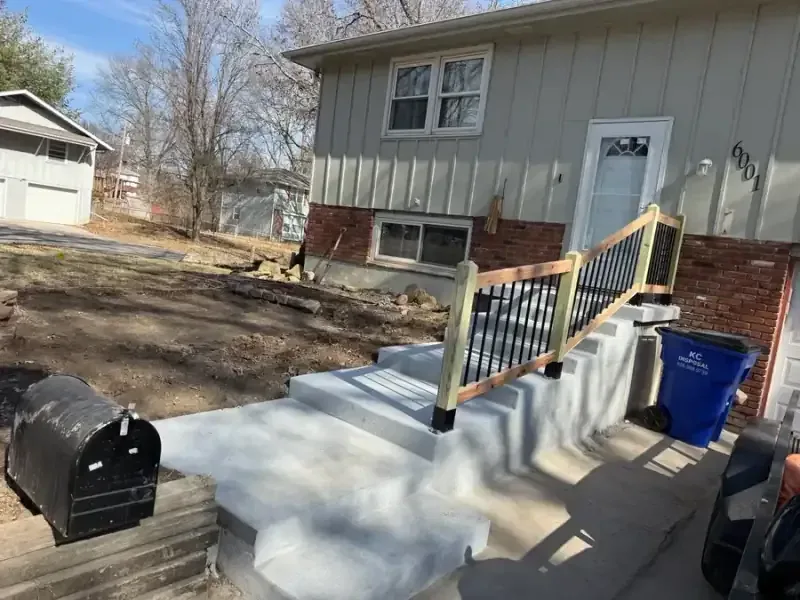
Sidewalks & Walkways in Olathe, KS
Olathe earned its name as the City of the Trails — your home's walkways should live up to that legacy.
Is Your Olathe Sidewalk Ready for What's Coming This Summer?
Summer in Johnson County hits fast. By late May, daytime temps push past 85 degrees and thunderstorms roll through every week. That cracked front walkway you ignored all winter? It's about to become a drainage problem and a trip hazard at the same time. Right now — late spring through early summer — is the ideal window for concrete pours. Warm soil, manageable humidity, and long daylight hours mean your new sidewalk cures evenly and reaches full strength before the August heat waves.
Most Olathe homeowners book walkway projects between April and October, and our schedule reflects that. If you wait until July, you're competing with every other homeowner in Heatherstone and Cedar Creek who had the same idea. Booking now puts your project in the ground before the peak rush. We typically see a three-to-four-week lead time this time of year, which means a call today could mean fresh concrete by mid-June.
Since 2015, we've completed 377 or more residential concrete projects across the Kansas City metro. Thirteen of those earned five-star Google reviews — and a good number came from right here in Olathe. We know this city's soil, its neighborhoods, and the permit process at City Hall on Santa Fe. That local knowledge makes a real difference in how your walkway performs five and ten years down the road.
What Goes Into a Quality Olathe Walkway
A sidewalk isn't just a slab on dirt. In Olathe, you're dealing with heavy clay subsoils that expand when wet and shrink when dry. That seasonal movement is the number one reason older walkways crack, heave, and settle unevenly — especially in neighborhoods built during the 1990s boom near Black Bob Road and 119th Street. Proper subgrade preparation is the single most important factor in a walkway that stays flat and intact for decades.
We pour residential walkways at a minimum of four inches thick with fiber-mesh reinforcement as standard. For front entry walks that see heavy foot traffic or connect to driveways, we often recommend a five-inch pour with rebar dowels at the junction points. Control joints are cut at precise intervals — typically every four to five feet — to direct any future cracking into planned, nearly invisible lines rather than random diagonal fractures across the surface.
Finish options range from a classic broom texture that provides solid grip in wet weather to exposed aggregate and stamped patterns that complement the stone and brick exteriors common in Persimmon Hill and Brougham Village. Every finish gets a high-quality cure-and-seal coat that protects against moisture penetration and the freeze-thaw cycling that defines Kansas winters. Your walkway should look as good in year ten as it does on pour day.
Olathe-Specific Sidewalks & Walkways Considerations
Johnson County Clay Soil and Subgrade Movement
Olathe sits on some of the most expansive clay soils in the Kansas City metro. This clay absorbs moisture during spring rains and contracts sharply in summer drought. Without proper subgrade preparation — including six inches of compacted AB-3 limestone base — a walkway will heave and settle within just a few years. We excavate deep enough to remove the organic topsoil layer entirely and replace it with stable, well-draining aggregate that resists seasonal soil movement.
Olathe's Permit and Right-of-Way Requirements
The City of Olathe requires permits for sidewalk work within the public right-of-way, and many front yard walkways fall partially into that zone. Setback requirements vary by neighborhood — especially in older subdivisions along Santa Fe Street versus newer developments near 159th. We pull permits, coordinate any required inspections, and ensure your new walkway meets current city code for thickness, slope, and ADA-compliant cross grades where applicable.
Mature Tree Root Interference in Established Neighborhoods
Havencroft, Brougham Village, and other neighborhoods built in the 1980s and 1990s have mature hardwood trees with aggressive root systems. Roots push up under existing sidewalks and create dangerous lips and cracks. We assess root proximity before pouring and can install root barriers, adjust walkway routing, or use thickened-edge designs that resist uplift. Protecting both the tree and the concrete requires planning — not guesswork.
Drainage Grading on Olathe's Rolling Terrain
Olathe's terrain isn't flat. Many homes in Cedar Creek and Persimmon Hill sit on gentle slopes that direct water toward foundations if walkways aren't graded correctly. Every walkway we pour maintains a minimum one-quarter-inch per foot cross slope away from structures. Where a walkway runs alongside the house, we incorporate subtle grade changes that channel rainwater toward yard drains or natural low points — keeping your foundation dry without visible pitch.
How We Build Sidewalks and Walkways in Olathe
Every project starts with a site visit where we measure, check grade elevations, and probe the soil. Johnson County clay varies from block to block — some areas near Heritage Park have six inches of topsoil over dense red clay, while sections closer to Lake Olathe sit on silty loam that drains faster but compacts differently. We need to see your specific conditions before we design anything. During this visit, we also flag underground utility lines, sprinkler heads, and any tree roots within the work zone.
Excavation goes eight to ten inches deep for most residential walkways. We remove all organic material and any existing loose fill. Then we bring in AB-3 crushed limestone from a Johnson County quarry — usually sourced within 20 miles of your home — and compact it in lifts using a vibratory plate compactor. Each lift gets compacted to 95 percent density. This base layer is the foundation your concrete will rest on for the next 25 to 30 years, so we don't cut corners here. Compaction testing is visual and mechanical — we watch for movement under load and re-compact any soft spots.
Forms go in next. We use steel or aluminum forms pinned to grade stakes, laser-leveled for consistent elevation across the full run. Where curves are part of the design — common on walkways leading from driveways to back patios — we bend flexible form boards to radius. Rebar or welded wire mesh gets set on chairs to sit at mid-slab height. Then we pour. We use a 4,000 PSI residential mix with air entrainment, which means tiny air bubbles are engineered into the concrete to absorb the expansion pressure during freeze-thaw cycles. This is non-negotiable in Olathe's climate.
After screeding and bull-floating, we apply the chosen finish — broom, stamped, or exposed aggregate — and then cut control joints with a groover or early-entry saw within hours of the pour. The slab gets sprayed with a curing compound that locks in moisture for seven days of proper hydration. We strip forms the next day, backfill edges with clean topsoil, and walk you through a care schedule. Full vehicle or heavy load traffic across adjacent areas stays restricted for at least seven days.
A Crumbling Entry Walk Gets a Fresh Start in Brougham Village
A homeowner on Brougham Drive called us about a front walkway that had seen better days. The original 1987 pour had cracked in five places, with two sections heaving nearly two inches above the adjacent slabs. Tree roots from a large silver maple had pushed under the concrete from the west side, and water pooled against the foundation every time it rained. The homeowner had patched it twice with bag mix, but the patches crumbled within a season. They wanted a clean, safe path from the driveway to the front porch — and they wanted it done before a family graduation party in early June.
We demoed the entire 48-foot walkway in one morning, hauled away 3.5 tons of broken concrete, and found exactly what we expected underneath: compacted clay with zero base material and roots snaking across the full width. We cut back the offending roots cleanly, installed a polyethylene root barrier along the tree side, and laid six inches of compacted AB-3 limestone. The new walkway went in at four and a half inches thick with rebar on chairs, a gentle crown for drainage, and a classic broom finish with a warm tan integral color that matched the home's stone veneer.
The pour happened on a Tuesday. By Thursday, the forms were stripped and the edges backfilled with fresh topsoil. The homeowner had the walkway fully in use five days before the party. No more pooling water, no more trip hazards, and a clean line from driveway to porch that actually complements the house instead of embarrassing it. That's what a properly built walkway does — it disappears into the landscape because everything about it just works.
How Much Does Sidewalks & Walkways Cost in Olathe?
| Type | Cost / Sq Ft | Typical 300 Sq Ft |
|---|---|---|
| Standard Sidewalk | $6–10 | $1,800–$3,000 |
| Decorative Walkway | $10–16 | $3,000–$4,800 |
| Trip Hazard Repair (per section) | $200–500 | $200–$500 |
Walkway pricing in Olathe typically runs between $8 and $14 per square foot for standard broom-finish concrete, with stamped or decorative finishes reaching $16 to $22 per square foot. The heavy clay subsoil in many Olathe neighborhoods often requires deeper excavation and more base material than homes on sandier ground, which can add $1 to $2 per square foot in site prep costs.
Sidewalks & Walkways FAQ for Olathe, KS
Does Olathe require a permit for a walkway that's entirely on my private property?
In most cases, a walkway that stays entirely within your private property line and doesn't modify drainage patterns does not require a city permit. However, some Olathe HOA covenants — especially in newer Cedar Creek and Persimmon Hill subdivisions — have architectural review requirements that function like a permit process. We check your specific situation during the site visit and handle any paperwork that's needed. If your front walkway extends into the public right-of-way, which is common on properties along collector streets, then a city permit and inspection are required.
How long does a typical Olathe walkway installation take from start to finish?
Most residential walkway projects take two to three days of on-site work. Day one covers demolition of the old walkway if applicable, excavation, and base preparation. Day two is the pour, finishing, and joint cutting. Day three is form removal, backfill, and cleanup. Stamped or decorative finishes may add a half day. You can walk on the surface in 24 to 48 hours, but we recommend waiting seven full days before placing heavy items like planters or furniture on it. Total timeline from signed estimate to completion is usually three to four weeks, depending on schedule.
What happens if my walkway needs to cross a spot where buried sprinkler lines run?
This comes up on almost every Olathe project, especially in Heatherstone and Brougham Village where irrigation systems are standard. We locate all sprinkler lines before excavation using utility flags and hand-digging in sensitive zones. If a line runs directly under the walkway path, we sleeve it through PVC conduit beneath the slab so it remains accessible for future repairs. Sprinkler heads within two feet of the walkway edge get relocated to prevent water from pooling against the concrete edge. We coordinate this work so your irrigation system stays functional throughout the project.
Can you match the color of my existing patio or driveway?
Yes, but with a realistic expectation. Fresh concrete is always lighter than aged concrete, so an exact day-one match is impossible. We use integral color additives mixed directly into the concrete to get close to your existing slab's hue. After curing, the new walkway typically blends within a few months as it weathers. For stamped or stained finishes, we bring color chart samples to your home and hold them against your existing concrete in natural light. We've matched everything from warm sandstone tones popular in Persimmon Hill to the darker charcoal stamps common in newer Cedar Creek homes.
My Havencroft home has a narrow side yard — what's the minimum walkway width you'll pour?
We'll pour as narrow as 30 inches in tight side-yard corridors, which is enough for single-file foot traffic with a wheelbarrow or garbage can. However, we strongly recommend 36 inches as a practical minimum — it allows comfortable walking and meets accessibility guidelines if that ever matters for resale. In Havencroft specifically, many homes have only four to five feet between the house and the fence line, so a 36-inch walkway still leaves room for landscaping on one side. We measure the space and show you form boards at the actual width before pouring so you can see exactly how it will feel.
Other Concrete Services in Olathe, KS
Sidewalks & Walkways in Nearby Cities
Request a Callback About Your Olathe Walkway Project
Leave your number and a few details about your project. We return calls within one business day and serve every Olathe neighborhood from Havencroft to Cedar Creek and everywhere in between.