
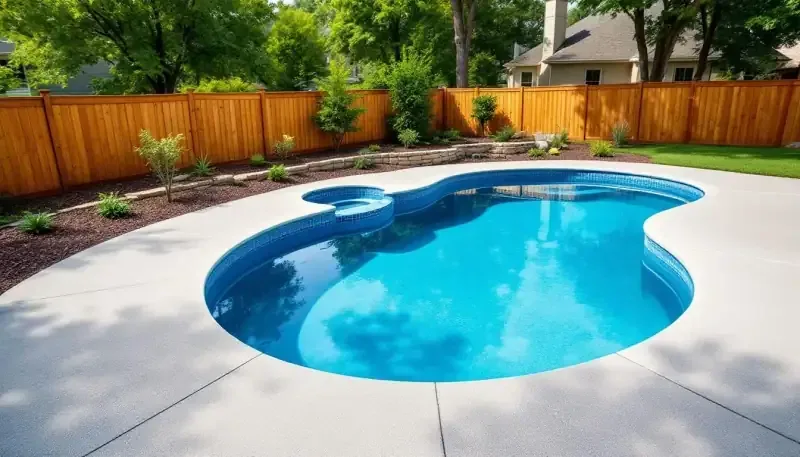
Pool Decks in Olathe, KS
Your pool deserves a deck that handles Olathe summers barefoot and Johnson County winters without flinching.
What Does a Concrete Pool Deck Actually Cost in Olathe?
Let's talk numbers upfront. A standard concrete pool deck in Olathe runs between $8 and $15 per square foot for a basic broom finish. Stamped or stained designs push that to $12 to $22 per square foot. These prices reflect real Johnson County labor rates, local material costs, and the subbase work that Olathe soil demands. A typical 600-square-foot pool deck lands between $5,400 and $13,200 depending on finish and complexity.
Why the range? Olathe sits on heavy clay that expands and contracts hard through our freeze-thaw cycles. That means we can't cut corners on subbase prep or reinforcement. Backyard access matters too. If your lot in Persimmon Hill or Cedar Creek has a narrow side yard, getting the concrete truck close enough adds logistical cost. But that honest prep work is what separates a pool deck that lasts fifteen years from one that cracks in three.
Concrete Pool Decks Built for Olathe Backyards
Olathe homeowners use their pools hard from late May through mid-September. Your pool deck takes constant foot traffic, UV exposure, chemical splash-out, and dramatic temperature swings. We pour 4-inch-minimum slabs with fiber-mesh reinforcement and #4 rebar on 12-inch centers around the pool coping. This isn't overkill for Johnson County clay — it's the baseline for a deck that stays flat and crack-free.
Finish options matter in this climate. A standard broom finish gives excellent slip resistance and costs the least. Stamped concrete mimics flagstone, travertine, or slate and pairs beautifully with the stone facades common in Brougham Village and Heatherstone. Exposed aggregate adds texture and hides the mineral staining that Olathe's high-iron well water leaves behind. Each finish handles pool chemicals differently, and we'll walk you through the tradeoffs during your consultation.
Drainage design is non-negotiable around pools. We slope every deck section at a minimum 1/8-inch per foot away from both your pool and your house foundation. In neighborhoods like Havencroft where lots trend flatter, we integrate subtle swale channels at the deck perimeter to keep water moving toward your yard drain system instead of pooling against your home.
Olathe-Specific Pool Decks Considerations
Johnson County Permitting and Pool Setback Rules
Olathe requires building permits for pool deck construction that exceeds certain thresholds. Johnson County also enforces pool barrier and setback requirements that affect how close your deck edge can sit to property lines and structures. We handle the permit application and know the current turnaround times at the Olathe Planning Division. Inspections typically happen at the subbase stage and after the pour, and we schedule them so your project doesn't stall waiting on the county.
Backyard Access Along K-7 and Southern Olathe Subdivisions
Many homes built during Olathe's 1990s and 2000s boom have narrow side yards, privacy fences, and mature landscaping that complicate equipment access. Concrete trucks are 30 feet long and weigh 40 tons loaded. In subdivisions near K-7 and south of 151st Street, we sometimes use line pumps to move concrete from the street to your backyard. This adds modest cost but protects your lawn, irrigation lines, and fence posts from heavy equipment damage.
Olathe's Expansive Clay and Freeze-Thaw Pressure
The clay soils under most Olathe neighborhoods swell when wet and shrink when dry. Add 40-plus freeze-thaw cycles each winter, and your pool deck faces serious stress. We excavate 6 to 8 inches below grade, install compacted Class 5 limestone base, and use control joints every 8 to 10 feet. This system lets the slab move without cracking. We've poured 377-plus projects since 2015, and this subbase approach is why our decks hold up where others fail.
What to Expect During Your Pool Deck Project
Day one is all about site prep. Our crew arrives early — usually by 7 a.m. — and sets up along your driveway or the closest street-side access point. We lay plywood runners to protect your lawn and mark the excavation area with spray paint. You'll hear a skid steer and shovels for most of the morning as we dig out the old surface or virgin soil to the required depth. If your fence gate is too narrow, we'll remove a panel and reinstall it at the end of the project at no extra charge.
Subbase and forming happen next. We compact the limestone base in lifts using a plate compactor — it's loud but fast. Steel rebar and fiber mesh go in, along with isolation joints around the pool coping and any adjacent patio slabs. This stage takes one to two days depending on your deck's size. Johnson County inspectors will visit to check the subbase and reinforcement before we pour. We coordinate that call so you don't have to chase the inspector's office on Santa Fe Street.
Pour day is the main event. The concrete truck will park on your street or driveway — we'll confirm the exact spot with you beforehand. Our crew places, screeds, and finishes the concrete in sections. If you chose a stamped or stained finish, this adds time and you'll see our contractors working the surface with texture mats and release agents. We'll ask you to keep kids, pets, and foot traffic away from the pour area for a minimum of 24 hours. You'll see barricade tape and sawhorses marking the zone.
Curing and sealing happen over the following 3 to 7 days depending on temperature and humidity. We apply a high-quality acrylic sealer that protects against UV, chlorine splash, and freeze-thaw damage. Final cleanup includes removing any forming lumber, sweeping your driveway, and hauling off all debris. We walk the finished deck with you, answer questions, and leave you with a maintenance guide specific to your finish type.
Concrete Pool Deck vs. Pavers: What Makes Sense in Olathe?
Pavers are popular in Olathe neighborhoods, and they look impressive on day one. But Johnson County clay creates real problems for paver pool decks over time. The expansive soil shifts seasonally, and individual pavers settle unevenly. Within 3 to 5 years, you'll see lippage — raised edges that catch toes and trip barefoot swimmers. Resetting pavers on clay costs $3 to $6 per square foot each time, and it becomes a recurring maintenance expense.
A properly poured concrete pool deck sits on a compacted limestone base that distributes load evenly across the clay. Control joints absorb movement. The result is a surface that stays level and requires only periodic resealing rather than physical resetting. Upfront, concrete costs 20 to 40 percent less than quality pavers installed on the same lot. Over a 15-year span, the total cost of ownership gap widens further because concrete maintenance is cheaper and less frequent.
There's one scenario where pavers make sense: if you plan to reconfigure your pool area within a few years. Pavers are easier to remove and reuse. But for Olathe homeowners building a pool deck they want to enjoy for a decade or more, poured concrete delivers better long-term value on our local soil conditions. We've completed 377-plus projects since 2015, and the vast majority of pool deck clients choose concrete once they see the numbers side by side.
How Much Does Pool Decks Cost in Olathe?
| Type | Cost / Sq Ft | Typical 400 Sq Ft |
|---|---|---|
| Standard Textured (Broom) | $8–12 | $3,200–$4,800 |
| Cool Deck Coating | $10–15 | $4,000–$6,000 |
| Stamped / Decorative | $12–18 | $4,800–$7,200 |
Pool deck pricing in Olathe reflects Johnson County's higher labor rates compared to the broader Kansas City metro, plus the subbase work that local clay soil requires. Expect to budget $5,000 to $14,000 for most residential pool decks, with stamped finishes and line-pump access on tight lots pushing the higher end.
Pool Decks FAQ for Olathe, KS
Do I need a permit for a pool deck in Olathe?
Yes, most pool deck projects in Olathe require a building permit through the city's Planning and Development Services. The permit ensures your deck meets Johnson County setback requirements and pool barrier codes. We handle the application paperwork and schedule the required inspections at the subbase and post-pour stages. Permit fees typically run $75 to $200 depending on project scope. Turnaround from application to approval is usually 5 to 10 business days, and we factor that into your project timeline so there are no surprises.
What finish is best for barefoot traffic around a pool?
Broom finish is the safest and most affordable option for barefoot use. The textured surface provides consistent grip even when wet. Stamped concrete can also be safe if we apply a non-slip additive to the sealer — aluminum oxide or polymer grit mixed into the final coat. Exposed aggregate offers natural texture from the stone but can feel rough on bare feet. For Olathe homeowners who want style and safety, we often recommend a light stamped pattern with the non-slip sealer additive. It looks great and keeps your family confident walking poolside.
How do Olathe winters affect a new pool deck?
Olathe averages over 40 freeze-thaw cycles per winter. Each cycle pushes moisture into concrete pores, expands as ice, and creates micro-stress. We counter this with air-entrained concrete mixes rated for severe exposure, proper control joint spacing, and quality acrylic sealers that block moisture penetration. The subbase drainage is equally important — standing water under the slab accelerates frost heave. With the right mix design and subbase, your pool deck handles Johnson County winters without the D-cracking problems you see on older commercial slabs near Black Bob Road.
Can you pour a pool deck if my backyard gate is only three feet wide?
Absolutely. Tight access is common in Olathe subdivisions, especially in Heatherstone and Persimmon Hill where privacy fences sit close to the house. We use a concrete line pump that can push material 200 feet or more from the truck on the street to your pool area. The pump hose fits through a standard gate opening. If even that won't work, we can temporarily remove a fence section and reinstall it when we're done. We always confirm access logistics during the site visit so the pour day runs smoothly.
Should I seal my pool deck every year?
Not every year, but regular resealing is important. In Olathe's climate, a quality acrylic sealer lasts 2 to 3 years before UV and pool chemicals break it down. You'll notice the surface starts absorbing water instead of beading it — that's your signal. We recommend a fresh coat every 2 years for stamped or colored concrete and every 3 years for broom-finish decks. Resealing costs a fraction of the original project and dramatically extends the life of your deck. We offer resealing as a standalone service if you want us to handle it.
How long after the pour until we can swim and use the deck normally?
You can walk on the deck carefully after 24 to 48 hours. Light furniture can go back after 3 days. Full use — including heavy furniture, grills, and normal poolside activity — is safe after 7 days in warm weather. If we pour in cooler fall temperatures, we recommend waiting a full 10 days. The sealer needs 24 hours to cure before any foot traffic or water exposure. We'll give you specific timelines based on your pour date and the forecast.
What's the typical project timeline from estimate to finished deck?
From your initial consultation to a finished, sealed pool deck, expect 3 to 5 weeks total. The first week covers your site visit, design decisions, and permit application. Permit approval in Olathe takes roughly 5 to 10 business days. Actual construction — excavation, subbase, forming, pouring, and sealing — runs 4 to 7 working days for an average-sized residential pool deck. Weather delays can add time, especially during spring rain patterns in Johnson County. We build buffer days into every schedule so your project stays on track.
Other Concrete Services in Olathe, KS
Schedule Your On-Site Pool Deck Consultation
During your free site visit, we measure your pool area, assess backyard access, evaluate soil and drainage conditions, and walk you through finish options with physical samples — right there at your Olathe home. You'll leave with a detailed written estimate and a clear project timeline.