
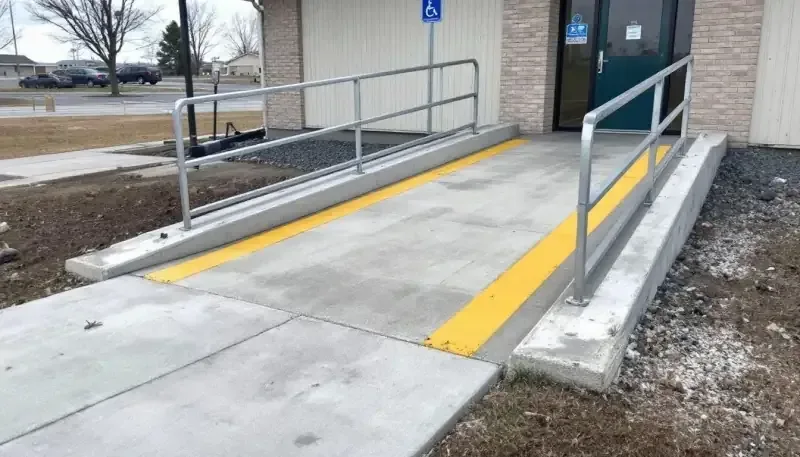
ADA Ramps & Compliance in Olathe, KS
Your Olathe commercial property doesn't need a lawsuit to justify ADA upgrades — but the cost of non-compliance far exceeds the cost of proper concrete ramp construction.
What Does ADA Ramp Work Actually Cost in Olathe?
Let's talk numbers. A single ADA-compliant concrete ramp in Olathe typically runs between $3,500 and $8,500, depending on slope correction, demolition of existing non-compliant surfaces, and whether your subgrade needs stabilization. That range shocks some property owners. But compare it to $75,000 or more in a single ADA demand letter settlement, and the math gets simple fast. Federal minimum damages start at $4,000 per violation in Kansas, and serial plaintiffs are actively targeting the Santa Fe Street corridor right now.
Material costs in Johnson County have climbed roughly 18 percent since 2021. Ready-mix concrete from local batch plants runs higher here than in Cass or Clay counties because of demand from the construction boom along the 175th Commerce Centre. Labor rates reflect a tight market — skilled concrete finishers who understand ADA slope tolerances don't come cheap, and they shouldn't. A ramp poured at 8.4 percent instead of the required 8.33 percent maximum fails inspection and fails your tenants.
The older commercial strips along Santa Fe Street and near Black Bob Road carry the highest correction costs. Those properties were built in the 1990s boom when ADA standards were newer and enforcement was lax. We regularly find ramps with slopes exceeding 10 percent, missing truncated domes, and landing areas six inches too narrow. Full remediation on a multi-tenant strip center in that corridor can run $25,000 to $60,000. Phased approaches bring that into manageable budget cycles.
Newer properties aren't immune. We've assessed buildings in Great Plains Commerce Center and Olathe Pointe that passed initial inspections but developed settling issues within three years. Johnson County's clay-heavy subgrade shifts seasonally, and a ramp that was compliant in 2021 may have a cross-slope violation by 2024. Ongoing compliance isn't optional — it's a cost of doing business in Olathe.
ADA Compliance for Olathe Commercial Properties: What's Really Required
Federal ADA standards require accessible routes with running slopes no steeper than 1:12, cross slopes no greater than 1:48, minimum 60-inch landings at top and bottom, and detectable warning surfaces at curb transitions. Kansas doesn't layer additional state accessibility codes on top of federal requirements, but Olathe's municipal building department enforces ADA during all permit reviews. If you're resurfacing, restriping, or altering your parking lot, that triggers a path-of-travel obligation that can require ramp upgrades even if the ramps weren't part of your original scope.
Johnson County commercial properties face a unique combination of challenges. The heavy clay soils throughout Olathe expand and contract dramatically between wet springs and dry summers. This movement tilts ramp surfaces out of compliance over time. Properties along the I-35 corridor also deal with vibration from constant heavy truck traffic — that NAFTA superhighway transmits ground movement into adjacent concrete slabs. We design our ramp foundations to account for these specific conditions, using deeper compacted aggregate bases and control joints placed to manage seasonal movement.
The compliance documentation we provide goes beyond a simple invoice. Every project includes as-built slope measurements recorded with a calibrated digital level, photographs of truncated dome placement, aggregate base depth verification, and concrete mix certifications. This package serves as your legal shield. If a plaintiff's attorney sends a demand letter claiming your property violates ADA standards, you hand your attorney a binder that proves otherwise. Since 2015, we've completed 377-plus projects across the Kansas City metro, and our documentation has held up in every dispute our clients have faced.
Olathe-Specific ADA Ramps & Compliance Considerations
Santa Fe Street Corridor: Legacy Non-Compliance
The commercial buildings lining Santa Fe Street between 119th and 151st represent some of Olathe's most serious ADA liability. Built primarily during the late 1980s and 1990s, these properties predate modern enforcement patterns. Many have ramps that were grandfathered under older standards but lost that protection the moment owners made alterations — sometimes as minor as restriping the parking lot. We've surveyed dozens of properties in this corridor and find an average of four to six distinct violations per site. Addressing these systematically, rather than piecemeal after complaints, saves significant money and disruption.
Johnson County Clay Subgrade and Ramp Settling
Olathe sits on expansive clay soils that swell when saturated and shrink during drought. This cycle creates differential settling beneath concrete ramps, pushing slopes out of compliance within just a few years. A ramp poured perfectly flat in April can develop a 2-percent cross-slope violation by October if the base wasn't prepared correctly. We excavate deeper than minimum requirements — typically 8 to 10 inches of compacted Class 5 aggregate — and use geotextile fabric to separate the clay from the structural base. This approach costs more upfront but eliminates the ramp replacement cycle we see at competing installations.
Trigger Events That Force Upgrades
Many Olathe property owners don't realize that routine maintenance can trigger ADA obligations. Resurfacing your parking lot, changing your building's use, or even restriping accessible spaces can constitute an alteration under ADA guidelines. The path-of-travel rule then requires you to spend up to 20 percent of the alteration cost on accessibility improvements. Properties in the Black Bob Road retail corridor are hitting this trigger frequently right now because their 1990s-era asphalt is reaching end of life. If you're planning a mill-and-overlay project, budget for ramp upgrades simultaneously — it's far cheaper than mobilizing twice.
Serial ADA Litigation Targeting Johnson County
Kansas has seen a sharp increase in serial ADA demand letters since 2022. Plaintiff firms drive commercial corridors, photograph violations from public sidewalks, and file in federal court. Olathe's high-traffic retail zones along K-7 and near Northgate Shopping Center are prime targets because violations are visible and properties are profitable enough to settle. The average demand settlement in Johnson County runs $8,000 to $15,000 per violation. One strip center owner on Black Bob Road faced four separate demand letters in a single quarter. Proactive compliance is the only reliable defense.
How We Build ADA Ramps That Last in Johnson County Soil
Every project starts with a full-property ADA assessment. We measure every existing ramp, curb transition, accessible route, and parking space using calibrated digital inclinometers accurate to 0.1 percent. We document each deficiency with GPS-tagged photographs and map them onto your site plan. This assessment typically takes half a day for a standard retail property and a full day for larger sites like those in Olathe Industrial Park. You receive a prioritized report ranking violations by legal risk and correction cost — this lets you make informed budget decisions rather than guessing.
Demolition and subgrade preparation is where most contractors cut corners, and it's where we invest the most time. We saw-cut existing non-compliant ramps cleanly to avoid damaging adjacent slabs, then remove concrete and haul it to a Johnson County recycling facility. The exposed subgrade gets probed for moisture content and compaction. Olathe's clay typically tests at 15 to 25 percent moisture depending on the season. If we find soft spots, we over-excavate and replace with compacted limestone screenings before laying our aggregate base. We use a plate compactor in 2-inch lifts — never dumping the full depth and running a compactor over the top once. Each lift gets tested with a penetrometer before the next goes down.
We pour 4,000 PSI air-entrained concrete with 6 percent air content for freeze-thaw resistance. The mix comes from a batch plant in southern Johnson County, which keeps truck travel time under 30 minutes — critical for maintaining proper slump and workability. Our crew sets forms to exact ADA dimensions using laser levels, checking running slope and cross-slope before any concrete hits the ground. Truncated dome panels get cast in place, not surface-applied with adhesive. Adhesive-mounted domes fail within two Kansas winters. Cast-in-place panels become part of the slab and carry the same 25-year service life as the ramp itself.
After the pour cures under wet-cure blankets for seven days minimum, we return for final compliance measurement. Every ramp gets measured at nine points across its surface. We record slope data, landing dimensions, flare angles, and truncated dome placement. All measurements go into your compliance documentation package along with concrete batch tickets, aggregate base compaction logs, and timestamped photographs from every stage. This package is your legal armor — precise, defensible, and organized for immediate attorney review if a demand letter ever arrives.
How ADA Challenges Differ Across Olathe's Commercial Zones
The Santa Fe Street commercial corridor running through Havencroft and older central Olathe presents the most urgent compliance problems. These properties date to the 1980s and early 1990s, built before rigorous ADA enforcement. Ramps here typically show excessive slopes, missing detectable warnings, and severe D-cracking in adjacent curb sections. The clay subgrade in this part of town sits closer to the water table, which accelerates settling. Full ramp replacement with deep aggregate bases is standard for this area — patch-and-repair approaches fail within two seasons.
The Black Bob Road and 119th Street retail corridor faces different challenges. These 1990s-boom properties were built with basic ADA compliance, but three decades of clay soil movement and freeze-thaw cycling have pushed most ramps out of tolerance. Cross-slope violations are the most common finding here, often caused by settling on one side of the ramp where drainage collects. Properties near Northgate Shopping Center also deal with heavy parking lot traffic that accelerates surface wear on truncated dome panels. We see adhesive-mounted dome replacements failing every 18 months in this corridor.
Newer commercial areas like the 175th Commerce Centre and portions of Great Plains Commerce Center near K-7 present a subtler challenge. These properties are only three to five years old, and most owners assume they're fully compliant. But Johnson County's expansive clay doesn't care about construction dates. We've measured first-generation settling at several 2020-2022 properties that has already pushed ramp cross-slopes to 1.9 percent — dangerously close to the 2.08 percent maximum. Early intervention with mud-jacking or targeted slab replacement costs a fraction of what full ramp reconstruction requires after the slab cracks from continued movement.
How Much Does ADA Ramps & Compliance Cost in Olathe?
| Type | Cost / Range | Per Installation |
|---|---|---|
| Standard ADA Ramp | $2,000–5,000 | Per Installation |
| Curb Cut / Curb Ramp | $1,500–3,000 | Per Installation |
| Complex / Multi-Level | $5,000–8,000 | Per Installation |
ADA ramp pricing in Olathe reflects Johnson County's higher ready-mix concrete costs and the deeper subgrade preparation that our expansive clay soils demand — expect 10 to 15 percent more than quotes from contractors working in less demanding soil conditions, but that premium eliminates the ramp failures and re-pours that plague cheaper installations.
ADA Ramps & Compliance FAQ for Olathe, KS
What specific ADA violations do you find most at Olathe properties along the Black Bob Road corridor?
The 1990s-era retail properties near Black Bob Road and 119th Street consistently show excessive running slopes on curb ramps — often 10 to 12 percent instead of the 8.33 percent maximum. We also find undersized landing areas, missing or deteriorated truncated dome panels, and cross-slopes that have worsened due to clay soil settling over three decades. Many of these ramps were code-compliant when built but have shifted out of tolerance. D-cracking in adjacent curbs compounds the problem by creating uneven transitions that violate accessible route requirements. A typical property in this corridor needs three to five ramp replacements to achieve full compliance.
How do you phase ADA work around tenant operations at Olathe Pointe or Northgate?
We sequence ramp replacements so that at least one accessible route to every tenant entrance remains open at all times. For multi-tenant retail centers like Olathe Pointe or Northgate Shopping Center, we typically work in two- to three-ramp sections, completing demolition through final cure on each section before moving to the next. Most sections take five to seven business days including cure time. We pour early morning before peak customer hours and maintain clearly signed temporary accessible routes with firm, stable surfaces that meet ADA standards for temporary conditions. Your tenants stay open throughout the project.
Do Olathe building permits cover ADA ramp replacement specifically?
Yes. Olathe requires a building permit for concrete ramp construction or replacement at commercial properties. The city's plan review includes ADA compliance verification, which actually works in your favor — it creates a municipal record that your ramps were reviewed and approved. We handle permit applications and coordinate inspections as part of every project. Permit fees in Olathe typically run $75 to $200 depending on project scope. The review timeline averages 5 to 10 business days. We submit applications the day you sign your contract so permitting doesn't delay your construction schedule.
Will my ramps stay compliant after Johnson County's freeze-thaw cycles?
They will if the subgrade and mix design are correct — and that's a big if. We use 4,000 PSI air-entrained concrete with 6 percent air content, which resists the 40-plus freeze-thaw cycles Olathe averages each winter. The deeper aggregate base we install prevents frost heave from pushing the slab out of slope compliance. We've tracked ramps we poured in 2016 and 2017 across Johnson County, and none have moved out of ADA tolerance. Contractors using standard 3,500 PSI non-air-entrained mixes see surface spalling within three winters and slope drift from inadequate base preparation.
I own property near I-35 — does highway vibration affect ADA ramps?
It can. Properties within 200 feet of I-35 experience measurable ground vibration from heavy truck traffic. Over years, this vibration contributes to differential settling in clay subgrades, which tilts ramp surfaces out of compliance. We've measured this effect at properties in Great Plains Commerce Center and along the I-35 frontage roads. Our approach for these sites includes a thicker aggregate base — typically 10 inches instead of 8 — and more aggressive compaction specifications. We also place additional control joints to allow the slab to move in controlled sections rather than cracking unpredictably. The added cost is roughly $400 to $600 per ramp.
What happens if my property gets an ADA demand letter after you complete the work?
You hand it to your attorney along with the compliance documentation package we provided at project completion. That package includes calibrated slope measurements at nine points per ramp, truncated dome placement verification, landing dimension records, concrete batch tickets, and timestamped construction photographs. This level of documentation demonstrates that your property meets or exceeds every applicable ADA standard. In our experience since 2015, no client who has presented our documentation has proceeded to litigation — demand letter plaintiffs move on to easier targets when they see precise, professional compliance records. We also make ourselves available to provide technical clarification to your legal counsel at no additional charge.
Other Concrete Services in Olathe, KS
ADA Ramps & Compliance in Nearby Cities
Request a Callback About Your Olathe Property
Leave your number and a brief description of your property. We return calls within four business hours and serve every commercial zone in Olathe from Santa Fe Street to the 175th Commerce Centre.