
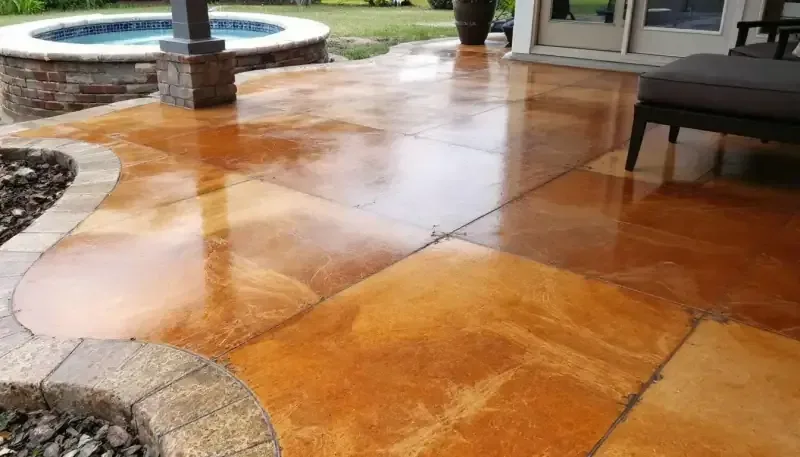
Stained & Colored Concrete in Shawnee, KS
Your Shawnee home deserves concrete that actually looks intentional. We transform dull grey slabs into rich, colored surfaces that hold up to Johnson County winters and still turn heads in July.
What Does Stained Concrete Actually Cost in Shawnee?
Let's talk dollars first. Basic concrete staining in Shawnee runs roughly $3 to $8 per square foot for existing slabs. Integral colored concrete on a new pour adds $1.50 to $3 per square foot over standard grey. The range depends on surface prep, color complexity, and whether your slab needs repairs first. A typical 300-square-foot Grey Oaks patio staining project lands between $1,200 and $2,800 installed and sealed. That's real money, but it's a fraction of tearing out and replacing with pavers or flagstone.
Why the spread? Shawnee's housing stock matters. Homes in Monticello and Woodland Park from the late '90s and early 2000s often have slabs with mild surface scaling from decades of freeze-thaw. That means extra grinding and prep before any color goes down. Labor rates in Johnson County run higher than the metro average too. We factor all of this into honest quotes so you're never surprised on invoice day.
How Stained & Colored Concrete Works on Shawnee Properties
Stained concrete uses either acid-based or water-based stains to permanently alter the color of your existing slab. Acid stains react chemically with the lime in concrete, producing rich, variegated earth tones that mimic natural stone. Water-based stains offer a wider color palette and more uniform coverage. Both options get sealed with a high-performance topcoat rated for Kansas freeze-thaw exposure. The result is a surface that resists UV fading along your south-facing Shawnee Mission Pkwy-area patio and handles seasonal temperature swings from -5°F to 105°F.
Integral colored concrete is a different approach entirely. Pigment gets mixed directly into the concrete before the pour. This means color runs all the way through the slab — not just on the surface. It's ideal for new driveways, patios, and walkways where you want lasting color without future touch-ups. We use iron oxide pigments that resist fading even on fully exposed surfaces near Clear Creek Park or Shawnee Mission Park.
Many Shawnee homeowners combine both techniques. A fresh integral colored patio pour in warm sandstone with an acid-stained border in walnut brown creates contrast you simply can't get from plain concrete or stamped patterns alone. Since 2015, we've completed 377+ projects across the metro, and stain-plus-color combos remain our most-requested decorative finish in Johnson County.
Shawnee-Specific Stained & Colored Concrete Considerations
Existing Slab Age and Condition in 1990s-2000s Neighborhoods
Shawnee's 2026 Neighborhood Revitalization focus highlights how many homes sit on slabs poured 20 to 30 years ago. Concrete from this era often has surface wear, minor spalling, or old sealant residue that must be removed before staining. Slabs in neighborhoods like Woodland Park and Monticello may need diamond grinding to open the pores for proper stain penetration. We assess every slab individually. If yours has deep structural cracks or significant settling, we'll tell you whether staining makes sense or if a new colored pour is the better investment.
HOA Color Restrictions in Shawnee Subdivisions
Several Shawnee neighborhoods — especially Grey Oaks and Lake Quivira — have homeowner association guidelines covering exterior modifications. Some HOAs restrict concrete colors to earth-tone palettes. Others require architectural review before any visible exterior change. We recommend checking your HOA covenants before selecting a stain color. We can provide sample boards and spec sheets formatted for HOA submissions. This prevents delays and ensures your project sails through approval without back-and-forth.
Sun Exposure and Fade Resistance Along South-Facing Elevations
Shawnee gets roughly 215 sunny days per year. South-facing patios and west-facing driveways near Quivira Rd and Midland Dr take intense UV exposure from May through September. Cheap stains fade noticeably within two to three years under these conditions. We use UV-stable stain products and apply high-solids acrylic or polyurethane sealers that block ultraviolet degradation. Resealing every three to four years keeps color vibrant. For maximum longevity on fully exposed surfaces, integral colored concrete outperforms surface stains because the pigment isn't just sitting on top.
What to Expect During Your Staining or Colored Concrete Project
Everything starts with a site visit. We walk your property, inspect the existing slab or layout area, and discuss color options on-site where you can see samples in your actual lighting. For homes along Shawnee Mission Pkwy or in tighter Monticello driveways, we also confirm access for equipment. Most staining projects don't require a concrete truck, but new colored pours do — and we'll show you exactly where the truck will stage so your landscaping and mailbox stay protected.
On project day for staining, our crew arrives and tapes off adjacent surfaces — siding, landscaping beds, garage doors. We clean and prep the slab first, which involves pressure washing and sometimes mechanical grinding. This step is loud, roughly comparable to a commercial mower. It usually takes two to four hours depending on slab size and condition. Then the stain goes down. Acid stains need four to eight hours of reaction time. You'll notice a fizzing or bubbling — that's normal chemistry, not damage. Water-based stains dry faster, typically two to three hours.
For new integral colored concrete pours, the process looks more like a standard concrete job. The truck arrives, we pour and screed the colored mix, then finish and texture the surface. Johnson County doesn't require a separate inspection for decorative flatwork on residential properties unless the project involves structural footings or exceeds certain square footage thresholds. We pull any necessary permits ahead of time so you're never caught off guard.
After staining or pouring, we apply sealer — usually the following day once the surface has cured enough. You'll need to keep foot traffic off the surface for 24 hours after sealing and vehicle traffic off for at least 72 hours. We leave detailed care instructions and schedule a follow-up check within two weeks to make sure the finish is curing correctly.
Staining Your Existing Slab vs. Tearing It Out for a New Colored Pour
Most Shawnee homeowners face this exact decision. Staining an existing slab costs $3 to $8 per square foot. Demolishing that same slab, hauling it away, and pouring new integral colored concrete runs $12 to $20 per square foot — roughly three to four times the price. For a 400-square-foot patio in Grey Oaks, that's the difference between $2,000 and $7,000. Staining wins on budget almost every time if your existing slab is structurally sound.
But cost isn't the only factor. Slabs poured in the '90s and early 2000s across Monticello, Woodland Park, and older sections near Downtown Shawnee sometimes have settling issues, wide cracks, or surface deterioration too severe for cosmetic staining. Stain can't hide structural problems — it actually highlights unevenness because the color variation draws the eye. If your slab has heaved more than a quarter inch at any joint or shows widespread spalling, a new colored pour gives you a fresh foundation and lifetime color in one project.
A practical middle ground exists too. We can repair isolated cracks and spalled areas, then stain the entire surface. The repaired sections may accept stain slightly differently, creating subtle variation that most homeowners find acceptable — especially with acid stain's naturally mottled appearance. During your site visit, we'll give you an honest assessment of which approach delivers the best result for your specific slab condition and budget.
How Much Does Stained & Colored Concrete Cost in Shawnee?
| Type | Cost / Sq Ft | Typical 300 Sq Ft |
|---|---|---|
| Acid Stain (Existing Concrete) | $4–8 | $1,200–$2,400 |
| Water-Based Stain (Existing) | $3–6 | $900–$1,800 |
| Integral Color (New Pour) | $10–15 | $3,000–$4,500 |
Pricing in Shawnee reflects Johnson County's higher labor rates and the frequent need for slab prep on homes built during the 1990s-2000s construction boom. Expect to pay 10-15% more than contractors quote in outlying Kansas counties, but the quality of finish and long-term durability justify every dollar.
Stained & Colored Concrete FAQ for Shawnee, KS
Can you stain concrete around the pool at my Lake Quivira home?
Yes. Pool deck staining requires a non-slip additive blended into the sealer coat. We use polymer grit additives that create texture without making the surface feel rough on bare feet. Chlorinated splash water and pool chemicals can degrade cheap sealers quickly, so we use chemical-resistant polyurethane sealers rated for pool environments. The color selection stays the same — you're not limited in palette just because it's a pool deck. We mask off coping and any adjacent stone to keep everything clean during application.
My Woodland Park patio was sealed years ago. Does old sealer need to come off before staining?
Almost always, yes. Old acrylic sealers block stain penetration completely. We test your slab by dropping water on the surface. If it beads up, there's still active sealer present. Removal involves chemical stripping or mechanical grinding — sometimes both. Slabs in Woodland Park from the late '90s frequently have multiple sealer layers that were reapplied without proper prep. Stripping adds to project cost but it's non-negotiable for quality stain adhesion. We include this assessment during our free site visit so your quote reflects the real scope.
Will winter deicing salt damage my stained driveway near I-435?
Deicing salt is hard on any concrete surface, stained or not. The real damage comes from the freeze-thaw cycle salt accelerates. A properly sealed stained driveway resists salt penetration far better than unsealed concrete. We recommend using calcium magnesium acetate instead of rock salt for homeowners near I-435 and Shawnee Mission Pkwy where road crews apply heavy salt in winter. Resealing every three years maintains that protective barrier. If salt damage does occur, we can touch up affected areas without restaining the entire surface.
How many color options do I have for a new integral colored concrete pour?
Standard iron oxide pigments come in roughly 30 to 40 base colors ranging from subtle buff and sandstone to deep charcoal and terra cotta. Custom blends expand that range significantly. We bring physical samples to your site visit because screen colors are unreliable — they shift depending on your phone or monitor. Integral color looks different in Shawnee's direct afternoon sun versus shade under a covered porch, so seeing samples in your actual environment matters. We also pour small test patches on request for an additional fee if you're choosing between similar shades.
Can I stain my garage floor if there are oil stains from years of parking?
Oil-contaminated concrete won't accept stain evenly. The petroleum creates a barrier that blocks chemical reaction with acid stain and prevents water-based stain absorption. We use commercial degreasing agents and sometimes poultice treatments to draw oil out of the pores. Light staining from occasional drips usually cleans up fine. Heavy saturation from years of leaks may leave ghost marks that show through lighter stain colors. In those cases, we recommend a darker stain or an opaque concrete coating system instead. We evaluate this honestly during our initial inspection.
Do stain colors look different on a shaded porch versus my sunny backyard patio?
Significantly different. Acid stains develop more muted, cooler tones in shaded areas and richer, warmer variation in direct sunlight. Water-based stains are more consistent between sun and shade but still shift in perceived tone. If you're staining both a covered front porch and an exposed backyard patio, we typically recommend seeing test applications in both locations before committing. Many Shawnee homeowners choose slightly different shades for covered versus exposed areas to achieve a consistent visual appearance despite the lighting difference.
What's the realistic lifespan of a stained and sealed patio in Shawnee's climate?
The stain itself is permanent — it chemically alters the concrete and won't peel or flake. What wears is the sealer on top. In Shawnee's climate with hot summers and freezing winters, a quality acrylic sealer lasts three to four years before needing a fresh coat. Polyurethane sealers can go five to seven years. Without resealing, the stain remains but loses its sheen and becomes more susceptible to surface wear and staining from leaves or dirt. Resealing costs a fraction of the original project — typically $1 to $2 per square foot — and takes less than a day.
Other Concrete Services in Shawnee, KS
Stained & Colored Concrete in Nearby Cities
Schedule Your Free On-Site Color Consultation in Shawnee
During your site visit, we inspect your existing concrete, show you physical stain and color samples in your actual lighting, and walk you through realistic costs for your specific project. Most consultations in Shawnee take about 30 minutes — you'll leave with a clear plan and a written quote.