
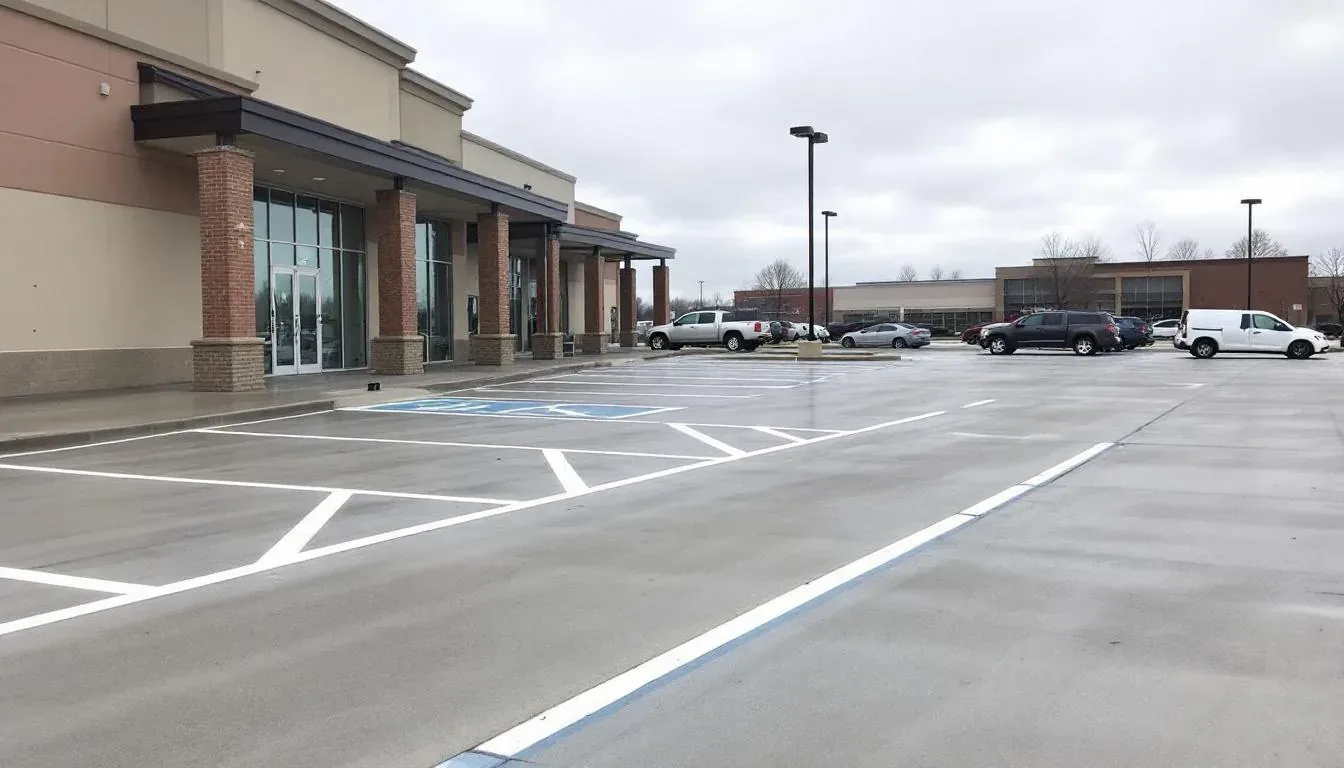
Parking Lots in Shawnee, KS
Your Shawnee parking lot is the first thing customers see and the last thing they remember. We build concrete lots that handle K-7 corridor logistics traffic and Shawnee Mission Parkway retail volume without flinching.
What Does a Commercial Concrete Parking Lot Actually Cost in Shawnee?
Let's talk numbers up front. A full concrete parking lot replacement in Shawnee typically runs between $6.50 and $9.50 per square foot for a standard commercial installation. That range depends on lot size, soil conditions, drainage complexity, and whether you're on the K-7 Industrial Corridor or along Shawnee Mission Parkway. We quote every project individually because no two lots in this city face the same conditions.
Johnson County soil is a significant cost driver. The expansive clay under most of Shawnee shifts seasonally, and that means deeper excavation, thicker subbase material, and engineered joint spacing. Skipping those steps saves money today and creates $80,000 problems five years from now. We build for the soil you actually have, not the soil you wish you had.
Material costs in the Kansas City metro have climbed roughly 18 percent since 2021. Ready-mix concrete, rebar, and dowel bars all cost more than they did when many Shawnee lots were originally poured. Labor rates in Johnson County reflect the skilled workforce needed to execute large commercial pours correctly. These aren't inflated numbers — they're what it costs to build a lot that lasts 30-plus years.
The real cost conversation isn't about the pour price. It's about lifecycle cost. Many business owners along Shawnee Mission Parkway are spending $3,000 to $5,000 annually on asphalt patching and sealcoating for lots built in the 1990s. A concrete replacement eliminates that recurring expense and adds decades of usable life. That math matters when you're running a business.
Concrete Parking Lots Built for Shawnee's Commercial Demands
Shawnee sits at a crossroads between commuter retail and industrial logistics. Lots along Shawnee Mission Parkway handle constant passenger vehicle turnover — hundreds of daily parking cycles that wear down surfaces and joints. The K-7 Industrial Corridor sees loaded semi-trucks and delivery vehicles that demand thicker slabs and reinforced joint systems. We design each lot for the specific traffic profile your business generates.
The city's 2026 Neighborhood Revitalization initiative is driving renewed attention to aging commercial properties. Many retail strips between Quivira Road and Midland Drive have original asphalt from the late 1990s showing advanced raveling and curb failure. Replacing these lots with concrete provides a 30-to-40-year asset that meets current ADA standards, stormwater codes, and fire lane requirements without the annual maintenance cycle asphalt demands.
We've completed 377-plus commercial concrete projects since 2015, and a growing number of those have been in western Johnson County as Shawnee expands. Our crew understands the permitting process, the local inspection cadence, and the utility coordination that commercial lot work in this city requires. From Downtown Shawnee's tighter footprints to the sprawling K-7 corridor lots, we build for the traffic, soil, and budget realities of this market.
Shawnee-Specific Parking Lots Considerations
Asphalt Raveling on Aging Retail Lots
Many Shawnee commercial lots built in the 1990s and early 2000s are experiencing surface raveling — loose aggregate, crumbling edges, and widening cracks. This is especially visible along Shawnee Mission Parkway's retail strips. Sealcoating extends the timeline but doesn't fix the structural problem. When raveling reaches this stage, a concrete replacement eliminates the annual patching cycle and gives you a surface that won't degrade under UV exposure and freeze-thaw cycles the same way asphalt does.
Commuter and Logistics Traffic Patterns
Shawnee's traffic splits into two distinct profiles. Shawnee Mission Parkway carries heavy commuter traffic that generates constant parking turnover at retail and restaurant locations. The K-7 corridor handles industrial and logistics traffic with heavier axle loads. We adjust slab thickness, joint spacing, and reinforcement based on which traffic pattern your lot serves. A 6-inch slab works for a retail lot near Monticello. A distribution center on K-7 needs 8 inches with doweled joints.
Curb and Gutter Failure in Commercial Strips
Curb and gutter systems along Shawnee's older commercial corridors are failing at a faster rate than the lots themselves. Undermined curbs create tripping hazards, ADA compliance issues, and stormwater runoff problems. When we replace a lot, we integrate new curb and gutter systems that tie into the city's stormwater infrastructure. This prevents the common problem of a new lot draining into failed gutters that push water toward your building foundation.
High-Contrast Striping and Trail Connectivity
Shawnee's trail system and pedestrian infrastructure create demand for high-visibility striping and crosswalk markings within commercial lots. Properties near Shawnee Mission Park and Clear Creek Park see significant pedestrian and cyclist traffic. We apply high-contrast thermoplastic striping that meets city standards for trail connectivity and pedestrian safety. This isn't just paint — it's a reflective, durable marking system that stays visible for years, even under heavy vehicle traffic.
How We Build Parking Lots in Shawnee — A Technical Walkthrough
Every Shawnee lot starts with soil testing. Johnson County's clay-heavy subgrade is notorious for seasonal expansion and contraction. We pull borings to determine moisture content and plasticity index before designing the subbase. In most Shawnee locations, we excavate 12 to 16 inches below finished grade and install 6 to 8 inches of compacted AB-3 aggregate base sourced from quarries in southern Johnson County. This aggregate layer acts as a buffer between the expansive clay and the concrete slab, absorbing moisture movement without transferring it upward.
Forming and grading is where the drainage story gets told. We laser-grade every lot to maintain a minimum 1.5 percent slope toward engineered collection points. For lots along Shawnee Mission Parkway, stormwater compliance often requires detention features or permeable edge treatments that satisfy Johnson County's runoff regulations. Our crew sets steel forms to exact elevation, then places rebar mats or welded wire reinforcement on chairs to ensure proper positioning within the slab. Dowel bars go in at every contraction joint on lots that handle truck traffic.
We pour using volumetric mixer trucks for smaller lots and standard ready-mix delivery for large-scale pours. Concrete arrives at a 4,000 PSI mix design with air entrainment for freeze-thaw resistance — critical in a climate where Shawnee sees 40-plus freeze-thaw cycles per winter. Our finishers strike, bull-float, and broom-finish the surface in sections, cutting contraction joints at 12-to-15-foot intervals depending on slab thickness. We don't cut joints late. Late joints mean random cracking, and random cracking means callbacks.
Curing takes seven days minimum under wet-cure blankets or spray-applied curing compound. We don't rush this step. Concrete reaches roughly 70 percent of its design strength in the first week, and premature loading — especially from delivery trucks — can cause permanent damage. After curing, we handle striping, ADA signage, fire lane markings, and wheel stops. The finished lot gets a final inspection walkthrough with the property owner before we close out the project.
Replacing a Failing Retail Lot Off Midland Drive
A property manager contacted us about a 22,000-square-foot asphalt lot behind a multi-tenant retail strip near Midland Drive and Quivira Road. The lot had been sealcoated annually for eight years, but the raveling had progressed past the point of repair. Loose aggregate was damaging vehicles, puddles formed in three low spots after every rain, and two ADA parking spaces had become non-compliant due to settling curbs. The tenants — a dental office, a salon, and a takeout restaurant — needed to stay open throughout the project.
We demolished the existing asphalt in three phases, maintaining at least 60 percent parking capacity at all times. Soil borings revealed a plasticity index of 38 — highly expansive clay typical of this part of Shawnee. We excavated 14 inches below finished grade, installed 8 inches of AB-3 aggregate subbase, and poured a 6-inch reinforced concrete slab with contraction joints at 12-foot intervals. New curb and gutter tied into the existing storm sewer, eliminating the ponding issues entirely.
The finished lot included compliant ADA spaces, thermoplastic fire lane markings, and high-contrast crosswalk striping connecting the lot to the adjacent sidewalk network. Total project duration was five weeks. The property manager reported zero tenant complaints about access during construction, and the lot now drains completely within minutes of heavy rain. That's what a properly engineered concrete lot looks like in Shawnee.
How Much Does Parking Lots Cost in Shawnee?
| Type | Cost / Sq Ft | Project Dependent |
|---|---|---|
| Standard Concrete Lot | $4–8 | Varies by scope |
| Heavy-Duty (Truck Traffic) | $6–10 | Varies by scope |
| Repair / Section Replace | $8–14 | Varies by scope |
Shawnee lot pricing reflects Johnson County's higher labor rates and the deeper excavation that expansive clay subgrade demands. Expect to budget 10 to 15 percent more than a comparable project in areas with stable, sandy soil.
Parking Lots FAQ for Shawnee, KS
What permits does Shawnee require for a commercial parking lot?
You'll need a commercial building permit from the City of Shawnee, and most projects require a grading permit and stormwater management plan approved through Johnson County. If your lot is along Shawnee Mission Parkway or in the Downtown Shawnee overlay district, additional design review may apply. We handle the permit application process and coordinate with city inspectors throughout the project. Typical permit turnaround in Shawnee runs three to four weeks, so we factor that into your project timeline from the start.
Why are so many Shawnee Mission Parkway lots showing surface damage?
Most of these lots were built in the mid-1990s to early 2000s using asphalt designed for a 15-to-20-year lifespan. They've now exceeded that window. The heavy commuter traffic along the Parkway accelerates surface raveling, and Johnson County's freeze-thaw cycles break down the binder holding the aggregate together. Sealcoating has kept many of these lots functional past their designed life, but the underlying structure is deteriorating. A concrete replacement gives you a surface that handles the same traffic volume for 30 to 40 years without annual sealing.
Can you phase my lot so my Shawnee Mission Parkway retail business stays open?
Absolutely. Phased construction is standard for our retail lot projects. We divide the lot into sections and maintain customer parking access throughout the project. For high-traffic locations along the Parkway, we typically work in two or three phases, completing one section before moving to the next. We coordinate with your business on timing — pouring early morning or scheduling heavy equipment work outside peak hours. Your customers won't have a perfect parking experience during construction, but they'll always have access.
How thick should a concrete lot be for K-7 corridor industrial use?
Industrial lots along K-7 that handle loaded semi-trucks and heavy delivery vehicles need a minimum 8-inch slab with doweled contraction joints. The subbase typically requires 8 inches of compacted AB-3 aggregate to manage load distribution over Johnson County's clay subgrade. For lots with dedicated truck lanes or loading dock aprons, we sometimes increase to 10 inches in high-stress zones. The extra two inches of concrete costs relatively little compared to the cost of replacing a failed truck lane three years into the lot's life.
Do you handle stormwater detention requirements for Johnson County?
Yes. Johnson County requires stormwater management plans for most commercial lot projects, and the requirements depend on your lot's impervious surface area and proximity to drainage channels. We work with local civil engineers to design detention features that meet county standards — whether that's underground detention cells, surface swales, or permeable concrete edge treatments. For properties near Clear Creek or other drainage corridors, additional buffer and infiltration requirements may apply. We build these elements into the project scope from the beginning.
What's the realistic timeline for a full lot replacement at a mid-size Shawnee commercial property?
A typical 15,000-to-30,000-square-foot lot replacement in Shawnee takes four to seven weeks from demolition to final striping. That includes demolition and haul-off of the existing surface, excavation, subbase installation, forming, pouring in phases, curing, and finishing. Permitting adds three to four weeks on the front end. Weather delays during spring and fall can push timelines by a few days. We give you a detailed schedule before work begins and communicate daily on progress. Most business owners are surprised how quickly the actual concrete work moves once the subbase is set.
Other Concrete Services in Shawnee, KS
Request a Callback About Your Shawnee Parking Lot
Leave your number and a brief description of your lot. Our crew responds within one business day and serves all of Shawnee — from Downtown to the K-7 corridor and everything between Quivira and Woodland Park.