Parking Lots in Overland Park, KS
Overland Park enforces some of the strictest pavement codes in the Kansas City metro. Your parking lot should exceed them, not just survive the next inspection cycle.
Resurface That Aging Asphalt — or Finally Switch to Concrete?
It's a debate we hear every week from Overland Park business owners. That oxidized asphalt lot along Metcalf Ave or College Boulevard looks faded and cracked. You've seal-coated it twice already. Now you're wondering: pour another asphalt overlay, or make the jump to concrete? The answer depends on your traffic volume, your timeline, and what Overland Park's aggressive pavement standards actually require. But here's what the city itself is doing — replacing asphalt with concrete in entire neighborhoods like Wycliff and Westbrooke South, targeting 50-year lifecycles.
We've completed 377+ concrete projects since 2015 across the Kansas City metro. A significant portion of that work has been commercial parking lots in Johnson County. We understand the permitting process, the inspection cadence, and the pavement engineering that Overland Park demands. This isn't a city where you can cut corners on subbase prep or joint spacing and hope nobody notices.
Asphalt lots along the Golden Mile — that 135th to 159th corridor — take a beating from weekend retail surges and weekday commuter traffic on US-69 and I-435. Unshaded expanses accelerate UV oxidation. Within 12 to 15 years, most asphalt surfaces in these high-traffic zones show serious distress. Concrete, properly installed with adequate thickness and jointing, gives you a 40- to 50-year service life with far less maintenance.
If you manage property in Corporate Woods, the Bluhawk development in South OP, or Oak Park Retail, a concrete parking lot isn't just an upgrade. It's a long-term financial decision that eliminates recurring seal-coat cycles, reduces liability from potholes and trip hazards, and meets the aesthetic bar this city sets. Let's talk about what it takes to get there.
What Makes a Concrete Parking Lot Work in Overland Park
Overland Park's commercial zones see a unique combination of stressors. The Metcalf Corridor handles steady professional commuter traffic five days a week. Then on weekends, the 135th Street retail corridor absorbs massive surges of vehicle traffic that rival some highway interchanges. A concrete parking lot needs to handle both patterns without developing the D-cracking and panel failures we see on older office park slabs from the 1980s and 1990s. We design for these loads specifically — thicker panels at drive aisles, proper doweled joints at expansion points, and air-entrained concrete mixes rated for Kansas freeze-thaw cycles.
Drainage engineering matters here more than most business owners realize. Overland Park sits on variable clay soils that shift seasonally. Without correct subbase compaction and slope grading, water pools under panels and accelerates failure from below. We install granular subbase layers that allow moisture migration away from slab bottoms, and we grade surfaces to direct stormwater toward approved collection points. Johnson County stormwater regulations are strict, and your lot design needs to comply from day one.
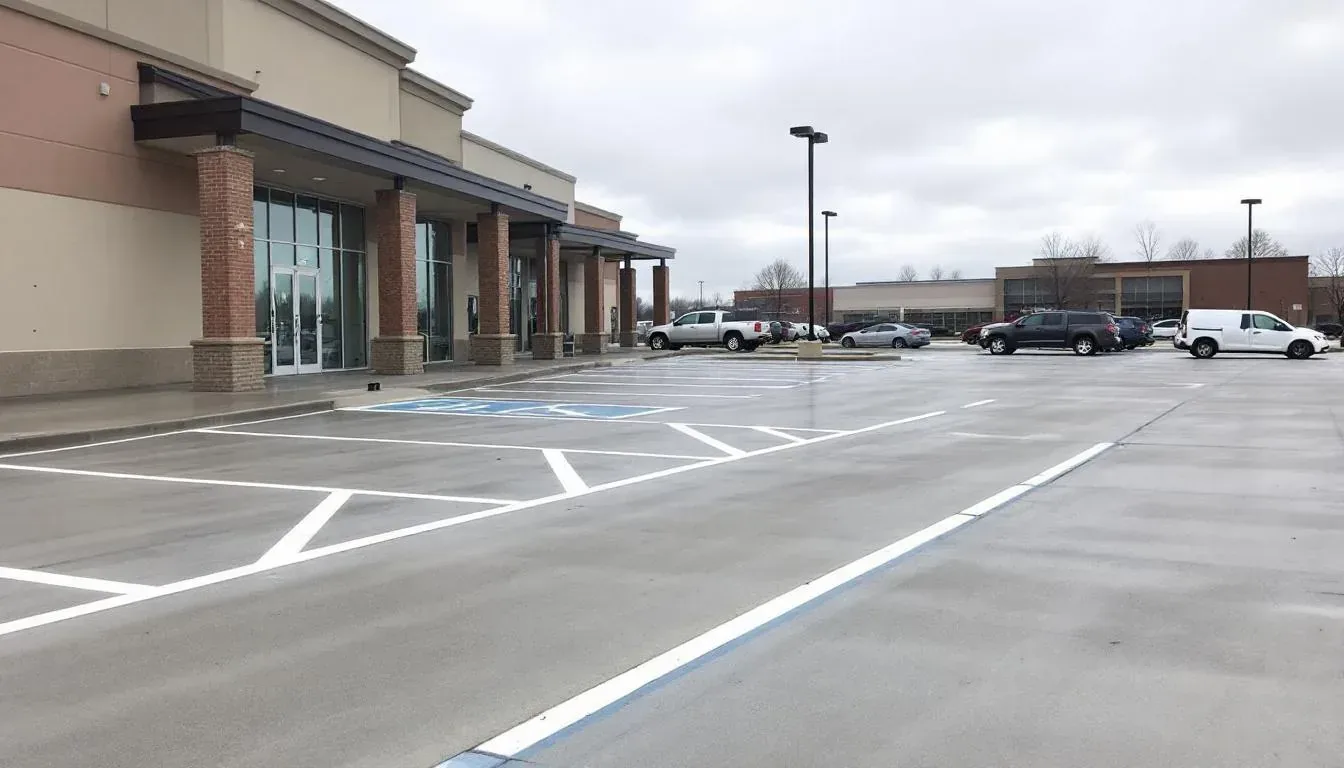
Striping and ADA compliance round out the project. Overland Park requires high-contrast pavement markings that meet specific reflectivity standards — those faded 'Lifestyle' stripes you see on aging lots are actually code violations waiting to be cited. We coordinate striping, fire lane markings, accessible parking layouts, and signage as part of the scope. Everything leaves our hands inspection-ready.
Overland Park-Specific Parking Lots Considerations
Overland Park's Pavement and Landscaping Code Enforcement
This city doesn't let commercial lots age quietly. Overland Park actively inspects and cites parking lot conditions including cracking, faded striping, and non-compliant ADA layouts. If your lot along College Boulevard or in Oak Park Retail has deferred maintenance, you may already be on the city's radar. A full concrete replacement brings you into compliance and keeps you there for decades. We handle the permit applications and coordinate directly with inspectors so you don't get caught in bureaucratic delays.
D-Cracking in Older Office Park Panels
D-cracking is a specific failure pattern showing up across older Overland Park office parks — especially near Corporate Woods and along the Metcalf Corridor. It starts as hairline cracks near joints and spreads into a network that compromises entire panels. The cause is usually aggregate that wasn't properly screened for freeze-thaw durability. When we replace these lots, we specify Kansas DOT-approved aggregate sources and air-entrained mix designs that resist this exact failure mode. It costs marginally more upfront and saves you from premature panel replacement.
High-Volume Weekend Retail Traffic on the Golden Mile
The 135th to 159th Street corridors generate weekend traffic volumes that rival weekday peaks. Retail lots in this zone see constant turning movements, stop-and-go loading, and heavy pedestrian crossings. We design these lots with reinforced drive aisles, thicker panels at high-turn areas near entrances, and strategic joint placement that prevents the random cracking caused by repetitive vehicle stress. Your lot needs to handle Saturday afternoon traffic in July and a snow-packed January morning equally well.
What to Expect During Your Overland Park Parking Lot Project
The first thing you'll notice is our survey crew marking the existing lot with paint and stakes. We map every drain, utility line, and grade change before we touch anything. In Overland Park, Johnson County requires a grading permit for most commercial lot projects, and the city may require a site plan review depending on your zoning district. We handle that paperwork before mobilization. You'll receive a phasing plan that shows exactly which sections of your lot close and when, so your business keeps operating throughout.
Demolition day is loud but fast. Our crew brings in a concrete saw and hydraulic breaker to remove old panels or asphalt in the designated phase. Debris trucks stage along your lot perimeter — usually near your service entrance or loading area, not your customer-facing frontage. Subbase excavation follows immediately. You'll see graders and compaction equipment shaping the granular base layer. This is where the real engineering happens. If our crew hits soft clay pockets — common near 135th Street and in the Bluhawk area — we over-excavate and replace with structural fill before compacting.
Pour day brings the concrete trucks. They stage on the nearest access road — Metcalf, 135th, or whichever route minimizes disruption to your customers. Our finishers work section by section, placing concrete, screeding to grade, and cutting control joints on a precise schedule. You'll see the crew working late if needed to finish a phase before the next business day. Johnson County inspectors may visit during the pour or shortly after to verify thickness, reinforcement placement, and drainage compliance.
After curing — typically five to seven days per phase — we stripe, install signage, and open each section back to traffic. You'll receive a final walkthrough with one of our contractors to verify every detail against the original scope. The last phase opens, and your lot is fully operational. Most Overland Park commercial lots take three to six weeks depending on size and phasing complexity.
A College Boulevard Office Park Gets a Long-Overdue Replacement
A property manager overseeing a 120-space office park lot near College Boulevard and Nall Avenue contacted us after receiving a code citation for deteriorating pavement and faded ADA striping. The existing lot was original 1990s concrete showing classic D-cracking at nearly every joint. Panels had shifted from subbase settlement, creating trip hazards at pedestrian crossings. The lot served three professional office tenants with 200+ daily commuters, and none of them could afford to lose parking access.
We designed a four-phase replacement plan that kept at least 80 spaces available at all times. Our crew removed failed panels, excavated soft clay subbase pockets discovered near the south end of the lot, and replaced them with compacted granular fill. New 6-inch air-entrained concrete panels went down with doweled joints and a reinforced 8-inch section at the main drive aisle where delivery trucks turn. The entire subbase was laser-graded to eliminate the ponding issues tenants had complained about for years.
The project wrapped in four weeks. Fresh high-contrast striping, compliant ADA signage, and properly sloped accessible routes brought the lot into full code compliance. The property manager passed their follow-up inspection without a single note. That lot is now engineered for a 50-year service life — well past the next lease cycle and the one after that.
How Much Does Parking Lots Cost in Overland Park?
| Type | Cost / Sq Ft | Project Dependent |
|---|---|---|
| Standard Concrete Lot | $4–8 | Varies by scope |
| Heavy-Duty (Truck Traffic) | $6–10 | Varies by scope |
| Repair / Section Replace | $8–14 | Varies by scope |
Overland Park parking lot pricing typically runs higher than the metro average due to Johnson County's stricter subbase and drainage requirements. Expect the additional grading permit fees and site plan review costs to factor into your total project budget.
Parking Lots FAQ for Overland Park, KS
What permits does Overland Park require for a commercial parking lot?
Most commercial parking lot projects in Overland Park require a grading permit from Johnson County and a building permit from the city. Depending on your zoning district, you may also need a site plan review, especially in the Metcalf Corridor or Bluhawk development area. If your project changes the impervious surface area, stormwater management review kicks in as well. We pull all necessary permits before work begins and coordinate inspection scheduling so there are no delays during the pour.
Why is D-cracking so common on older Overland Park office park lots?
D-cracking happens when moisture-susceptible aggregate inside the concrete goes through repeated freeze-thaw cycles. Older lots — especially those poured in the 1980s and 1990s near Corporate Woods and along College Boulevard — used aggregate sources that weren't screened to current durability standards. The cracks start at joints and panel edges, then spread inward. Repair is temporary at best. Full panel replacement using Kansas DOT-approved aggregate and air-entrained concrete is the permanent fix. We see this issue on nearly every older office park lot we evaluate in Johnson County.
How do you phase the project to keep my business open?
We divide your lot into sections and close only one section at a time. Each phase gets demolished, prepped, poured, and cured before we move to the next. Your customers always have access to parking — we just redirect them temporarily. We schedule demolition and pours to avoid your peak hours when possible. For retail locations on the Golden Mile, that usually means heavy work happens early morning on weekdays. You'll have a phasing map before we start so your staff knows exactly what to expect each week.
Can a concrete lot handle delivery truck traffic at my Metcalf Corridor location?
Absolutely. We design drive aisles and loading zones with increased slab thickness — typically 7 to 8 inches with reinforcement — specifically for truck wheel loads. Standard parking stalls get 5 to 6 inches. The jointing pattern also changes in truck zones to prevent stress cracking from concentrated axle loads. Metcalf Corridor businesses regularly receive deliveries from full-size semis, and we engineer for that from the start. Your lot won't develop the ruts and slab failures you see on undersized asphalt surfaces.
What's the realistic lifespan difference between asphalt and concrete in this climate?
In the Overland Park climate — hot summers, freeze-thaw winters, and intense UV exposure on large unshaded lots — asphalt typically lasts 15 to 20 years with regular seal-coating every 3 to 5 years. Concrete, properly installed with air-entrained mix and correct jointing, lasts 40 to 50 years with minimal maintenance. The city itself is targeting 50-year lifecycles as it replaces asphalt streets with concrete in neighborhoods like Wycliff and Westbrooke South. The upfront cost is higher, but the total cost of ownership over 40 years is significantly lower.
Do you handle stormwater compliance for Johnson County?
Yes. Johnson County has specific stormwater management requirements for commercial sites, particularly when you change the amount of impervious surface. We engineer lot grades to direct runoff toward approved collection points — catch basins, bioswales, or existing storm infrastructure. If your project triggers a stormwater review, we prepare the required drainage calculations and submit them with your permit package. This is non-negotiable in Overland Park, and we build it into every commercial lot scope from the initial site evaluation.
Other Concrete Services in Overland Park, KS
Parking Lots in Nearby Cities
Schedule a Site Consultation for Your Overland Park Lot
During your on-site visit, one of our contractors walks the lot with you, identifies failure points, measures grades, and outlines a phasing plan that keeps your Overland Park business running through every stage of the project.