
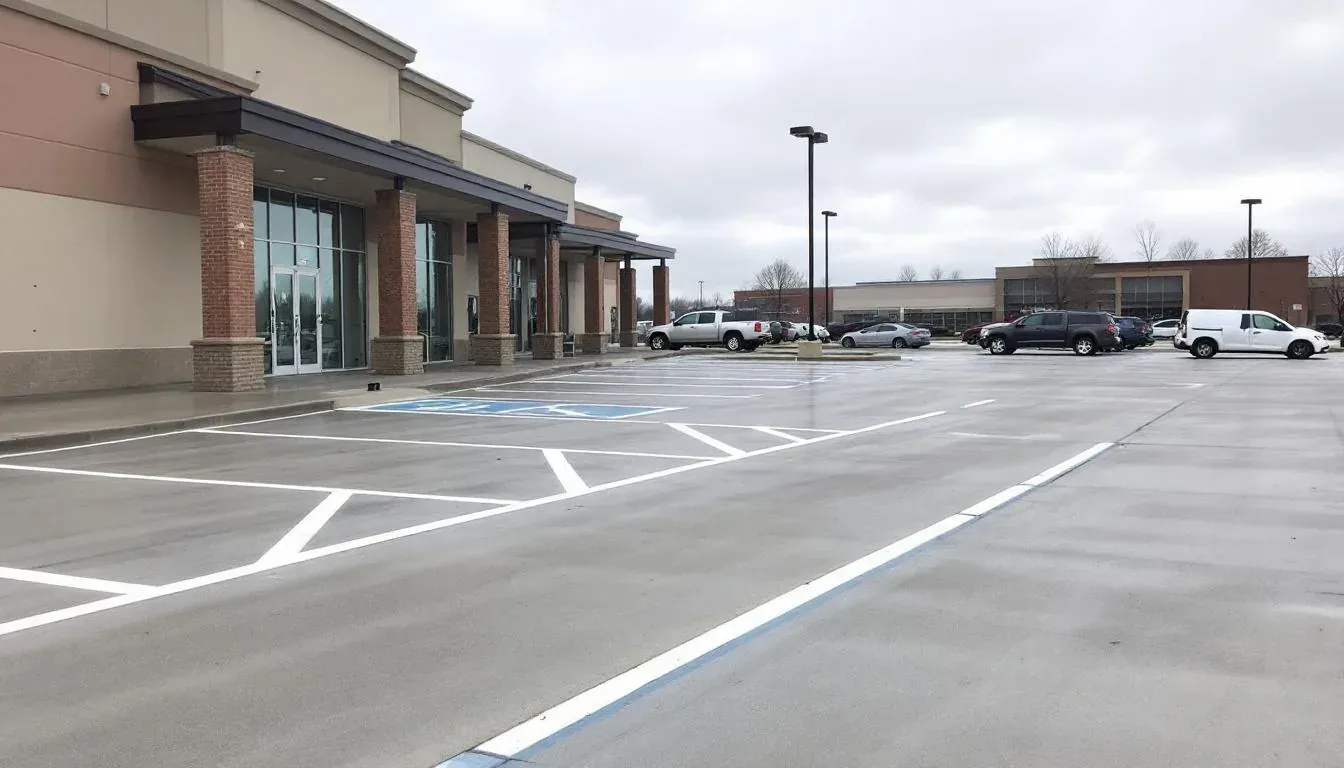
Parking Lots in Prairie Village, KS
Prairie Village business owners expect more from every surface their customers touch. Your parking lot is the first impression — we build it to match the standard this community demands.
Is your boutique lot keeping up with Prairie Village expectations?
Summer heat is already stressing every parking surface in Johnson County. Asphalt lots near Corinth Square and The Shops of Prairie Village are softening under UV exposure right now. Oxidation accelerates fast in Kansas heat — and fall won't fix the damage. If your lot shows fading, raveling, or cracked joints, this is the season to act. Concrete pours cure strongest between May and October. Booking now means your project finishes before the holiday retail rush hits Prairie Village hard.
This community holds commercial properties to a higher visual standard than most cities in the metro. Drive down Mission Road or Roe Ave and you'll see it — tight curbing, clean joint lines, decorative finishes that match storefront aesthetics. A deteriorating lot stands out here more than anywhere else. Your customers notice. Your tenants notice. The city notices. We've poured parking lots for properties across Johnson County since 2015, completing 377 projects with the kind of precision Prairie Village demands.
A concrete parking lot isn't just pavement. It's engineered infrastructure that handles daily commuter traffic, pedestrian flow, stormwater management, and ADA compliance — all while looking sharp enough for a premium retail environment. We build lots that perform for decades, not just seasons. Every project starts with a site consultation tailored to your property's specific conditions, traffic patterns, and aesthetic goals.
Concrete Parking Lots Built for Prairie Village's Premium Commercial Districts
Prairie Village commercial zones like Corinth Square and Meadowbrook Retail Hub see heavy pedestrian traffic daily. Your parking lot has to manage vehicle flow and foot traffic simultaneously without compromising safety or appearance. We design lots with clear circulation paths, properly graded surfaces, and high-visibility striping that keeps customers moving efficiently. Reinforced concrete slabs at 6 to 8 inches thick handle everything from daily sedan traffic to periodic delivery trucks without the rutting and deformation you see in aging asphalt lots along Somerset Dr.
Aesthetic standards matter here more than in most Johnson County cities. We offer exposed aggregate, broom-finished surfaces, and decorative saw-cut joint patterns that complement Prairie Village's architectural identity. Premium curbing details — including radius curbs and colored concrete borders — match the high-spec aesthetic curbing this market expects. Every visible element gets the same attention your storefront receives. We've seen too many contractors treat parking lots like utility slabs. In Prairie Village, your lot is part of your brand.
Stormwater engineering is built into every lot we pour. Johnson County stormwater regulations require proper detention and drainage for commercial surfaces. We integrate slope grading, catch basin placement, and permeable concrete options where applicable. This prevents the ponding and sheet-flow problems common on older lots near 83rd St and Tomahawk Rd. Proper drainage also protects your concrete from the freeze-thaw cycling that destroys poorly graded surfaces every winter.
Prairie Village-Specific Parking Lots Considerations
High-Visibility Commercial Aesthetics Along Mission Road and Corinth Square
Prairie Village enforces a visual standard that most Johnson County cities don't. Properties near The Shops of Prairie Village and Corinth Square face scrutiny from both the city and discerning customers who expect clean, well-maintained surfaces. Asphalt oxidation is a constant problem on boutique lots — fading and raveling within five to seven years. Concrete resists UV degradation far longer and accepts decorative finishes that maintain curb appeal. We design joint layouts and surface textures that align with adjacent hardscape and building materials. Your lot won't just function — it'll reinforce the premium positioning your business depends on.
Pedestrian-Heavy 'Village Center' Traffic Patterns
Prairie Village's Safe Routes initiative and walkable commercial centers create unusual traffic dynamics. Your lot handles both vehicles and significant pedestrian flow — shoppers walking between stores, residents on foot from Countryside East or Corinth Hills. This means ADA-compliant ramps, clearly delineated crosswalks, and slip-resistant surface finishes aren't optional. We engineer pedestrian pathways directly into the lot design with contrasting broom textures and colored concrete crossings. Bollard placement, curb cuts, and sight-line management are standard in every lot plan we produce for Prairie Village properties.
Concrete Scaling and Joint Deterioration on Existing Premium Lots
We see a recurring pattern on Prairie Village commercial lots: surface scaling and premature joint failure caused by deicing salt exposure and inadequate initial joint spacing. Many existing lots in the Meadowbrook and Corinth Square areas were poured with joints spaced too far apart for Kansas freeze-thaw cycles. Concrete contracts and expands through 40-plus freeze-thaw events per winter here. We space control joints at 10-to-12-foot intervals maximum and seal every joint with flexible polyurethane sealant. Air-entrained concrete at 6 percent minimum handles deicing chemicals without the spalling that plagues older Prairie Village lots.
What to Expect During Your Prairie Village Parking Lot Project
After your site consultation, we deliver a detailed scope document covering slab design, drainage engineering, ADA layout, and phasing schedule. You'll know exactly which sections of your lot stay open and which sections close on specific dates. For properties near Corinth Square or The Shops of Prairie Village, we typically phase work into two or three stages so your business never fully loses parking access. We coordinate delivery truck routing — concrete trucks usually stage on the adjacent street or your property's service lane, keeping Mission Road and Roe Ave clear of obstructions during peak hours.
Demolition starts with saw-cutting the existing surface into manageable sections. You'll hear saws and skid-steer loaders for one to three days depending on lot size. Subbase preparation follows — we excavate to proper depth, compact the aggregate base in lifts, and verify compaction with density testing. If we encounter the silty clay common in Prairie Village subgrades, we stabilize it with lime or cement-treated base before pouring. This step prevents the settlement cracking that shows up two years later on lots built without proper soil work.
Concrete pours happen in planned sections. Our crew typically starts at dawn to maximize working time before afternoon heat accelerates curing. You'll see a concrete pump truck, a crew of six to ten finishers, and a laser screed for flatness accuracy within 1/8 inch over 10 feet. Each section gets saw-cut joints within 12 hours, then cures under membrane-forming compound for seven days. We barricade cured sections clearly so your customers and tenants know where to park during each phase.
Johnson County requires inspections at the subbase and final slab stages for commercial parking projects. We schedule these directly and handle all communication with the county inspector. Your Prairie Village building permit application goes through the city's planning department — we prepare the site plan, drainage calculations, and ADA compliance documentation your permit requires. Most Prairie Village commercial lot permits process within two to three weeks. Final striping, signage, and wheel stop installation happen after the full cure period. You'll walk the finished lot with our project lead before we close out.
Repair and Resurface vs. Full Replacement: What Makes Sense for Your Prairie Village Lot
Many Prairie Village business owners ask whether patching and resurfacing can extend their existing lot's life. If your lot has isolated cracking, minor joint spalling, or surface wear but a solid subbase, repair work can buy you five to eight more years at roughly 30 to 40 percent of replacement cost. We evaluate subbase integrity with core samples and deflection testing before recommending either path. For lots near Corinth Square where appearance drives customer perception, even well-done repairs can look patchy against surrounding premium surfaces.
Full replacement makes sense when subbase failure is widespread, drainage problems exist under the slab, or the lot has been overlaid multiple times already. Many older lots along Somerset Dr and 83rd St fall into this category — they were built on uncompacted fill or inadequate aggregate bases that have settled unevenly over decades. A new concrete lot on a properly engineered subbase eliminates recurring repair costs and gives you a 25-to-35-year surface that actually increases property value.
The cost math is straightforward. If you're spending $2 to $4 per square foot on repairs every three to five years, you'll match the cost of full replacement within 12 to 15 years — and still have an aging lot. A new concrete lot at $7 to $12 per square foot resets that clock entirely. In a market like Prairie Village where tenants and customers expect premium conditions, the full replacement often pays for itself through reduced vacancy and higher lease rates.
How Much Does Parking Lots Cost in Prairie Village?
| Type | Cost / Sq Ft | Project Dependent |
|---|---|---|
| Standard Concrete Lot | $4–8 | Varies by scope |
| Heavy-Duty (Truck Traffic) | $6–10 | Varies by scope |
| Repair / Section Replace | $8–14 | Varies by scope |
Prairie Village parking lot projects typically run $7 to $12 per square foot for standard reinforced concrete, with decorative finishes and premium curbing adding $1.50 to $3 per square foot — a cost driven by the aesthetic expectations in this market and Johnson County's stormwater compliance requirements.
Parking Lots FAQ for Prairie Village, KS
What permits does Prairie Village require for a commercial parking lot?
Prairie Village requires a building permit through the city's planning and development department for any commercial parking lot construction or full replacement. You'll need a site plan showing drainage, ADA-compliant access, setbacks, and stormwater management. Johnson County also reviews stormwater detention compliance separately. We prepare all documentation and submit on your behalf. Most permits process within two to three weeks. If your property is near Corinth Square or a designated pedestrian zone, additional design review may apply — we handle that coordination as well.
How long does a full lot replacement take for a mid-size Prairie Village retail property?
A typical 8,000 to 15,000 square foot lot takes three to five weeks from demolition to final striping. Phased projects add a week because we're working in sections to keep your business accessible. Weather delays can extend the timeline — sustained rain stops concrete pours entirely. We build buffer days into every schedule. Subbase work takes the longest, especially if clay stabilization is needed. The actual concrete pour for each section happens in a single day. The seven-day cure period per section is non-negotiable for long-term strength.
Why is concrete better than UBAS or asphalt overlay for my Prairie Village lot?
UBAS and asphalt overlays are maintenance strategies, not permanent solutions. They extend an existing surface by three to seven years. A properly poured concrete lot lasts 25 to 35 years with minimal maintenance. In Prairie Village, where property values and aesthetic standards are high, concrete holds its appearance far longer than asphalt. It resists UV oxidation, doesn't soften in summer heat, and handles the freeze-thaw cycling that degrades asphalt every winter. The upfront cost is higher, but the lifecycle cost per year is significantly lower. For high-visibility lots along Mission Road or near The Shops, concrete is the clear long-term investment.
Can you match decorative concrete finishes to my building's existing hardscape?
Yes. We regularly match exposed aggregate blends, integral color mixes, and broom-finish textures to existing sidewalks, patios, and storefronts in Prairie Village. We pull samples from your existing hardscape, then work with our batch plant to match aggregate size, color tone, and cement shade. Decorative saw-cut joint patterns can mirror the geometric layouts common in Corinth Square and Meadowbrook commercial areas. We pour test panels on-site for your approval before the full pour begins.
What happens with stormwater management on my new lot?
Johnson County requires commercial lots to manage stormwater runoff — you can't increase impervious surface without addressing detention or retention. We engineer positive drainage slopes at a minimum 1.5 percent grade toward catch basins or bioswales. If your property has limited space for detention, we can incorporate permeable concrete pavers in overflow parking areas to reduce total runoff volume. Every drainage plan gets reviewed by the county before permit approval. We include all engineering calculations in your project package.
Will my lot handle delivery trucks?
Standard delivery trucks up to 26,000 pounds operate fine on our 6-inch reinforced slabs. If your property receives semi-trailer deliveries — common at Meadowbrook Retail Hub locations — we pour 8-inch slabs with #4 rebar on 12-inch centers in the delivery apron and loading areas. We also thicken the slab at turning radius points where tire scrub concentrates stress. Approach aprons at the street connection get additional reinforcement to handle the transition load. We design truck routes into the lot layout so heavy traffic stays on reinforced sections.
How do you prevent the surface scaling we see on so many Prairie Village lots?
Scaling in Prairie Village almost always traces back to two causes: insufficient air entrainment and premature finishing. We specify 6 percent air entrainment minimum in every mix — this creates microscopic voids that absorb the pressure from freeze-thaw expansion. Our finishers wait for bleed water to fully evaporate before troweling, which prevents a weak surface layer that flakes under deicing salt. We also apply membrane-forming curing compound immediately after finishing to ensure proper hydration. These steps eliminate 90 percent of scaling failures. Joint sealant maintenance every three to five years handles the rest.
Other Concrete Services in Prairie Village, KS
Schedule Your Prairie Village Lot Consultation This Week
During the site visit, we'll evaluate your existing surface, test subbase conditions, and walk through drainage, ADA layout, and phasing options specific to your property. You'll leave with a clear scope and realistic numbers — no surprises down the road.