
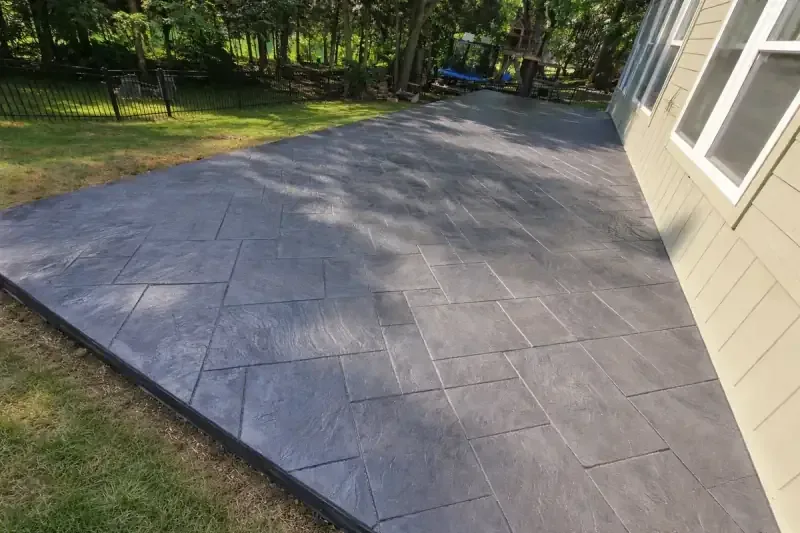
Stamped Concrete in Prairie Village, KS
Prairie Village homeowners expect more from their outdoor surfaces. We pour stamped concrete that meets those expectations — and the neighborhood standard.
What Does Stamped Concrete Actually Cost in Prairie Village?
Let's talk numbers first. In Prairie Village, most stamped concrete patios run between $12 and $18 per square foot installed. That range depends on pattern complexity, color layers, and how much site prep your lot needs. Johnson County labor rates sit higher than the metro average. Material costs reflect that too. A typical 400-square-foot patio lands between $4,800 and $7,200 before any demolition or grading work. That's real money — and you deserve to know what drives those figures before anyone shows up with a contract.
The cost connects directly to what's under your yard. Prairie Village sits on heavy clay soil that shifts with every wet-dry cycle Kansas throws at us. That means deeper base preparation, thicker slabs, and reinforcement details that cheaper pours skip. Homes along Somerset Dr and in Corinth Hills often need extra grading work due to mature tree root systems. These aren't upsells — they're what keeps your stamped surface from cracking in year two. Spending right the first time saves you thousands over the slab's 25-year life.
Stamped Concrete Built for Prairie Village's Premium Standards
Prairie Village isn't a typical suburb. Homeowners here maintain properties to a standard that reflects the neighborhood's identity as Johnson County's residential jewel. Your stamped concrete needs to match that standard. We pour patios, driveways, walkways, and pool surrounds using patterns and colors selected specifically for your home's architecture. From mid-century ranches in Homestead to updated colonials in Prairie Hills, every project gets a custom color and pattern consultation.
Concrete scaling is a documented issue across Prairie Village's premium walkways and entry paths. We address this with air-entrained concrete mixes rated for Kansas freeze-thaw cycles, proper curing compounds, and high-quality acrylic sealers. Our stamped surfaces resist the salt damage and moisture intrusion that causes scaling on cheaper installations. After 377 completed projects since 2015, we know exactly which mix designs and sealer schedules perform in this climate.
Pattern selection matters more here than in most cities. Prairie Village HOAs and neighbors notice details. We carry over 30 stamp patterns — from ashlar slate and European fan to herringbone brick and seamless textures. Our crew hand-selects release colors and integral tones on site, matching your home's brick, stone, or siding. The goal is a surface that looks like it was always part of the property, not bolted on as an afterthought.
Prairie Village-Specific Stamped Concrete Considerations
Johnson County Clay and Your Slab's Foundation
Prairie Village soil is heavy montmorillonite clay. It swells when saturated and shrinks during dry spells, creating movement that cracks underprepared slabs. We excavate to a minimum 6-inch depth, install compacted Class 5 aggregate base, and reinforce with fiber mesh or rebar depending on slab size. Homes in Countryside East near Meadowbrook Park tend to have higher water tables, requiring additional drainage consideration before we pour. This foundation work is non-negotiable — it's why our stamped concrete stays flat and intact through years of Kansas weather.
Matching Prairie Village's Architectural Character
Most Prairie Village homes were built between the 1940s and 1970s, with significant renovation waves in the 2000s and 2010s. That creates a mix of original brick ranches, stone-clad split-levels, and modern additions. A stamped patio near Corinth Square needs a different approach than one backing up to Harmon Park. We photograph your home's exterior materials during the site visit and bring physical color samples to match. The wrong color choice on a stamped driveway off Mission Road is visible to every neighbor and every visitor. We get it right before the truck arrives.
Pedestrian-Friendly Design in a Walkable Community
Prairie Village prioritizes Safe Routes and pedestrian connectivity. Many homeowners want stamped walkways connecting driveways to front entries or side yards to patios. These paths see foot traffic in rain, snow, and ice. We apply anti-slip texturing additives to every walkway pour and select stamp patterns with enough surface relief to maintain traction when wet. For homes along Roe Ave and 83rd St where foot traffic is heaviest, we also recommend a penetrating sealer underneath the topical coat for extra moisture resistance and longevity.
From First Call to Finished Stamped Concrete
It starts with a phone call — usually about 15 minutes. You tell us what you're thinking: a patio, a driveway, maybe a walkway loop around the side yard. We ask about square footage estimates, your home's age, and any drainage problems you've noticed. We'll check your Prairie Village address against soil maps and note your neighborhood. If you're in Homestead near Tomahawk Rd, we already know the grading tendencies. If you're in Corinth Hills, we know those lots drain toward the back. By the end of the call, we've scheduled a site visit within the week.
At your property, our contractor walks the area with a tape measure, a level, and a moisture probe. We check soil compaction, measure existing slopes, and look at how water moves across your yard after rain. We photograph your home's exterior — brick color, stone accents, trim paint, existing hardscape. Then we sit down with you and a physical pattern book. You'll see stamp textures pressed into colored samples, not just photos on a screen. We discuss edge profiles, step-downs, and where control joints should fall to stay hidden. You get a written proposal within 48 hours with exact costs, timeline, and material specs.
Pour day is orchestrated. Our crew arrives early, sets forms, and verifies grade one final time. The concrete truck rolls in with our specified mix — 4,000 PSI minimum, air-entrained, with fiber reinforcement. We place, screed, and bull-float the surface, then apply color hardener by hand broadcast for deep, UV-stable pigment. Release agent goes on next, and our stampers press patterns while the concrete is at the perfect plasticity window. Timing is everything. Too early and the stamps sink. Too late and you lose detail. This is where experience shows — 377 projects have taught us exactly when to press.
Two to three days later, we return to wash excess release agent, revealing the color contrast beneath. We inspect every square foot for detail sharpness and color consistency. Then we apply a high-gloss or matte acrylic sealer — your choice — that locks in color and creates a protective barrier against moisture and stains. We walk you through your maintenance schedule: when to reseal, how to clean, what to avoid. Your stamped concrete is ready for furniture in about a week. And it looks like it's been part of your Prairie Village home forever.
How Stamped Concrete Needs Differ Across Prairie Village
Countryside East sits lower in elevation near Meadowbrook Park, and its yards tend to retain more moisture. Soil here stays saturated longer after heavy rain, which means we spend extra time on base compaction and sometimes install drainage fabric beneath the aggregate layer. Many homes date to the late 1950s, with original concrete stoops and walkways that need full removal before new stamped work begins. The demolition and haul-off adds cost, but it's the only way to build a lasting foundation.
Corinth Hills homes sit on slightly better-draining ground closer to Corinth Square, but mature oak and maple root systems create challenges. We've seen root heave lift 4-inch slabs in this neighborhood. Our approach includes root pruning consultation, deeper excavation near large trees, and strategic joint placement that allows controlled movement. The architecture here skews toward 1960s colonials and updated ranches — ashlar slate patterns in warm gray tones are consistently the best match.
Prairie Hills and Homestead feature a mix of original mid-century builds and significant 2000s-era renovations. In Prairie Hills, larger lots allow for expansive patio designs — 600 square feet and up. Homestead's tighter setbacks near Tomahawk Rd often require creative layout solutions. We've designed L-shaped patios, wraparound walkways, and stepped surfaces to maximize usable space on compact lots. Each neighborhood demands a different conversation about scale, drainage, and style. That's why the site visit matters as much as the pour.
How Much Does Stamped Concrete Cost in Prairie Village?
| Type | Cost / Sq Ft | Typical 300 Sq Ft |
|---|---|---|
| Basic Patterns (1 color) | $12–15 | $3,600–$4,500 |
| Premium Patterns (2 colors) | $15–18 | $4,500–$5,400 |
| Multi-Color / Custom | $16–20 | $4,800–$6,000 |
Prairie Village pricing reflects Johnson County's higher labor rates and the deeper site preparation required by local clay soils. Expect $12–$18 per square foot for most residential stamped concrete, with demolition of existing surfaces adding $2–$4 per square foot depending on thickness and access.
Stamped Concrete FAQ for Prairie Village, KS
Does Prairie Village require a permit for a stamped concrete patio?
Most backyard patios under a certain size don't require a permit in Prairie Village, but there are exceptions. If your project is within setback boundaries, involves drainage modifications, or connects to an existing structure, you may need one. We check with Johnson County and Prairie Village building codes before every project. If a permit is needed, we handle the paperwork and schedule any required inspections. You won't have to make a single trip to city hall.
How does stamped concrete compare to pavers for a Prairie Village driveway?
Pavers cost significantly more — often $20 to $30 per square foot installed — and require ongoing maintenance as individual units shift on Johnson County clay. Stamped concrete gives you a similar look for roughly 40 percent less cost. It's a single monolithic slab, so there's no weed growth between joints and no re-leveling needed. The tradeoff is that individual paver replacement is easier than patching a stamped surface, but with proper base preparation and reinforcement, you shouldn't need repairs for 20-plus years. For Prairie Village driveways, stamped concrete is the stronger value.
What maintenance does a stamped patio need in this climate?
Resealing every two to three years is the main task. Kansas UV exposure and freeze-thaw cycles break down sealer over time. A fresh coat of acrylic sealer costs between $0.50 and $1.00 per square foot if you hire it out, or you can DIY with a roller and a Saturday afternoon. Beyond resealing, keep the surface clean with a garden hose and mild detergent. Avoid metal shovels for snow removal — use a plastic blade. That's genuinely all it takes to keep your stamped patio looking sharp for decades.
Can you pour stamped concrete right next to my foundation?
Yes, and we do it regularly in Prairie Village. The key is proper slope — we grade stamped surfaces to fall away from your foundation at a minimum quarter-inch per foot. We also install isolation joints where the new concrete meets the foundation wall. This prevents bonding between the two structures, which would transfer movement and cause cracking. For homes in Prairie Hills and Countryside East where foundation drainage is critical, we sometimes recommend adding a French drain channel beneath the new slab edge.
Which colors resist fading longest?
Earth tones hold up best in direct Kansas sun. Tans, warm grays, sandstone shades, and terra cotta maintain their depth for years. We use iron oxide-based color hardener that's integral to the surface layer, not a topical paint. These pigments are UV-stable and don't bleach out the way cheaper integral colors can. Darker charcoals and slate tones look stunning initially but show fading and sealer wear more visibly. For Prairie Village homes with red or brown brick, we often recommend a walnut or autumn brown hardener with a dark charcoal release for contrast.
How thick should a stamped concrete driveway be in Prairie Village?
We pour residential driveways at a minimum of 5 inches, often 6 inches for SUV and truck traffic. The base layer matters just as much — we install at least 4 inches of compacted aggregate beneath the slab. Prairie Village clay requires this depth because the soil's expansion coefficient is significant. A 4-inch driveway on uncompacted clay will crack within two winters. We also use 4,000 PSI concrete with fiber mesh reinforcement as standard. For driveways off Mission Road or Roe Ave with heavier daily traffic, we add welded wire fabric for extra tensile strength.
Do your stamped patterns work with mid-century homes?
Absolutely. Prairie Village has a strong mid-century housing stock, especially in Homestead and along Somerset Dr. These homes pair well with clean-lined stamp patterns — random stone, smooth slate, and large-format ashlar layouts complement the horizontal emphasis of ranch and split-level architecture. We avoid overly ornate patterns like cobblestone or European fan on mid-century homes because they clash with the era's design language. Color-wise, cool grays and sandstone tones integrate naturally with the original brick and limestone details common in 1950s and 1960s Prairie Village construction.
Other Concrete Services in Prairie Village, KS
Schedule Your Free Prairie Village Property Assessment
We'll evaluate your soil conditions, measure existing grades, photograph your home's exterior for color matching, and identify any drainage concerns — all before providing a detailed written estimate specific to your property.