
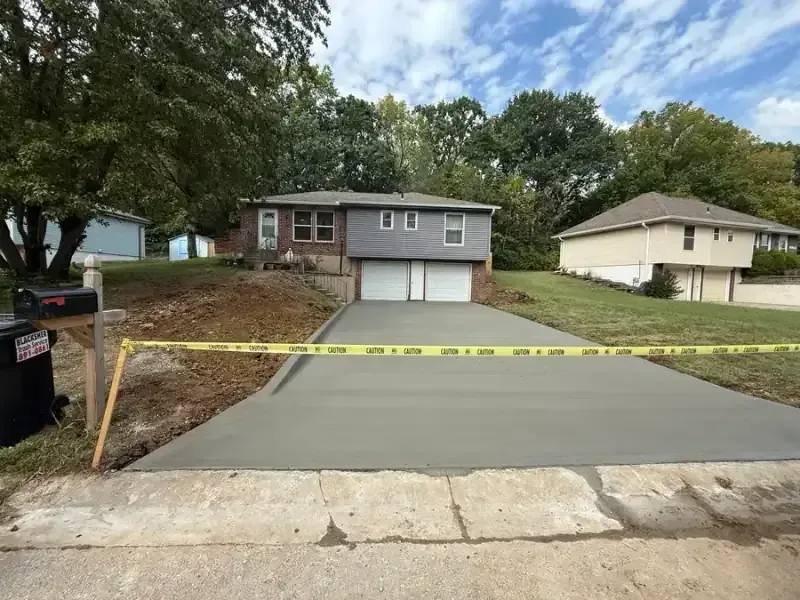
Concrete Driveways in Prairie Village, KS
Your Prairie Village driveway should match the neighborhood it sits in — not drag it down with spider cracks and sunken slabs that catch every visitor's eye.
What's That Crack Doing to Your Curb Appeal on Roe Avenue?
You notice it every time you pull in. That long diagonal crack running from the garage apron to the street. The corner slab that sank an inch last winter. Maybe the surface is spalling in patches, exposing aggregate that looks rough against your neighbors' pristine Corinth Hills frontage. In Prairie Village, where property standards run high and neighbors notice everything, a deteriorating driveway stands out like a sore thumb.
Most driveways in Prairie Village date to the 1950s through 1970s original builds. That means decades of Kansas City freeze-thaw cycles working on concrete that was poured thinner and with less reinforcement than modern standards require. The result is scaling, heaving, and settlement that gets worse every spring. Patching only delays the inevitable — and it never looks right.
We've poured driveways across Johnson County since 2015, completing over 377 projects in the metro. Prairie Village homeowners call us because they want work that holds up and looks intentional. Not a patchwork of repairs that signals neglect. A full replacement gives you a clean slate with proper subgrade prep, modern reinforcement, and finishes that suit this community's aesthetic expectations.
This page walks you through what a driveway project actually looks like in Prairie Village — from the permit process to the pour day logistics to the finish options that make sense for your specific lot. No generic sales pitch. Just the details you need to make a smart decision about one of the most visible features of your home.
What Goes Into a Prairie Village Driveway That Actually Lasts
A residential driveway in Prairie Village typically runs 16 to 24 feet wide and 40 to 60 feet long, depending on lot depth and garage setback. We pour at a minimum 4-inch thickness for standard passenger vehicles, stepping up to 5 or 6 inches at the apron and any section where delivery trucks or moving vans will park. Fiber mesh reinforcement goes into every pour, and we add rebar on longer runs or lots with known soil movement. The goal is a slab that handles Johnson County's clay expansion cycles without cracking apart in three years.
Finish options matter here more than in most communities. Prairie Village homeowners frequently request exposed aggregate, broom-finish borders with stamped center panels, or integral color that complements their brick or stone exterior. We've matched earth tones to mid-century ranch facades in Homestead and installed clean slate-gray broom finishes for updated colonials along Somerset Drive. Every finish gets a proper cure time and professional-grade sealer application before we consider the job complete.
Drainage design is built into every project. Many Prairie Village lots are relatively flat, especially in Countryside East and Prairie Hills. Without correct slope and control joint placement, water pools against the garage foundation or sheets across the sidewalk onto the street. We grade every driveway at a minimum 1% slope away from the structure and install swale cuts or channel drains where the lot geometry demands it.
Prairie Village-Specific Concrete Driveways Considerations
HOA and Neighborhood Aesthetic Standards
Several Prairie Village neighborhoods have homeowner associations or informal community standards that dictate driveway appearance. Corinth Hills and Countryside East residents sometimes face restrictions on color, finish, or width. Before we pour, we confirm any HOA covenants and ensure the design complies. We also coordinate with adjacent property lines on shared drainage patterns. In a community this tight-knit, the details of how your driveway meets your neighbor's lawn edge actually matter.
Mature Tree Root Intrusion Along Mission Road Corridors
Prairie Village's tree canopy is one of its best features — until those roots reach your driveway. Mature oaks, maples, and elms along Mission Road, 75th Street, and through Harmon Park neighborhoods push root systems under existing slabs. We encounter this regularly during tear-out. Our approach includes root pruning in coordination with a certified arborist when necessary, installing root barriers, and adjusting the subgrade depth to provide clearance. Ignoring root intrusion guarantees premature cracking within five to seven years.
Street Apron and Sidewalk Transitions in Older Subdivisions
Prairie Village's public sidewalk system creates a unique challenge. Your driveway crosses a city sidewalk and connects to the street through an apron — and both transitions need to meet city specifications. The apron section between the sidewalk and curb is technically in the public right-of-way, so it requires city approval. We handle the permit paperwork with Prairie Village Public Works and ensure the apron pour matches thickness and grade requirements. Getting this wrong means a costly redo at the city's request.
What to Expect When We Replace Your Prairie Village Driveway
After your consultation, we pull the necessary permit through Prairie Village city hall. Johnson County doesn't require a separate county permit for residential flatwork, but the city does inspect subgrade preparation before the pour. We schedule the inspection window in advance so there's no delay on pour day. You'll receive a project timeline with specific dates — typically two to three weeks from signed agreement to completion, depending on season and permit processing.
On demolition day, our crew arrives early. We saw-cut the existing slab into manageable sections and load them into a dumpster positioned in your driveway or along the curb. If you're on a narrower street like those off Tomahawk Road, we coordinate truck placement to keep one lane open for neighbors. Demolition and haul-off usually takes one day. You'll hear saw-cutting and jackhammer noise for four to six hours. We notify adjacent neighbors in advance as a courtesy.
Subgrade prep happens the following day. We excavate to the specified depth, compact the native soil, and lay a 4-inch compacted limestone base. This is when the city inspector checks our work. Once we pass inspection, we set forms, place reinforcement, and schedule the concrete truck. On pour day, the mixer parks at the street and we chute or pump the concrete into your forms. The truck is large — about 40 feet long — but Prairie Village's residential streets handle them fine. We'll protect your lawn edges with plywood where the truck parks.
After the pour, we finish the surface to your selected texture, cut control joints, and apply a curing compound. You stay off the driveway for seven days minimum. We return after curing to apply sealer and do a final walkthrough with you. The whole process — demo through sealer — runs about ten to fourteen days, with only three or four of those involving active work on your property.
A Crumbling Corinth Hills Driveway Gets a Second Life
A homeowner near 71st and Cherokee Drive in Corinth Hills called us about a driveway that had been patched four times in six years. The original 1958 pour was just 3.5 inches thick with no reinforcement — standard for the era but nowhere near adequate for modern use. Three large silver maples along the property line had pushed roots under the north half of the slab, lifting two sections nearly two inches above grade. Water pooled against the garage foundation every time it rained, and the surface scaling had spread to the point where the exposed aggregate looked like gravel.
We removed the entire slab and discovered the root damage extended further than the visible heaving suggested. Working with a local arborist, we pruned the offending roots cleanly and installed a polyethylene root barrier along the north edge before laying our limestone base. The new 4-inch pour with fiber mesh and rebar at the apron included a 2% cross-slope directing all runoff toward the street. We finished the surface in exposed aggregate with a warm sandstone tone that matched the home's original limestone accents.
The homeowner parked on the new driveway two weeks after the pour. Six months later, after a full Kansas City winter with multiple freeze-thaw cycles, not a single crack appeared. The pooling issue at the garage was completely resolved. The neighbor to the south liked the result enough to schedule their own replacement the following spring — same finish, same crew.
How Much Does Concrete Driveways Cost in Prairie Village?
| Type | Cost / Sq Ft | Typical 600 Sq Ft |
|---|---|---|
| Standard Gray (Broom Finish) | $8–12 | $4,800–$7,200 |
| Colored / Stained | $10–15 | $6,000–$9,000 |
| Exposed Aggregate | $10–16 | $6,000–$9,600 |
| Stamped / Decorative | $12–18 | $7,200–$10,800 |
Most Prairie Village driveway replacements run between $7,500 and $15,000, depending on size, finish, and whether root removal or drainage corrections are needed. The city permit fee adds roughly $75 to $150, and the high aesthetic bar in this community means most homeowners opt for upgraded finishes that add 15-20% over a standard broom finish.
Concrete Driveways FAQ for Prairie Village, KS
Does Prairie Village require a permit for a driveway replacement?
Yes. Prairie Village requires a building permit for any driveway replacement or new pour. The permit covers subgrade inspection before concrete placement and ensures your apron meets city right-of-way specifications. We handle the application and scheduling with Public Works so you don't have to make trips to city hall. The permit typically processes in five to ten business days. Pouring without one risks a stop-work order and potential requirement to tear out and redo the work at your expense.
How long before I can park on my new driveway?
We require a minimum seven-day cure period before foot traffic and fourteen days before parking a vehicle on the surface. Full cure takes 28 days, so avoid heavy loads like moving trucks or dumpsters during that window. Kansas City's summer heat can accelerate surface curing but doesn't speed up the internal strength development. We apply a curing compound immediately after finishing to control moisture loss. Parking too early causes surface indentations that are permanent and not covered under warranty.
Can you widen my driveway without tearing out the whole thing?
Sometimes, but it depends on the condition of your existing slab. If the current driveway is sound and level, we can saw-cut a clean edge and pour an extension with doweled rebar connections. The color won't match perfectly — new concrete is always lighter than weathered concrete — but it blends over one to two years. If your existing slab has settlement, cracking, or scaling, an extension will only inherit those problems. In that case, a full replacement gives you a uniform result that actually adds value to your Prairie Village home.
What finish options look best with Prairie Village's mid-century homes?
Exposed aggregate is the most popular choice for ranch and split-level homes built in the 1950s and 1960s. It complements natural stone and brick facades without looking too modern or too plain. For updated colonials and newer builds in Prairie Hills, a smooth broom finish with saw-cut geometric patterns works well. Stamped concrete in ashlar slate or running bond patterns suits homes with formal landscaping. We bring finish samples to your consultation so you can see them against your home's exterior materials in natural light.
Will a new driveway fix the puddle that forms at the bottom near the sidewalk?
Almost certainly. That puddle exists because your current slab has settled or was originally graded without enough slope. When we pour a replacement, we set forms to a precise grade that directs water toward the street or a designated drainage channel. If your lot is exceptionally flat — common in Countryside East — we may install a trench drain at the sidewalk transition to intercept water before it pools. We address the drainage plan during your site consultation so there are no surprises.
My driveway connects to a shared property line — how do you handle that?
Shared driveway situations are fairly common in older Prairie Village neighborhoods where homes sit close together. We install an isolation joint at the property line so your new slab moves independently from your neighbor's. If the adjacent driveway is significantly higher or lower, we transition the grade smoothly within your property boundary. We recommend talking with your neighbor before the project starts. In some cases, neighbors choose to replace both sides simultaneously, which saves on mobilization costs and produces a cleaner result at the shared edge.
Other Concrete Services in Prairie Village, KS
Schedule Your On-Site Driveway Consultation in Prairie Village
We'll walk your existing driveway, measure the area, check the drainage grade, and discuss finish options that suit your home — all on-site at your Prairie Village property. Most consultations take about 30 minutes, and you'll have a written estimate within 48 hours.