
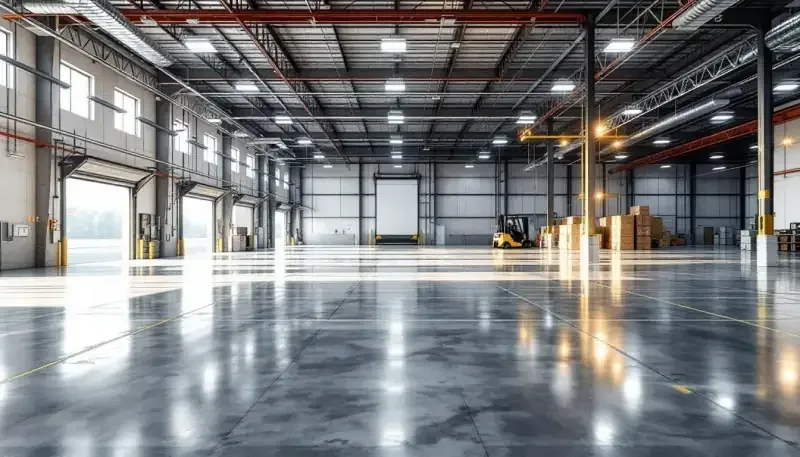
Warehouse & Industrial Floors in Prairie Village, KS
Prairie Village businesses deserve industrial floors built to the same high standard as the community itself. We pour warehouse slabs that handle heavy loads, forklift traffic, and decades of daily abuse without cracking under pressure.
Patch the Old Floor or Pour a New One — Which Makes Sense for Your Prairie Village Facility?
We hear it constantly from Prairie Village business owners: should I keep patching this failing floor or invest in a full replacement? The answer depends on what's happening beneath the surface. If your slab has widespread joint deterioration, random cracking, or moisture vapor issues, repairs are just expensive Band-Aids. A new engineered slab with proper subbase treatment and vapor mitigation solves the root cause. For facilities near Corinth Square or along Roe Ave, where property values and tenant expectations run high, a compromised floor drags down your entire operation.
On the other hand, localized damage from point loads or minor joint spalling can sometimes be addressed with targeted repairs and a densifier treatment. We evaluate every floor honestly. If a repair makes financial sense, we'll tell you. If your 1970s-era slab near Mission Road has outlived its useful life, we'll explain exactly why replacement is the smarter long-term investment. Since 2015, we've completed 377+ concrete projects across the Kansas City metro — and a good number of those started with this exact conversation.
Industrial-Grade Floors for Prairie Village's Evolving Commercial Landscape
Prairie Village may be known as Johnson County's residential jewel, but its commercial districts are quietly demanding more from their infrastructure. Distribution tenants near the Meadowbrook Retail Hub need floors that support heavy racking. Light manufacturing spaces along 83rd St require chemical-resistant surfaces. Even the boutique warehouse spaces near The Shops of Prairie Village are seeing increased forklift traffic as e-commerce fulfillment operations move closer to affluent zip codes. Each of these scenarios calls for a different slab design — and we engineer every floor to match the actual use case.
Our warehouse floors in Prairie Village typically range from 5-inch to 8-inch slabs, reinforced with fiber mesh, welded wire fabric, or rebar depending on your load requirements. We specify 4,500 to 6,000 PSI concrete mixes, select the joint layout around your racking plan, and install polyethylene vapor barriers where moisture testing warrants it. For automated operations, we achieve FF/FL flatness numbers that meet or exceed ACI 117 standards — critical if you're running narrow-aisle forklifts or automated guided vehicles.
Prairie Village's maintenance-centric approach to infrastructure means your floor should match the premium standards of the surrounding community. We apply lithium silicate densifiers or topical sealers based on your traffic type. Saw-cut joints are placed precisely to control cracking and align with column lines. The result is a floor that performs under load and looks sharp for years — no dusting, no random cracking, no curling at the joints.
Prairie Village-Specific Warehouse & Industrial Floors Considerations
Johnson County Clay Soils and Subbase Engineering
The expansive clay soils common throughout Johnson County create real problems under warehouse slabs. Seasonal moisture changes cause the clay to swell and shrink, which translates to differential settlement and slab cracking. We address this with a minimum 6-inch compacted granular subbase — often crushed limestone sourced locally from Johnson County quarries. For heavier load applications, we'll specify a stabilized subbase with lime or cement treatment. Proper compaction testing before the pour is non-negotiable. We verify density with a nuclear gauge to make sure the base won't shift under your racking loads.
High Property Value Standards in Commercial Zones
Prairie Village holds its commercial properties to an aesthetic and functional standard that most Kansas City suburbs don't. Facilities near Corinth Square and The Shops of Prairie Village face scrutiny from both the city and neighboring tenants. A warehouse floor that dusts, cracks prematurely, or develops drainage issues reflects poorly on your operation and your landlord. We build floors that meet the community's expectations — clean joint lines, proper slope to drains, and surfaces that stay sealed and presentable even under heavy industrial use.
Navigating Tight Commercial Lots and Neighboring Businesses
Prairie Village commercial properties tend to sit on compact lots with shared parking and close neighbors. Concrete trucks, pump trucks, and material staging require careful logistics planning. We coordinate delivery routes along Mission Road or Tomahawk Rd to avoid peak pedestrian hours in the village centers. Our crew stages materials to minimize disruption to adjacent tenants. If your building shares a wall or loading dock with another business, we plan the pour sequence to keep noise and vibration contained to scheduled windows.
Permitting and Code Compliance in Prairie Village
Interior warehouse floor replacement in Prairie Village typically requires a building permit, especially if you're modifying structural elements or altering drainage. Johnson County inspectors pay attention to ADA compliance at dock areas and fire lane access. We handle the permit application, provide engineered drawings when required, and schedule inspections at the right milestones. This keeps your project on track and avoids the costly delays that come from trying to navigate the process without experience in Prairie Village's specific requirements.
How We Build Warehouse Floors in Prairie Village — A Technical Walkthrough
Every project starts with a site evaluation. We core the existing slab to measure thickness, check reinforcement condition, and test for moisture vapor transmission using calcium chloride or relative humidity probes. We also probe the subgrade — Johnson County's clay content varies even within Prairie Village, and we need to know what we're building on before we spec the new slab. If we find organic fill or poorly compacted material, we design the subbase correction into the project scope upfront. No surprises during demolition.
Demolition and removal come next. Our crew uses skid steers with hydraulic breakers to saw-cut and remove the old slab in manageable sections. We haul debris to a Johnson County recycling facility — most old concrete gets crushed and repurposed as aggregate. Once the old floor is out, we fine-grade the subbase, add granular fill in lifts, and compact each layer to 95% Modified Proctor density. We verify with field testing. The vapor barrier goes down next — a 15-mil polyethylene membrane lapped and sealed at every seam. This step alone prevents the moisture problems that destroy warehouse floors from below.
For the pour itself, we source concrete from local Johnson County batch plants to keep transit times under 30 minutes. Short transit means consistent slump and workability. We place concrete using a laser screed for large open pours — this gives us the flatness tolerances that narrow-aisle and automated operations demand. For smaller pours or phased work, we use vibratory screeds and hand-finish around columns and dock pits. Joint sawing happens within 12 hours of placement, timed to concrete maturity and ambient temperature.
Curing and finishing are where good floors separate from great ones. We apply a spray-on curing compound immediately after finishing to lock in moisture for proper hydration. After the 28-day cure period, we come back with a lithium silicate densifier that hardens the surface and eliminates dusting permanently. If your operation requires additional chemical resistance or a high-gloss finish, we discuss epoxy or polyurethane topcoats tailored to your specific traffic and exposure. The floor is ready for light traffic in 72 hours and full forklift loads within 7 to 10 days depending on conditions.
From Crumbling Slab to Forklift-Ready Floor Near Countryside East
A distribution tenant occupying a 22,000-square-foot warehouse off Somerset Dr near the Countryside East neighborhood called us about chronic floor problems. The original slab — poured in the early 1980s — had extensive joint deterioration, random mid-panel cracks, and visible moisture staining along the south wall. Their narrow-aisle reach trucks were bouncing over uneven joints, damaging product and slowing pick rates. Two previous patch jobs had failed within a year.
We cored the slab in six locations and found the root cause: no vapor barrier, a compacted clay subgrade with zero granular base, and unreinforced 4-inch concrete that was never designed for modern warehouse loads. The fix required a full tear-out. We removed and recycled the old slab, excavated 8 inches of unsuitable subgrade, and installed a compacted limestone base with a 15-mil vapor barrier. The new 6-inch slab used 5,000 PSI concrete with welded wire reinforcement, laser-screeded to FF 32/FL 24.
The project was phased into three zones so the tenant could keep receiving shipments on the north side while we worked south to north. Total downtime per zone was 10 days. After the 28-day cure, we applied a lithium silicate densifier and sealed every joint with semi-rigid polyurea. The floor has been in service for over a year now — no cracks, no dusting, no joint failures. The tenant reported a measurable improvement in pick speed and a significant drop in product damage claims.
How Much Does Warehouse & Industrial Floors Cost in Prairie Village?
| Type | Cost / Sq Ft | Project Dependent |
|---|---|---|
| Standard Industrial Slab | $3–6 | Varies by scope |
| Polished Concrete | $5–10 | Varies by scope |
| Epoxy / Coating System | $4–8 | Varies by scope |
Warehouse floor costs in Prairie Village typically run $7 to $12 per square foot installed, depending on slab thickness, reinforcement, and finish specifications. Tight commercial lot access near Corinth Square or The Shops of Prairie Village can add modest logistics costs due to equipment staging constraints.
Warehouse & Industrial Floors FAQ for Prairie Village, KS
What PSI concrete do you recommend for a Prairie Village warehouse floor?
We typically specify 4,500 PSI for general warehousing and distribution use. Facilities with heavy racking point loads, cold storage requirements, or frequent forklift traffic may need 5,000 to 6,000 PSI mixes. The right specification depends on your actual operations — we evaluate your racking layout, vehicle types, and load weights before finalizing the mix design. Higher PSI adds modest cost per yard but significantly extends the floor's service life under heavy use.
How long does a full warehouse floor replacement take for a 15,000-square-foot facility?
A typical 15,000-square-foot warehouse floor replacement in Prairie Village takes 10 to 14 working days from demolition through final densifier application. That includes removal of the old slab, subbase preparation, vapor barrier installation, concrete placement, joint sawing, and initial curing. Weather and phasing requirements can extend the timeline. If you need to keep part of your facility operational during the project, we phase the work into sections — usually two or three zones — which adds roughly 3 to 5 additional days to the overall schedule.
Can your floors handle AGVs and robotic pallet movers?
Yes. Automated guided vehicles and robotic systems require tighter flatness tolerances than standard forklift operations. We pour to FF 35/FL 25 or higher using laser screed technology. These numbers meet the specs that most AGV manufacturers require for reliable navigation and sensor accuracy. We also discuss your specific equipment vendor's requirements before we finalize the floor design. Joint widths, slab levelness at transitions, and surface hardness all factor into a floor that keeps your automation running without sensor faults or wheel damage.
Do you offer a warranty on Prairie Village industrial floor projects?
We provide a written warranty on every warehouse floor we install. The standard coverage addresses structural cracking, joint failure, and surface defects resulting from materials or workmanship for a defined period based on the project scope. We also provide a maintenance guide that covers joint sealing schedules, densifier reapplication, and cleaning protocols. Proper maintenance extends floor life well beyond the warranty period. We've been in business since 2015 and stand behind our work — our 13 five-star Google reviews reflect that track record.
What time of year works best for pouring a warehouse floor in this area?
Spring and fall are ideal in the Johnson County area. Moderate temperatures between 50°F and 80°F give us the best control over concrete hydration and curing rates. Summer pours are manageable inside an enclosed warehouse since the building provides shade, but we adjust mix designs with retarders to compensate for heat. Winter pours require heated enclosures and insulated curing blankets, which add cost but are absolutely feasible. We've poured successfully in every month of the year across the Kansas City metro. The key is adjusting the approach to the conditions, not waiting for perfect weather.
Other Concrete Services in Prairie Village, KS
Request a Callback About Your Prairie Village Warehouse Floor
Leave your number and project details — our crew returns calls within two hours during business days. We serve all of Prairie Village and greater Johnson County, from Corinth Hills to Homestead and every commercial zone in between.