Warehouse & Industrial Floors in Overland Park, KS
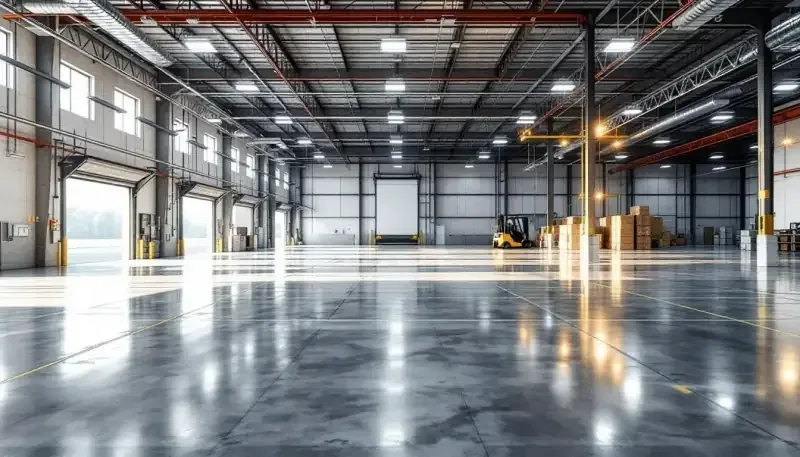
Your Overland Park distribution center deserves a floor that keeps forklifts rolling and inventory safe — not one that cracks under the weight of your growth.
Is Your Warehouse Floor Costing You More Than You Realize?
You walk into your Metcalf Corridor warehouse on a Monday morning and spot it — another curled joint edge catching your pallet jack wheels. Hairline cracks have turned into full fractures near the dock doors. Dust kicks up every time a forklift makes a turn. Your floor is bleeding concrete fines onto product, slowing operations, and creating safety hazards that keep your site manager up at night. This isn't cosmetic. It's costing real money in damaged goods, downtime, and liability exposure.
Overland Park warehouse operators face a specific set of floor challenges. Johnson County's clay-heavy subgrade shifts seasonally. High-volume facilities along US-69 and College Boulevard push slabs beyond their original design loads. D-cracking — a pattern Overland Park knows well from its older office parks — doesn't stay outside. It works its way into interior slabs too. We build industrial floors engineered for these exact conditions.
Industrial-Grade Floors Built for Overland Park's Busiest Facilities
We pour warehouse and industrial floors for distribution centers, manufacturing plants, cold storage facilities, and high-bay fulfillment operations across Overland Park. Our work spans the Bluhawk development corridor, the established commercial zones along 135th Street, and the corporate logistics hubs near I-435 and US-69. Every slab we install is designed around your operational reality — forklift traffic patterns, racking point loads, chemical exposure, and floor flatness requirements specific to your equipment.
Overland Park's building codes rank among the strictest in the metro. The city demands thorough permitting even for interior floor replacements in commercial buildings. We handle the permit process, coordinate inspections, and ensure every pour meets or exceeds the city's aggressive 50-plus year lifecycle targets for concrete infrastructure. Our 377 completed projects since 2015 include dozens of industrial floors across Johnson County.
From 5,000-square-foot maintenance bays in Oak Park Retail to 80,000-square-foot distribution slabs near Corporate Woods, we scale our crew and equipment to match the job. We install vapor barriers, joint sealants, densifiers, and surface hardeners as integrated components — not afterthoughts. The result is a floor that handles your loads, resists moisture migration, and stays flat under years of heavy use.
Overland Park-Specific Warehouse & Industrial Floors Considerations
Johnson County Clay Subgrade and Slab Performance
The expansive clay soils throughout Overland Park swell when wet and shrink when dry. This seasonal movement generates enormous upward pressure on slabs. We perform subgrade testing before every project and specify compacted aggregate bases — typically 6 to 8 inches of crushed limestone — to create a stable platform. On sites with severe clay near Wycliff or Westbrooke South, we sometimes over-excavate 12 inches and import engineered fill. Skipping this step is how warehouse floors fail in year three.
Forklift Traffic and Flatness Requirements Along the US-69 Corridor
Many Overland Park warehouses run narrow-aisle reach trucks or automated guided vehicles that demand FF50/FL30 or higher flatness and levelness numbers. Standard residential-grade finishing won't cut it. We use laser screed equipment and check floor profiles with digital profilometers during and after the pour. For facilities near the 135th to 159th Street corridors handling high-volume retail distribution, we often specify superflat pours in critical aisles to prevent racking sway and product damage.
Dock Door Transitions and Loading Bay Design
Overland Park's commercial buildings often feature multiple dock positions along a single wall. Each dock leveler, bumper, and approach apron must tie into the interior slab at precise elevations. We survey existing dock hardware before designing joint layouts and pour sequences. This prevents the lip-and-step problems that damage pallet jacks and create trip hazards. We also slope approach aprons for drainage without creating grade changes that stall loaded forklifts.
Strict Overland Park Permitting and Inspection Standards
Overland Park enforces some of the tightest construction codes in the Kansas City metro. Interior warehouse floor replacements typically require a building permit, structural engineering review, and multiple inspections. We prepare permit submittals with mix designs, reinforcement schedules, and subgrade compaction reports. Our crew coordinates inspection timing so we don't lose pour windows waiting on city staff. We've navigated the Overland Park permitting process on numerous projects and know what the inspectors expect.
How We Build Warehouse Floors in Overland Park — A Technical Walkthrough
Every project starts with a site visit where we assess the existing slab condition, subgrade type, and facility operations. We core the existing floor to check thickness, reinforcement, and moisture conditions. We probe the subgrade to determine clay content and compaction levels — critical in Johnson County where montmorillonite clays dominate. We also map your racking layout, forklift traffic patterns, and dock positions. This data drives our slab design, joint plan, and pour sequence.
Demolition comes next. We saw-cut the existing slab into manageable sections and remove it with skid steers and excavators. Debris goes into roll-off containers and gets hauled to certified recycling facilities near the I-435 corridor. Once the old concrete is out, we proof-roll the subgrade with a loaded truck to identify soft spots. Weak areas get excavated and replaced with compacted Class 3 aggregate. We then place and compact the full aggregate base in lifts, verifying density with nuclear gauge testing at multiple points across the floor area.
Before concrete arrives, we install polyethylene vapor barriers — typically 15-mil — lapped and sealed at every joint. Reinforcement goes in next: we use fiber-reinforced concrete for light-duty areas and welded wire fabric or rebar mats for heavy-load zones. Chairs and supports hold reinforcement at the correct elevation. We source our concrete from Johnson County batch plants to minimize transit time and ensure consistent slump and air content at the point of placement. Our standard mix for Overland Park industrial floors runs 4,500 to 5,000 PSI with a low water-to-cement ratio.
We place concrete using laser-guided screeds that maintain tight elevation tolerances across the full pour width. Our finishing crew follows immediately with power trowels, bringing the surface to the specified flatness. We cut contraction joints within 12 hours using early-entry saws — the joint layout matches your racking and column grid to keep cracks where they belong. After curing, we apply lithium silicate densifier and joint sealant. The finished floor is ready for light foot traffic in 24 hours and full forklift operations within 7 to 10 days, depending on conditions.
How Much Does Warehouse & Industrial Floors Cost in Overland Park?
| Type | Cost / Sq Ft | Project Dependent |
|---|---|---|
| Standard Industrial Slab | $3–6 | Varies by scope |
| Polished Concrete | $5–10 | Varies by scope |
| Epoxy / Coating System | $4–8 | Varies by scope |
Warehouse floor pricing in Overland Park typically runs $6 to $10 per square foot for a standard 6-inch slab with vapor barrier and densifier. Johnson County's clay subgrade conditions often require additional base preparation, which can add $1 to $2 per square foot depending on excavation depth and fill material requirements.
Warehouse & Industrial Floors FAQ for Overland Park, KS
What permits does Overland Park require for replacing a warehouse floor inside an existing building?
Overland Park typically requires a building permit for interior warehouse floor replacement, even when the building shell remains unchanged. The permit application needs a structural engineering review of the slab design, reinforcement schedule, and subgrade preparation plan. We handle the full submittal package. The city schedules inspections at subgrade, pre-pour, and final stages. Permit turnaround usually takes 10 to 15 business days. We factor this timeline into every project schedule so there are no surprises once demolition begins.
How does Johnson County's soil affect my warehouse slab long-term?
Johnson County sits on highly expansive clay that swells with moisture and contracts during dry spells. Without proper subbase engineering, this movement lifts slab edges, opens joints, and creates uneven surfaces that damage forklifts and racking. We mitigate this by over-excavating clay, importing compacted limestone aggregate, and installing moisture barriers that prevent water from reaching the subgrade. A properly built base turns a 15-year floor into a 30-plus year floor. Every site gets subgrade testing before we finalize the slab design.
Can you work around our second-shift operations?
Yes. Many Overland Park distribution centers along US-69 and College Boulevard run multiple shifts. We design phased pour sequences that isolate active zones from construction areas using temporary barriers and traffic control. Demolition and pouring happen during your lowest-activity windows. We coordinate with your operations manager weekly to adjust the schedule as needed. Noise-sensitive pours near occupied office spaces along the Metcalf Corridor get additional planning around city noise ordinance hours.
What's the difference between a surface densifier and an epoxy coating for my warehouse floor?
A densifier penetrates the concrete surface and chemically hardens it. It reduces dusting, improves abrasion resistance, and costs significantly less than epoxy. It works well for most dry-goods warehouses and distribution centers. Epoxy coatings create a thick, impermeable film on top of the concrete. They resist chemicals, make cleaning easier, and provide high-visibility color coding for safety zones. Epoxy costs roughly two to three times more per square foot than densifier. We recommend epoxy for food processing, chemical storage, and facilities where spill containment matters. For standard pallet storage and forklift operations, densifier handles the job.
Other Concrete Services in Overland Park, KS
Warehouse & Industrial Floors in Nearby Cities
Request a Callback About Your Warehouse Floor Project
Leave your contact info and project details. Our crew responds within one business day and serves all of Overland Park — from the Bluhawk corridor to Corporate Woods and every commercial zone in between.