Warehouse & Industrial Floors in Lenexa, KS
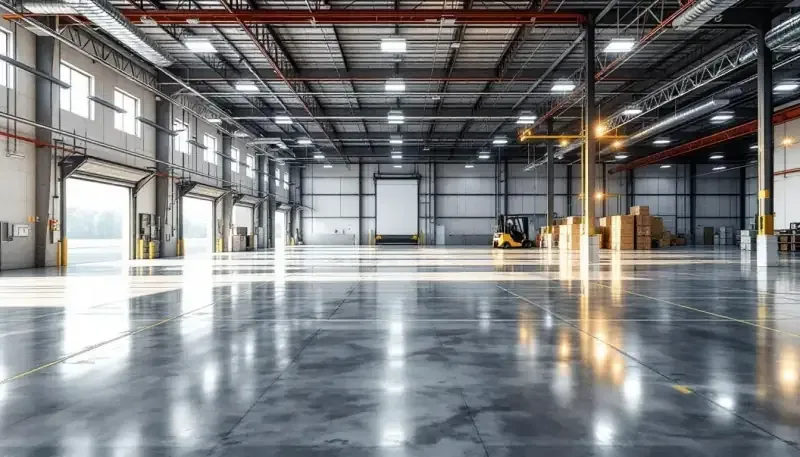
Your Lenexa warehouse floor is the most abused surface in your entire operation. We build floors that absorb that punishment for decades — from Greystone Industrial Park to the Logistics Park corridor.
What Does a New Warehouse Floor Actually Cost in Lenexa?
Let's talk numbers first. A warehouse floor replacement in Lenexa typically runs $5.50 to $8.50 per square foot for a standard 6-inch reinforced slab. That range depends on demolition scope, subbase condition, and whether your facility sits on the sandy loam near I-35 or the heavier clay soils common around the College West Business Park corridor. Material costs in Johnson County run slightly above the national average because ready-mix plants serving the KC metro charge a premium during peak construction months — usually April through October.
Labor is the other major cost driver. Lenexa sits in one of the tightest construction labor markets in Kansas. Our crew handles the full scope in-house, which eliminates subcontractor markups that inflate bids from general contractors by 15 to 25 percent. For a 20,000-square-foot facility in Pine Ridge Business Park, you're looking at a total project cost between $110,000 and $170,000 depending on floor specs and demolition complexity.
The cheapest floor is rarely the smartest investment. A distribution center on Lackman Road running loaded forklifts 16 hours a day needs a different slab than a light assembly shop near Renner Boulevard. We design every floor around your actual loads, traffic patterns, and equipment layout. That prevents the premature joint failures we routinely see in Lenexa's newer commercial plazas — where value-engineered concrete is already cracking after five years.
The real cost question isn't what you'll spend. It's how long the floor performs before it needs major maintenance. A properly designed and installed industrial floor in Lenexa should give you 25 to 30 years of service. We've completed 377 projects since 2015, and our approach to subbase prep and joint design is specifically calibrated for Johnson County conditions.
Industrial Floor Solutions Built for Lenexa's Logistics Corridor
Lenexa's Logistics Park corridor along Lackman Road and Renner Boulevard handles some of the heaviest commercial traffic in the KC metro. That means the warehouse floors in this area take constant abuse from loaded semi-trailers, pallet jacks, and reach trucks operating around the clock. We pour floors rated for point loads exceeding 10,000 pounds per post, using fiber-reinforced concrete with strategic rebar placement that matches your racking layout exactly. Every joint is planned to fall between rack uprights — never underneath them.
Greystone Industrial Park and Pine Ridge Business Park present different challenges. Many of these buildings date from the 1990s and early 2000s, and their original slabs are showing classic signs of wear: dusting surfaces, curled joints, and random cracking from inadequate subbase compaction. We perform full geotechnical evaluation before bidding these projects. If the existing subbase is salvageable, we compact and re-grade it rather than hauling in all new material. That saves you money without compromising the finished floor.
For newer facilities near City Center and the 87th Street Parkway corridor, we often see buildings with relatively young floors that are already failing. The culprit is usually poor joint design combined with Lenexa's freeze-thaw cycling. We address this with proper isolation joints at column lines, contraction joints at 12-to-15-foot spacing, and high-quality polyurea joint fill that flexes with seasonal temperature changes instead of pulling apart.
Lenexa-Specific Warehouse & Industrial Floors Considerations
Heavy Truck Traffic on Lackman Road and Renner Boulevard
If your facility sits along the Logistics Park corridor, your floor doesn't just support interior operations — it connects to exterior truck courts that experience constant heavy vehicle movement. We design the transition zones between your dock aprons and interior slab to handle the concentrated stress where trailers brake and turn. This area is where most warehouse floors fail first. Our approach uses thickened-edge slabs and doweled joints at dock door thresholds, preventing the settlement and spalling that plagues facilities on these high-traffic routes.
Joint Failure Patterns in Lenexa's Commercial Construction
Johnson County has a documented pattern of premature joint failure in commercial concrete — the City Center retail plazas are a visible example. In warehouse settings, the consequences are worse. Failed joints destroy forklift wheels, create safety hazards, and allow moisture infiltration that erodes the subbase. We use armored joints in high-traffic aisles and diamond-dowel load transfer systems at critical intersections. Our joint layout is engineered around your specific equipment paths rather than defaulting to a generic grid pattern.
What Your Warehouse Floor Timeline Looks Like in Lenexa
Days 1-3: Demolition and removal. Our crew uses skid steers with hydraulic breakers to saw-cut and remove the existing slab in sections. We haul debris to a Johnson County-approved recycling facility. If your operation needs to keep running, we phase the demolition into zones so you maintain partial warehouse access throughout. Dust control barriers go up on day one.
Days 4-6: Subbase preparation. We excavate to design depth, proof-roll the subgrade with a loaded truck to find soft spots, and compact new aggregate base in lifts. Lenexa building permits for interior floor replacement typically take 5 to 7 business days — we submit during demolition so there's no gap. Vapor barrier installation and rebar/mesh placement happen once the subbase passes compaction testing.
Days 7-9: Concrete placement. We pour in alternating strips or checkerboard panels, depending on your facility layout. A 20,000-square-foot floor usually requires two to three pour days. Our crew starts at 5 AM to take advantage of cooler morning temperatures during Lenexa's summer months. Laser screeds maintain FF/FL flatness numbers that meet or exceed your spec requirements.
Days 10-14: Curing and joint cutting. We wet-cure for a minimum of seven days using curing compound and moisture-retaining blankets. Contraction joints are saw-cut within 6 to 12 hours of placement to control cracking. During this phase, we install joint filler and apply surface densifier if specified. No traffic of any kind during this period — it's the most important phase for long-term performance.
Days 15-21: Phased return to service. Light foot traffic resumes around day 10. Forklift traffic at day 21 minimum. Racking installation can begin at day 14 for lighter systems, but we recommend waiting the full 28-day cure before applying heavy point loads. We provide a written return-to-service schedule tailored to your equipment weights so there's zero guesswork.
How Floor Needs Differ Across Lenexa's Commercial Zones
Greystone Industrial Park features buildings from the late 1980s and 1990s with original 4-inch slabs that were never designed for today's heavier racking loads and forklift traffic. Most floors here need full replacement rather than repair. The subbase is typically stable — compacted limestone aggregate that has settled over decades — but it needs re-grading and proof-rolling before a new pour. These projects move quickly because the existing infrastructure is straightforward.
The Logistics Park corridor along Lackman Road and Renner Boulevard hosts newer distribution centers with 30,000-plus-square-foot footprints. The soil here tends toward silty clay, which requires more aggressive subbase treatment. We typically excavate 8 to 12 inches below slab depth and install compacted AB-3 aggregate to create a stable platform. These facilities also demand heavier floor specs — 6-inch slabs minimum with 6,000 PSI concrete and fiber reinforcement to handle constant loaded truck traffic.
Old Town Lenexa and areas near College West Business Park present a different scenario entirely. Smaller warehouse and flex spaces from the 1960s and 1970s often have deteriorated slabs with no vapor barrier and minimal reinforcement. Renovation projects here frequently uncover subbase issues including organic fill material that was common in that era's construction. Budget an extra two days for these projects — the subbase work is unpredictable until we open up the floor.
How Much Does Warehouse & Industrial Floors Cost in Lenexa?
| Type | Cost / Sq Ft | Project Dependent |
|---|---|---|
| Standard Industrial Slab | $3–6 | Varies by scope |
| Polished Concrete | $5–10 | Varies by scope |
| Epoxy / Coating System | $4–8 | Varies by scope |
Lenexa warehouse floor projects typically range from $5.50 to $8.50 per square foot, with ready-mix concrete costs running higher during peak season due to demand from Johnson County's active commercial construction market along the I-35 and K-10 corridors.
Warehouse & Industrial Floors FAQ for Lenexa, KS
Does Lenexa require a building permit for replacing a warehouse floor inside my existing building?
Yes. The City of Lenexa requires permits for structural concrete work inside commercial buildings, even when you're replacing an existing floor. The permit review process through Johnson County typically takes 5 to 7 business days. We handle the full submittal package including engineered drawings, mix design specifications, and a site plan. Our crew submits during the demolition phase so the permit is approved before we're ready to pour. There's no downtime waiting on paperwork.
How do you handle moisture under warehouse slabs in Lenexa?
We install a 15-mil vapor barrier directly beneath the slab, lapped and sealed at all seams. This is critical in Lenexa because the water table in parts of the Logistics Park corridor and areas near Little Mill Creek can push moisture upward through a slab that lacks protection. Moisture vapor transmission causes adhesive failures under coatings, damages stored inventory, and creates that white efflorescence buildup on the surface. We tape-test the existing subgrade moisture levels before pouring to confirm our barrier spec is adequate for your specific site.
Can you install floor flatness specs high enough for automated guided vehicles?
Absolutely. AGVs and autonomous mobile robots require FF 50/FL 30 or higher, depending on the manufacturer's spec sheet. We achieve these numbers using laser-guided screeds and power trowel finishing protocols. For facilities in Greystone Industrial Park and Pine Ridge that are converting to automated operations, we map out the AGV travel paths and prioritize flatness in those corridors. Random traffic areas can be held to a lower standard, which reduces cost where it doesn't matter.
What's the best time of year to pour a warehouse floor in Lenexa?
The ideal window is late March through mid-November. Summer pours require early morning starts to beat the heat, which accelerates set times and can cause plastic shrinkage cracking. We've poured successfully in every month of the year, but winter pours in December through February require heated enclosures and insulated blankets that add roughly 10 to 15 percent to project cost. If your schedule is flexible, the sweet spots are April through May and September through October when temperatures are moderate and rain is less frequent.
Will you coordinate with our racking vendor on anchor bolt placement?
Yes, and we strongly recommend it. We need your racking layout before we finalize joint locations. Anchor bolts that land on or near a contraction joint will fail — the joint moves, the bolt loosens, and you've got a racking safety issue. We coordinate directly with your racking installer to position every anchor bolt in the center of a slab panel. If you're using post-installed anchors drilled after the pour, we ensure slab thickness and reinforcement placement support the pullout loads your racking system requires.
How do you minimize disruption to neighboring tenants in a Lenexa business park?
We stage equipment and materials to avoid blocking shared drives, especially in tight parks like Pine Ridge and College West where parking and truck access are limited. Demolition noise is contained to daytime hours per Lenexa's municipal code. Dust barriers seal your space from adjacent tenants. Concrete trucks are scheduled in tight windows to prevent queuing on access roads. We notify neighboring businesses of our schedule before we start. On projects along busy routes like 87th Street Parkway, we coordinate truck routing to stay off peak commuter lanes during morning and evening rush.
Other Concrete Services in Lenexa, KS
Warehouse & Industrial Floors in Nearby Cities
Get Your Free Warehouse Floor Estimate in Lenexa
Tell us about your facility — square footage, current floor condition, and what you're running on it. We'll visit your site near Greystone, Pine Ridge, or anywhere in Lenexa and deliver a detailed written estimate within 48 hours.