
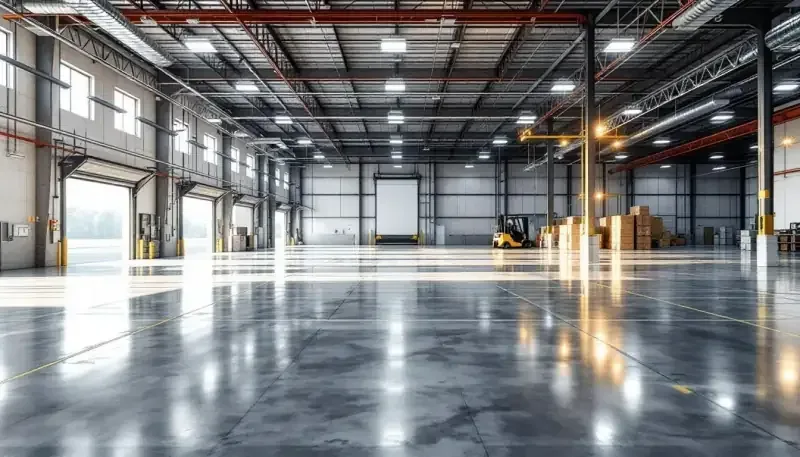
Warehouse & Industrial Floors in Shawnee, KS
The K-7 Industrial Corridor keeps growing, and your warehouse floor needs to keep up with every loaded pallet jack rolling across it.
Is Your Shawnee Warehouse Floor Slowing Down Your Operation?
Summer heat in Johnson County means one thing for warehouse operators: it's prime pouring season. Warm, stable temperatures between June and September give concrete the ideal curing window. If your facility along the K-7 corridor or Shawnee Mission Parkway is dealing with cracked, dusting, or uneven floors, right now is when you lock in your project. Crews book fast through fall, and waiting until October means working against tighter weather margins.
Shawnee's western industrial expansion has brought distribution centers, fulfillment operations, and manufacturing shops into the K-7 corridor at a pace that outstrips most Johnson County cities. Many of these buildings sit on slabs poured in the late 1990s or early 2000s — floors that have taken two decades of forklift traffic, point loads from racking systems, and seasonal temperature swings. The wear shows up as joint deterioration, surface delamination, and uneven slabs that slow down material handling.
We've completed 377+ concrete projects since 2015, and a significant share of that work happens inside active commercial buildings. Our crew understands how to phase a warehouse floor replacement so your operation doesn't grind to a halt. Every project starts with a detailed facility assessment tailored to your Shawnee property, your equipment loads, and your operational schedule.
What a Shawnee Industrial Floor Project Actually Involves
Warehouse floors aren't residential slabs poured thicker. They're engineered systems designed to handle specific load profiles, traffic patterns, and environmental conditions. In Shawnee, that means accounting for Johnson County's clay-heavy soils, the logistics-heavy truck traffic along K-7, and whatever your forklifts, pallet jacks, or automated systems demand from the surface. We design mix specifications, joint layouts, and reinforcement schedules around your actual operation — not a generic template.
Most of our Shawnee industrial floor work falls into two categories: full slab replacement for aging facilities and new construction pours for buildings going up in the western expansion zones. Full replacements involve sawcutting, demolition, hauling, subbase preparation, and a fresh pour with modern mix designs. New construction pours let us build the floor system from scratch with optimized vapor barriers, reinforcement, and joint placement that matches your racking plan from day one.
Surface finishing matters more than most operators realize. A burnished steel-trowel finish resists forklift tire wear. Densifiers harden the surface against dusting. Proper joint spacing and sealing prevent the edge spalling that plagues floors in high-traffic aisles. We specify the right combination based on what rolls across your floor and how your facility operates day to day.
Shawnee-Specific Warehouse & Industrial Floors Considerations
K-7 Corridor Access and Logistics Scheduling
The K-7 Industrial Corridor handles heavy logistics traffic throughout the day. Concrete trucks, pump trucks, and demolition haulers need clear access to your facility without disrupting neighboring operations or blocking truck docks. We coordinate material deliveries during off-peak windows and stage equipment to avoid conflicts with your inbound and outbound freight schedule. For facilities near Shawnee Mission Parkway intersections, we plan routes that keep concrete trucks off congested commuter corridors during morning and evening rush.
Aging Subbases Under 1990s-Era Slabs
Many Shawnee warehouses along Shawnee Mission Parkway and the older commercial strips were built on subbases that have shifted or deteriorated over 25 years. Johnson County's expansive clay soils amplify the problem — moisture cycling causes heave and settlement that cracks slabs from below. When we tear out an old floor, we evaluate the existing subbase with compaction testing. If the material has degraded, we remove it and install properly graded and compacted aggregate before pouring. Skipping this step guarantees premature cracking.
Johnson County Permitting for Interior Floor Work
Shawnee falls under Johnson County jurisdiction for commercial building permits. Interior floor replacement inside an existing building typically requires a permit if structural modifications are involved — which includes changes to slab thickness, reinforcement, or load capacity. We handle the permit application process and coordinate any required inspections. If your project triggers a review by the city's planning department, especially in the Downtown Shawnee commercial zone, we manage that timeline so it doesn't stall your construction schedule.
From First Call to Finished Floor: Your Shawnee Project Journey
It starts with a phone call. You describe what's happening with your floor — maybe the joints are blowing out in your high-traffic aisles, or your new racking vendor says the slab can't handle the point loads they need. We ask about your facility size, your operation type, and your timeline. Within a few days, one of our contractors is on-site at your Shawnee building, walking the floor with a straightedge, checking joint conditions, and identifying where the real problems live beneath the surface.
During the site visit, we look at everything the floor touches. Loading dock transitions, column spacing, drain locations, existing utility trenches, and your racking layout. If your building sits along the K-7 corridor, we check access points for concrete trucks and pump placement. We take measurements, photograph problem areas, and discuss phasing options so your warehouse can keep operating during the project. You get a detailed proposal within a week — not a ballpark guess, but an engineered scope with mix specs, joint layout drawings, and a day-by-day schedule.
Pour day is controlled chaos done right. Our crew arrives early, and the concrete trucks roll in on a precise schedule. For a typical 15,000-square-foot warehouse section, we're placing, screeding, and finishing in a single continuous operation. Laser screeds keep the surface within tight flatness tolerances. Finishing crews follow immediately behind, applying the specified trowel and densifier treatment. Curing compounds go on before the surface loses moisture. The entire pour moves like a production line because it has to — concrete doesn't wait.
A few days later, we're back to saw-cut control joints at the engineered locations, seal the joints, and do a final flatness check. We walk the floor with you, point out every detail, and give you a clear timeline for when you can start moving equipment and racking back in. Most Shawnee warehouse clients are running forklifts on their new floor within seven to ten days of the pour.
How Much Does Warehouse & Industrial Floors Cost in Shawnee?
| Type | Cost / Sq Ft | Project Dependent |
|---|---|---|
| Standard Industrial Slab | $3–6 | Varies by scope |
| Polished Concrete | $5–10 | Varies by scope |
| Epoxy / Coating System | $4–8 | Varies by scope |
Warehouse floor costs in Shawnee typically range from $6 to $12 per square foot depending on slab thickness, reinforcement, and demolition scope. Facilities in the K-7 corridor with tight access or phased pours will land on the higher end due to logistics coordination and smaller batch placements.
Warehouse & Industrial Floors FAQ for Shawnee, KS
What permits does Shawnee require for warehouse floor replacement?
Most interior floor replacements in Shawnee require a commercial building permit through the city's planning and development department, especially if you're changing slab thickness or structural capacity. We handle the application and coordinate required inspections. Permit timelines typically run two to three weeks for straightforward projects. If your building is in the Downtown Shawnee overlay district, additional review may apply. We build permit lead time into your project schedule so it doesn't cause delays.
How do you handle the clay soils under Shawnee warehouse buildings?
Johnson County's expansive clay is a known problem for slab-on-grade construction. When we remove an existing floor, we test the exposed subgrade for compaction and moisture content. If the clay has swelled or softened, we over-excavate and replace it with compactable granular fill — typically six to eight inches of crushed limestone, compacted in lifts and verified with a nuclear density gauge. This creates a stable, non-expansive base that won't heave under your new slab. For new construction sites in western Shawnee, we often recommend a moisture-conditioned subgrade treatment.
Can you phase the project so our warehouse stays partially operational?
Yes. Phased pours are standard for active Shawnee facilities. We divide the floor into sections and work one area at a time while your operation continues in the remaining space. Joint locations between phases are engineered so the final floor performs as a unified system. Most clients maintain 60 to 75 percent of their usable floor space throughout the project. We coordinate each phase around your shipping schedule, especially for K-7 corridor distribution operations with fixed delivery windows.
What concrete strength do you specify for Shawnee warehouse floors?
Most warehouse and distribution floors we pour in Shawnee use a 5,000 PSI mix design with a low water-to-cement ratio for durability and reduced shrinkage cracking. For facilities with heavy point loads from narrow-aisle racking or automated systems, we may specify 6,000 PSI or add fiber reinforcement alongside conventional rebar or welded wire. The mix design also accounts for Johnson County's freeze-thaw exposure at dock areas and overhead doors where the slab meets exterior conditions.
How flat will my new warehouse floor be?
We pour to FF 35/FL 25 or better for standard warehouse operations, which meets the requirements for conventional forklifts and pallet jacks. If you're running narrow-aisle turret trucks or automated guided vehicles, we can achieve FF 50/FL 30 or higher using laser screed technology. We measure flatness with an F-meter within 72 hours of the pour and provide you with certified floor flatness reports. These numbers matter for equipment warranties and insurance requirements on high-value automated systems.
What's the typical project timeline for a 20,000-square-foot Shawnee warehouse floor?
A full tear-out and replacement of a 20,000-square-foot floor in Shawnee typically takes three to four weeks from demolition to final cure, assuming a two-phase approach. Demolition and hauling takes three to five days per phase. Subbase preparation adds two to three days. Each pour phase is a single day. Curing requires seven days minimum before light traffic. If your facility needs a three- or four-phase approach to maintain operations, add a week or two. Permitting and material scheduling usually require two to three weeks of lead time before we break ground.
Do you warranty your Shawnee warehouse floor work?
We provide a written warranty covering materials and workmanship. The standard warranty covers cracking beyond normal control joint behavior, surface delamination, and joint failure for a defined period based on project scope. We also provide you with complete documentation including mix design tickets, compaction test results, flatness reports, and curing records. These records protect you during equipment vendor negotiations, lease discussions, and insurance reviews. Every project gets a final walkthrough where we review the entire floor with you before closeout.
Other Concrete Services in Shawnee, KS
Warehouse & Industrial Floors in Nearby Cities
Schedule Your Free Shawnee Facility Assessment
We'll walk your warehouse floor, evaluate joint conditions, check for subbase issues, and assess your load requirements — all specific to your Shawnee operation. Call today to get on the summer schedule before crews book through fall.