
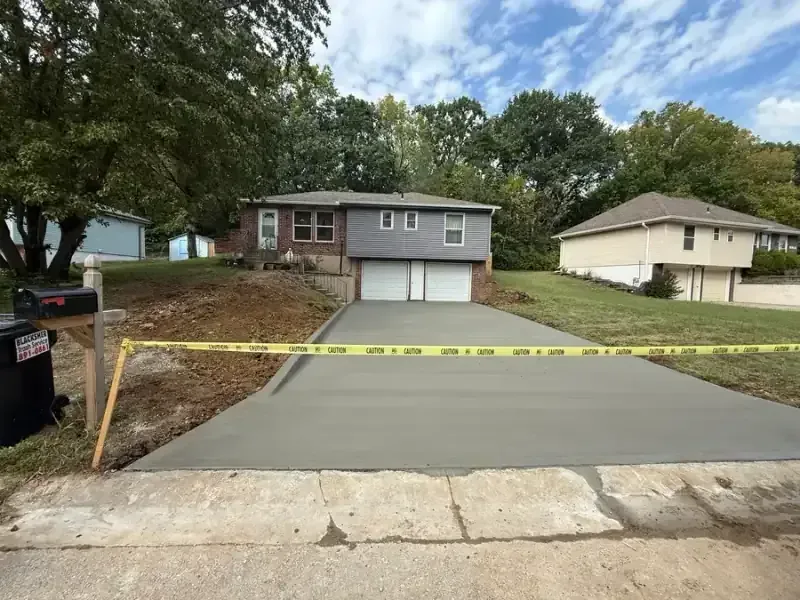
Concrete Driveways in Shawnee, KS
Your Shawnee neighbors in Grey Oaks and Monticello aren't patching anymore — they're pouring fresh concrete that handles K-7 commuter wear and Johnson County winters without flinching.
Patch It Again or Pour It Right — What Makes More Sense for Your Shawnee Driveway?
We hear it every week from homeowners along Midland Drive and in Woodland Park: should I keep patching this driveway or just replace the whole thing? If your slab is from the 1990s or early 2000s — and most Shawnee driveways are — you're probably past the point where crack filler does any real good. Patching buys you a season. A properly poured replacement gives you 25 to 30 years. The math favors starting fresh once you hit three or more major cracks per panel.
Some folks also weigh concrete against asphalt. Asphalt is cheaper upfront by a few dollars per square foot. But Shawnee's 2026 Neighborhood Revitalization push is raising property standards across older subdivisions, and concrete adds measurably more curb appeal and resale value. It also holds up better under the freeze-thaw cycles we get in Johnson County. We've poured 377-plus projects since 2015, and the driveways we installed in our first year still look solid.
What a New Concrete Driveway Actually Does for a Shawnee Home
A concrete driveway is the first thing visitors see and the last thing you think about — until it starts failing. In Shawnee neighborhoods like Lake Quivira and Grey Oaks, homes sit on lots that were graded for drainage decades ago. Over time, soil movement and root intrusion shift those original grades. A new pour lets us correct slope issues, direct water away from your garage, and restore a clean, level surface that matches your home's character.
Shawnee sits in a corridor of heavy daily commuting. Vehicles pulling in and out along Shawnee Mission Parkway and Quivira Road put real stress on residential slabs. We pour a minimum four-inch thickness for standard residential driveways and go to five or six inches at the apron and where vehicles turn. Fiber mesh reinforcement is standard on every Shawnee pour. Rebar goes in on longer runs or where we see softer subgrade conditions.
Finish options range from a clean broom texture to exposed aggregate and stamped patterns. Many homeowners near Shawnee Town 1929 and the downtown corridor choose decorative borders to complement older architecture. We also pour extra-wide pads and turnarounds for families who need space beyond a standard two-car width. Every project includes saw-cut control joints placed to manage cracking before it starts.
Shawnee-Specific Concrete Driveways Considerations
Johnson County Clay and Subgrade Prep
Shawnee sits on heavy clay soil that expands when wet and contracts when dry. This seasonal movement is the number-one reason older driveways crack. Before we pour, we excavate to a stable depth and lay a compacted aggregate base — typically four to six inches of AB-3 limestone. Proper compaction eliminates voids beneath the slab and gives the concrete a stable platform that resists heaving through Johnson County's freeze-thaw cycles.
HOA and Neighborhood Standards
Subdivisions like Monticello and Grey Oaks often have HOA guidelines covering driveway width, finish, and even color. We review your covenants before finalizing the design. If your HOA requires a specific look — say, a broom finish with a stamped border — we build that into the quote from day one. No surprises at the architectural review stage.
Street Apron and Public Sidewalk Transitions
Shawnee's public right-of-way rules govern the section of driveway between your property line and the street. Many homes along Quivira Road and Midland Drive have sidewalks that bisect the driveway. We handle the full run — from garage slab to curb cut — so the grade, thickness, and finish are consistent. We coordinate any required city inspections and pull the permit so you don't have to chase paperwork.
Mature Landscaping and Access Logistics
Shawnee's older neighborhoods have established trees, irrigation lines, and narrow side yards. A loaded concrete truck weighs around 40 tons, so we plan the approach carefully. We use plywood mats to protect turf and confirm clearance from overhead branches and utility lines before pour day. If your street is tight — common in the blocks near Clear Creek Park — we stage the truck on the nearest accessible point and use chutes or a pump to reach the forms.
How We Build Concrete Driveways in Shawnee
Every project starts with a site visit where we measure the existing slab, check grade and drainage paths, and probe the soil depth. Johnson County clay is predictable but not uniform — some Shawnee lots near creek beds have softer pockets that need extra excavation. We mark utility lines through Kansas 811 and note any irrigation or landscape features that need protection. This assessment drives the engineering of your specific pour, not a cookie-cutter spec sheet.
Demolition comes next. We saw-cut the old slab into manageable sections, load the debris into roll-off containers, and haul it to a local recycling yard in Johnson County. Once the old concrete is gone, we excavate to the required depth and grade the subbase for drainage — typically a quarter-inch per foot of fall away from the garage. Then we lay and compact AB-3 crushed limestone sourced from quarries in the southern KC metro. Compaction happens in lifts with a plate compactor, and we verify density before setting forms.
Forms go in using steel stakes and dimensional lumber, checked for level and alignment at every joint. We place fiber mesh throughout and add rebar at the apron and any section wider than 12 feet. On pour day, we use a local Johnson County ready-mix supplier — our standard residential mix is 4,000 PSI with air entrainment for freeze-thaw resistance. We screed, bull-float, and then apply your chosen finish while the surface is still workable. Control joints get saw-cut within 12 hours.
After the pour, we apply a curing compound to slow moisture loss. We keep traffic off the slab for at least seven days. Before we leave, we backfill along the edges, clean up the site, and walk you through a simple maintenance plan — mostly keeping deicers off the surface for the first winter and applying a quality sealer after 30 days. The whole process, from demolition to driving on your new driveway, typically runs 7 to 10 working days for a standard two-car Shawnee driveway.
How Much Does Concrete Driveways Cost in Shawnee?
| Type | Cost / Sq Ft | Typical 600 Sq Ft |
|---|---|---|
| Standard Gray (Broom Finish) | $8–12 | $4,800–$7,200 |
| Colored / Stained | $10–15 | $6,000–$9,000 |
| Exposed Aggregate | $10–16 | $6,000–$9,600 |
| Stamped / Decorative | $12–18 | $7,200–$10,800 |
Most Shawnee residential driveways fall between $6 and $10 per square foot for a standard broom finish, with stamped or decorative options running higher. Johnson County disposal fees and the depth of clay excavation on your specific lot are the two biggest variables that shift the final number.
Concrete Driveways FAQ for Shawnee, KS
Does Shawnee require a permit for a residential driveway replacement?
Yes. The City of Shawnee requires a right-of-way permit if your driveway crosses a public sidewalk or connects to a city street. Most replacements fall under this rule. We handle the permit application, pay the fee upfront, and schedule any required inspections. The process typically adds two to five business days before we can start demolition, depending on the city's current workload.
How long will my new Shawnee driveway last compared to the one from the '90s?
Concrete technology and installation practices have improved significantly since the 1990s. Many Shawnee driveways from that era were poured at 3,500 PSI without air entrainment, which makes them vulnerable to freeze-thaw spalling. We pour at 4,000 PSI with six percent air entrainment as standard. Combined with proper subgrade compaction and fiber mesh reinforcement, you should expect 25 to 30 years of solid performance with basic maintenance — sealing every three to five years and avoiding harsh chemical deicers during the first winter.
Can you match a new driveway to my existing stamped patio or walkway?
We can get very close. Concrete color is affected by mix design, weather on pour day, and curing conditions, so an exact match to aged concrete isn't physically possible. What we do is select the same stamp pattern and integral color, then adjust the release agent to complement the weathered tone of your existing work. Most homeowners in neighborhoods like Grey Oaks and Monticello find the match blends well within a few months as the new concrete cures and weathers slightly.
What if my lot slopes toward the garage instead of away from it?
This is more common in Shawnee than you'd think, especially on lots near Clear Creek Park and in older subdivisions where settling has changed the original grade. We re-establish proper drainage by adjusting the subgrade during excavation. In some cases we install a trench drain at the garage threshold as a secondary safeguard. The goal is a minimum quarter-inch-per-foot slope carrying water toward the street or a designated drainage swale, not toward your foundation.
Do you pour driveways in winter months in Shawnee?
We can pour in late fall and early winter when daytime temperatures stay above 40 degrees Fahrenheit for at least three consecutive days after the pour. We use hot water in the mix and apply insulated blankets over the fresh slab to maintain curing temperature. January and February in Johnson County are usually too cold and unpredictable. Most Shawnee homeowners find that scheduling between March and early December gives us the best conditions and avoids weather delays.
Other Concrete Services in Shawnee, KS
Concrete Driveways in Nearby Cities
Request a Callback About Your Shawnee Driveway
Leave your number and a few details about your project. We return calls within one business day and serve all Shawnee neighborhoods — from Lake Quivira to Woodland Park and everywhere along the K-7 corridor.