Warehouse & Industrial Floors in Bonner Springs, KS
Bonner Springs runs on heavy industry and high-traffic logistics. Your warehouse floor should handle both without cracking under pressure.
Is Summer Event Season Already Stressing Your Warehouse Floor?
Summer in Bonner Springs means two things: scorching heat and massive traffic surges. Between Azura Amphitheater concerts and the tourist rush along K-7, your warehouse operation runs harder than ever. That seasonal spike exposes every crack, spall, and joint failure in aging industrial floors. If your forklift operators are dodging damaged sections right now, you're losing money every shift.
Here's the timing reality. Pouring warehouse concrete in Kansas summer heat requires precise scheduling — early morning pours, rapid curing protocols, and crews who know how to manage hydration in 95-degree temps. Fall bookings fill fast once facility managers start planning around cooler weather. The smart move is locking in your project now, before our September-through-November window disappears.
We've completed 377+ concrete projects across the Kansas City metro since 2015. Bonner Springs Industrial Park, the K-7 Retail Corridor, downtown facilities — we know this town's soil, its infrastructure challenges, and the permitting process inside Wyandotte County. Our 13 five-star Google reviews reflect that local knowledge in every slab we pour.
Industrial-Grade Floors Built for Bonner Springs Operations
Bonner Springs may have a small-town feel, but its industrial footprint is serious. Facilities along K-7 and near I-70 handle heavy distribution, manufacturing, and logistics operations daily. These floors endure constant forklift traffic, pallet jack abuse, and point loads from fully stacked racking systems. We engineer every slab for the actual loads your operation puts on it — not some generic spec sheet.
The city's Smart Infrastructure Maintenance Program flagged industrial lots near K-7 as 'Late-Life' for good reason. Decades of subbase failure on older industrial access roads tell the same story underground. Your warehouse floor sits on that same Wyandotte County soil. We address what's beneath the slab as aggressively as what goes on top of it, because a 5,000 PSI floor means nothing over a failed subbase.
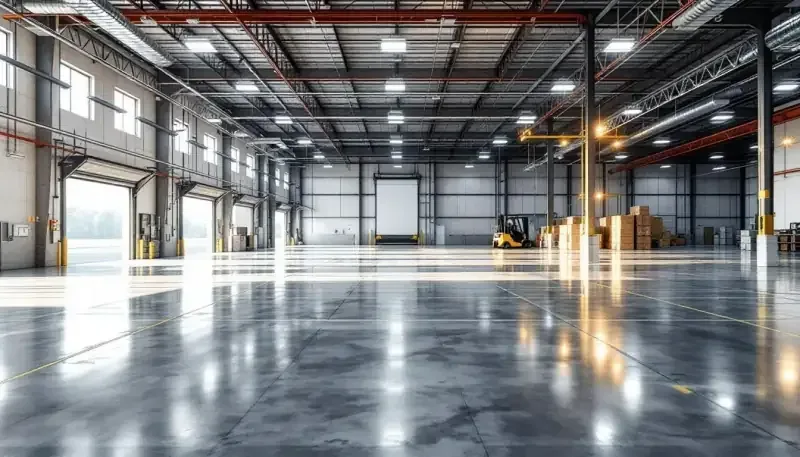
Our warehouse floors include fiber reinforcement, vapor barriers, proper joint layout for your racking configuration, and surface densification as standard practice. We build floors for distribution centers, manufacturing plants, cold storage facilities, and flex-space warehouses throughout the Bonner Springs Industrial Park and surrounding commercial zones.
Bonner Springs-Specific Warehouse & Industrial Floors Considerations
Wyandotte County Clay and Subbase Instability
The heavy clay soils across Wyandotte County expand and contract dramatically between wet springs and dry summers. Older industrial sites near K-7 often have compromised subbase material from decades of heavy truck loading without proper compaction. We proof-roll every subbase with loaded equipment before pouring. If we find soft spots — and in Bonner Springs, we usually do — we over-excavate and replace with compacted Class 5 aggregate. Skipping this step is why so many local warehouse floors develop random mid-panel cracking within five years.
Heavy Industrial and Commuter Traffic Vibration
Your building doesn't exist in isolation. Significant truck and commuter traffic on K-7 and I-70 generates ground vibration that transfers through soil into your foundation. Facilities within a quarter mile of these corridors experience micro-vibrations that accelerate joint deterioration over time. We account for this with thicker edge sections, doweled construction joints, and reinforcement detailing that resists fatigue cracking from repeated vibration loading.
Aging Industrial Park Infrastructure
The Bonner Springs Industrial Park includes facilities dating back several decades. Many original floor slabs were poured to specs that don't meet modern load requirements — thinner sections, no vapor barriers, minimal reinforcement. If your building was constructed before the 1990s, there's a strong chance your floor lacks the joint spacing and subbase prep that current standards demand. We assess the existing conditions and design a replacement that actually matches what your operation needs today.
Seasonal Scheduling Around Event Traffic
Bonner Springs transforms during summer event season. Traffic along K-7 and US-40 spikes dramatically during Azura Amphitheater events and the Renaissance Festival season. Concrete delivery trucks and equipment mobilization get caught in that congestion. We schedule material deliveries and equipment moves during early morning hours or off-peak windows to avoid delays. For facilities near the K-7 Retail Corridor, we coordinate pour days around known event schedules to keep your project on track.
How We Build Warehouse Floors in Bonner Springs — A Technical Walkthrough
Every project starts with a site visit where we core the existing slab and test the subbase. In Bonner Springs, we're usually looking at 8 to 14 inches of clay-heavy native soil beneath whatever aggregate was originally placed. We bring in a geotechnical probe if the building is near the Kansas River floodplain or in the older sections of the Industrial Park. This tells us exactly how deep we need to excavate and what compaction density the replacement aggregate must hit. We don't guess on subbase — we verify it with loaded proof-rolling before a single yard of concrete arrives.
We source our concrete from batch plants within 20 minutes of Bonner Springs, which matters more than most people realize. Short haul times mean consistent slump, better workability, and no emergency water additions that weaken the mix. Our standard warehouse spec is 5,000 PSI with synthetic macro-fiber reinforcement, though we'll bump to 6,000 PSI with welded wire or rebar for heavy manufacturing loads. The vapor barrier goes down as a 15-mil membrane, sealed at every seam, directly under the slab. Wyandotte County's high water table makes this non-negotiable.
Pour day is choreographed down to the minute. Our crew runs laser screed equipment for FF/FL flatness numbers that meet or exceed ACI 117 standards — critical if you're running narrow-aisle forklifts or planning future automation. We cut contraction joints within 4 to 12 hours using early-entry saws, following a layout we've already coordinated with your racking vendor or facility manager. Joint spacing is calculated for your specific slab thickness, not defaulted to some generic 12-foot grid.
Curing gets the same attention as the pour. We apply a lithium-based densifier and curing compound that penetrates the surface, hardens the top layer, and dramatically reduces dusting. In summer pours, we may also use evaporation retarders to prevent plastic shrinkage cracking — a real risk during Kansas July and August when wind and heat conspire against fresh concrete. Your floor is typically ready for foot traffic in 48 hours and forklift traffic in 7 to 10 days, depending on ambient conditions.
How Much Does Warehouse & Industrial Floors Cost in Bonner Springs?
| Type | Cost / Sq Ft | Project Dependent |
|---|---|---|
| Standard Industrial Slab | $3–6 | Varies by scope |
| Polished Concrete | $5–10 | Varies by scope |
| Epoxy / Coating System | $4–8 | Varies by scope |
Warehouse floor pricing in Bonner Springs typically runs $6 to $10 per square foot for a full replacement, depending on subbase condition and slab thickness. The aging subbase common in the Industrial Park near K-7 often requires over-excavation, which adds to the scope but prevents costly failures down the road.
Warehouse & Industrial Floors FAQ for Bonner Springs, KS
What flatness specs should I expect for my Bonner Springs warehouse floor?
We pour to a minimum FF 35/FL 25 for standard warehouse operations, which handles conventional forklifts and pallet jacks without issues. If you're running narrow-aisle turret trucks or planning automated guided vehicles, we target FF 50/FL 30 or higher using laser screed equipment. We measure flatness with a Dipstick profiler after every pour and provide you with documented results. These numbers are part of your project deliverables, not just a verbal promise.
Do I need a Wyandotte County permit for interior warehouse floor work?
Yes, in most cases. Wyandotte County's Unified Government requires a building permit for structural floor replacement even inside an existing building. The permit process typically takes 5 to 10 business days. We handle the application, structural drawings, and any required inspections. If your facility is in the Bonner Springs Industrial Park, there may be additional site plan review depending on how material staging and concrete truck access affect adjacent properties. We manage all of this so it doesn't slow your project.
How do you handle moisture testing before pouring a new slab?
We perform calcium chloride tests and relative humidity testing on the existing subgrade before designing the vapor barrier system. Bonner Springs sits near the Kansas River with a relatively high water table, especially in facilities closer to K-32 and the floodplain areas. Moisture vapor emission rates above 3 lbs per 1,000 square feet per 24 hours require a heavy-duty 15-mil vapor barrier with taped seams. We always install a vapor barrier regardless, but testing tells us if additional drainage or subbase venting is needed. Skipping this step is the number one cause of coating failures and surface delamination on industrial floors.
Can you match new floor sections to our existing slab elevation?
Absolutely. Phased pours and partial replacements require precise elevation matching at construction joints. We shoot existing floor elevations with a rotary laser before demolition and set forms to match within 1/16 inch. Transition joints get doweled and sealed to prevent differential movement. This is especially common in Bonner Springs facilities where one section of floor has failed but the rest is still serviceable. We make the transition seamless for forklift traffic.
What's the full timeline from first call to forklifts rolling on the new floor?
For a typical 15,000 to 25,000 square foot warehouse floor in Bonner Springs, plan on 6 to 8 weeks total. That includes the site assessment, permitting through Wyandotte County's Unified Government, demolition, subbase preparation, pouring, and curing. The actual concrete work usually takes 2 to 3 weeks depending on whether we're phasing the project to keep part of your operation running. Curing adds another 7 to 10 days before full forklift loads are allowed. We build a detailed schedule at project kickoff so your logistics team can plan around every milestone.
Other Concrete Services in Bonner Springs, KS
Request a Callback About Your Warehouse Floor
Drop your info and we'll call you back within one business day. We serve Bonner Springs, the Industrial Park, K-7 corridor, and every commercial zone in Wyandotte County.