
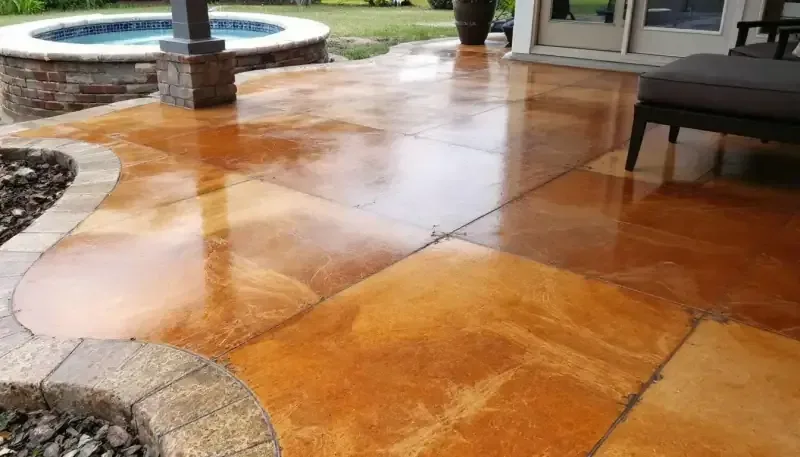
Stained & Colored Concrete in Bonner Springs, KS
Your Bonner Springs home deserves more than plain gray. We transform existing slabs and pour new colored concrete that holds up to Wyandotte County's freeze-thaw reality — and actually looks better with age.
What Does Stained Concrete Actually Cost in Bonner Springs?
Let's talk numbers first. Basic concrete staining in Bonner Springs runs $4 to $8 per square foot for most residential projects. Acid stains sit at the higher end. Water-based stains cost less but offer more color options. A typical 300-square-foot patio staining project lands between $1,200 and $2,400 all in, including surface prep, stain application, and sealer. New integral colored concrete pours run $8 to $14 per square foot depending on the finish you want.
Those prices reflect Bonner Springs realities. Labor costs here track slightly lower than overtown in Johnson County, but material delivery adds a bit since most concrete suppliers run trucks from KCK or Lenexa along K-7. The clay-heavy soil common across Saratoga Park and Oak Hills means we sometimes need extra surface prep on older slabs that have shifted or developed hairline cracks from subgrade movement.
Color choice also affects your bottom line. A single-tone acid stain on your existing patio is the most affordable route. Layered staining with multiple colors, scoring patterns, or stained borders around a new colored concrete pour adds labor hours. We always price these separately so you see exactly what each design element costs before committing.
Since 2015 we've completed 377 or more residential concrete projects across the Kansas City metro. Our 13 five-star Google reviews reflect honest pricing conversations like this one. No hidden fees. No surprise upcharges on stain day. You get a written quote before we touch your slab.
How Stained & Colored Concrete Works in a River Town
Bonner Springs sits where the Kansas River meets heavy clay soils and seasonal moisture swings. That combination matters for stained concrete. Acid stains react chemically with the lime content in your slab, creating translucent, marbled tones that won't peel or flake. Water-based stains penetrate the surface and offer solid, opaque colors from warm terracotta to cool slate gray. Both methods work beautifully here — but the sealer selection is critical. We use penetrating sealers rated for Wyandotte County's freeze-thaw cycles, not cheap film-forming products that blister after one winter.
Integral colored concrete is a different animal entirely. The pigment gets mixed into the concrete before we pour, so the color runs all the way through. If your slab chips fifteen years from now, you still see color — not gray underneath. This is ideal for new driveways along K-32, front walkways in Tiblow Mills, or backyard patios where you want permanent color without maintenance beyond periodic resealing.
We handle both approaches and frequently combine them. A popular option in Bonner Springs is pouring a new integral colored concrete patio with a contrasting acid-stained border. The two methods complement each other and create depth you can't get with stamped concrete alone. Every project starts with a color consultation using actual concrete samples — not paper swatches that look nothing like the real thing.
Bonner Springs-Specific Stained & Colored Concrete Considerations
High-Moisture Soil and Slab Preparation in River-Adjacent Neighborhoods
Homes in Alden and along K-32 near the Kansas River floodplain sit on soil with high moisture content. That moisture migrates upward through older concrete slabs via capillary action. If we stain over a slab that's wicking moisture, the stain won't bond properly and the sealer will cloud or peel within months. We test every slab with a moisture meter before starting. Slabs reading above 4.5 pounds per 1,000 square feet get a vapor-mitigating primer first. This adds a day and roughly $1.50 per square foot to your project — but it's the difference between a stain job that lasts eight years and one that fails in eight months.
Event Season Traffic and Timing Your Project
Bonner Springs hosts massive crowds at Azura Amphitheater and the Kansas Renaissance Festival grounds from May through October. If your home sits near K-7 or US-40, traffic congestion during event weekends can complicate material delivery and crew access. We schedule residential staining projects in these corridors on weekday windows when traffic is manageable. The upside: fall and early spring are actually ideal staining weather in Wyandotte County. Temperatures between 50 and 80 degrees give stains the best reaction time and cure conditions. Booking outside peak event season often means faster scheduling and better results.
What Your Stained & Colored Concrete Timeline Looks Like
Day 1: Surface Preparation. Our crew arrives early and moves furniture, planters, and grill equipment off your patio or driveway. We pressure wash the slab and address any cracks, spalling, or old sealer residue. In Bonner Springs, most older slabs in Saratoga Park and Sunningdale have some degree of surface wear from decades of freeze-thaw. Grinding and patching takes four to six hours. Your driveway or patio is off-limits from this point forward.
Day 2: Stain Application. This is the transformation day. Acid stains go down in the morning and need six to eight hours of uninterrupted reaction time. We tape off adjacent surfaces, protect landscaping, and apply the stain in controlled sections. Water-based stains dry faster — about two to three hours per coat — and we can apply multiple coats the same day. Temperature matters here. Bonner Springs summer afternoons above 90 degrees can flash-dry water-based stains unevenly, so we often start at 7 AM.
Day 3: Neutralize and Clean (Acid Stain Only). Acid stains require a baking soda rinse to neutralize the chemical reaction. We scrub, rinse, and let the slab dry completely. This step reveals the final color. It always looks different wet versus dry — we'll walk you through what to expect before you see it for the first time. The slab needs 12 to 24 hours of dry time before sealing, weather dependent.
Day 4: Sealer Application. We roll on two coats of a high-performance penetrating sealer. Each coat needs three to four hours to cure. Light foot traffic is safe 24 hours after the final coat. Vehicle traffic on driveways should wait 72 hours. We mark your slab with caution tape and leave you a written care sheet with exact timing based on current Bonner Springs weather conditions.
Day 5-7: Full Cure Window. Your stained concrete reaches full hardness and chemical stability within seven days. During this window, avoid dragging heavy furniture across the surface and keep garden hoses pointed away from the slab. After seven days, your patio or driveway is fully operational. Total household disruption: about four days of restricted access, with the heaviest impact on days one and two.
Stained Concrete Across Bonner Springs: A Neighborhood-by-Neighborhood Look
Saratoga Park and downtown-adjacent homes were largely built in the 1950s through 1970s. Patios and walkways here are often original pours — 50 to 70 years old with surface wear, minor scaling, and decades of embedded dirt. These slabs are excellent staining candidates after proper grinding and cleaning. The porous, aged surface actually absorbs acid stain deeply and produces rich, variegated color that newer concrete can't replicate. We've transformed several Saratoga Park patios into showpiece spaces for under $2,000.
Oak Hills and Tiblow Mills feature newer construction from the 1990s and 2000s. Slabs here are generally in good structural condition but tend to have smoother, denser finishes that require etching before stain will penetrate. The clay subgrade in Oak Hills creates more seasonal slab movement than Tiblow Mills, where builders used thicker gravel subbases. We adjust our prep approach accordingly. Homeowners in these neighborhoods often request integral colored concrete for new pours — matching earth tones popular in newer Bonner Springs developments.
Alden sits closest to the Kansas River and deals with the highest ambient moisture levels in Bonner Springs. Concrete slabs here frequently test high for moisture vapor transmission. We almost always apply a moisture-mitigating primer before staining in Alden. The extra step adds cost but prevents sealer failure. Alden homeowners also benefit from darker stain colors — deep browns and charcoals — that mask the subtle mineral efflorescence common on river-adjacent concrete surfaces.
How Much Does Stained & Colored Concrete Cost in Bonner Springs?
| Type | Cost / Sq Ft | Typical 300 Sq Ft |
|---|---|---|
| Acid Stain (Existing Concrete) | $4–8 | $1,200–$2,400 |
| Water-Based Stain (Existing) | $3–6 | $900–$1,800 |
| Integral Color (New Pour) | $10–15 | $3,000–$4,500 |
Stained concrete pricing in Bonner Springs reflects moderate Wyandotte County labor rates and the slightly higher material delivery costs from KCK and Lenexa suppliers running trucks along K-7. Expect $4-$8 per square foot for staining existing slabs and $8-$14 per square foot for new integral colored concrete pours.
Stained & Colored Concrete FAQ for Bonner Springs, KS
How does Bonner Springs' clay soil affect my existing patio slab before staining?
Clay-heavy soil across much of Bonner Springs — especially in Oak Hills and Alden — expands and contracts with moisture changes. This movement can cause hairline cracks and minor slab settling over time. Before staining, we inspect your slab for structural integrity and repair any cracks. Hairline cracks actually absorb more stain and often become a design feature, creating darker accent lines. Larger cracks get filled with color-matched patching compound. If your slab has heaved more than half an inch, we'll tell you honestly whether staining makes sense or whether a new colored concrete pour is the better investment.
Will stained concrete fade from the intense sun my Sunningdale backyard gets?
Acid stains are mineral-based and chemically bonded into the concrete surface. They don't fade from UV exposure the way paint or surface coatings do. Water-based stains have improved dramatically but can lighten slightly in full-sun exposures over five to seven years. The sealer does most of the UV protection work. We use sealers with UV stabilizers rated for Kansas sun exposure. Resealing every three to four years keeps the color locked in and the surface protected. Most Sunningdale patios we've worked on still look sharp after multiple summers.
Can you stain my driveway even though it gets heavy daily use from my I-70 commute?
Absolutely. Driveways along the I-70 corridor in Bonner Springs take serious daily wear. The key is proper sealer selection. We use commercial-grade penetrating sealers that resist tire marks, road grime, and deicing salt tracked in from the highway. Acid stains are embedded in the concrete itself, so they don't wear off from tire friction the way a surface coating would. We recommend resealing driveway surfaces every two to three years — more frequently than patios — because of the heavier abrasion. With that maintenance schedule, your stained driveway will hold its color for a decade or more.
What stain colors pair well with the brick exteriors common in older Bonner Springs homes?
Older homes near downtown Bonner Springs and in Saratoga Park frequently feature red or brown brick. We steer those homeowners toward earthy acid stain tones — walnut, cola, and English red — that complement warm brick without competing with it. Cool gray or charcoal water-based stains also create striking contrast against red brick. During your color consultation, we bring actual stained concrete samples to hold against your home's exterior. Picking colors from a screen or paper swatch never tells the full story. Natural light and your specific brick tone make a huge difference.
Do I need a permit to stain or pour colored concrete at my Bonner Springs home?
Staining an existing slab is cosmetic work and requires no permit in Bonner Springs. New colored concrete pours may require a permit depending on scope. Replacing a driveway or adding a new patio over 200 square feet typically triggers a permit review through Wyandotte County. Permit turnaround averages five to seven business days. We handle the application and inspection scheduling so you don't have to navigate the process yourself. The permit fee for most residential flatwork projects runs $50 to $100.
How soon after a new concrete pour can you apply stain?
New concrete needs a minimum of 28 days to cure before acid staining. This gives the slab time to reach full strength and allows excess moisture to evaporate. Staining too early traps moisture under the sealer and causes clouding or adhesion failure. Water-based stains can sometimes go down at 21 days in warm, dry conditions, but we rarely rush it. If we're pouring new integral colored concrete with a stained border accent, we plan the timeline so the base pour cures fully before the stain phase begins. In Bonner Springs, summer pours cure faster than fall pours due to higher ambient temperatures.
Other Concrete Services in Bonner Springs, KS
Get Your Free Stained Concrete Estimate in Bonner Springs
We'll come to your Bonner Springs home, test your slab, and walk you through color options with real concrete samples — not paper swatches. One visit, one honest quote, no surprises on project day.