Concrete Overlays & Resurfacing in Bonner Springs, KS
Your Bonner Springs driveway or patio doesn't need a full tearout. A professional overlay can restore worn concrete surfaces to better-than-new condition — often in just a couple of days.
Is Your Bonner Springs Concrete Looking Rough After Another Kansas Summer?
Summer in Bonner Springs pushes concrete hard. Between the 95-degree days and the sudden thunderstorms that roll through the Kansas River valley, surface damage accelerates fast. Spalling, flaking, and discoloration that seemed minor in spring can look a lot worse by August. If your driveway or patio has crossed that line from 'a little worn' to 'embarrassing,' fall is the ideal window to act. Cooler cure temperatures and lower humidity give overlays the best bond strength of the year.
Booking now means your project lands in our fall schedule before demand spikes. We see a surge of calls every September from homeowners in Oak Hills, Tiblow Mills, and Sunningdale who spent summer staring at damaged concrete. The reality is that good fall weather in Wyandotte County only lasts through mid-November. After that, nighttime temps drop below the 40-degree threshold most overlay products require. A call this week puts you ahead of the rush.
Since 2015, we've completed 377+ concrete projects across the Kansas City metro, with 13 five-star Google reviews backing up our work. Bonner Springs is a town we know well — the soil conditions along the river bottoms, the freeze-thaw cycles that punish exposed slabs, and the heavy event traffic that wears down surfaces near the amphitheater and fairgrounds. We understand what your concrete is up against.
How Concrete Overlays Bring Bonner Springs Slabs Back to Life
A concrete overlay is a thin cementitious or polymer-modified layer applied directly over your existing slab. It bonds mechanically and chemically to the old surface, creating a new wear layer that's typically three-eighths to a half-inch thick. For Bonner Springs homeowners, this means transforming a spalled driveway or a faded patio without the cost, noise, or multi-day disruption of a full removal and repour. The old concrete stays in place — it just gets a new face.
Resurfacing works especially well on the 1980s and 1990s-era slabs common in neighborhoods like Saratoga Park and Alden. Those slabs were typically poured at four inches with decent subbase prep. The structural concrete underneath is usually still sound, even if the surface has deteriorated from decades of freeze-thaw cycles and deicing salt. We evaluate every slab for structural soundness before recommending an overlay. If the base has failed, we'll tell you — and we'll explain alternatives honestly.
Finish options range from a clean broom texture to decorative stamped and stained patterns. Many Bonner Springs homeowners choose a flagstone or slate stamp for patios and a simple knockdown texture for driveways. Color matching is precise enough to complement your home's existing stone or brick. The result is a surface that resists UV fading, handles Kansas weather, and looks like a fresh pour — at roughly 40 to 60 percent of the cost.
Bonner Springs-Specific Concrete Overlays & Resurfacing Considerations
High-Volume Event Traffic Near the Amphitheater and Fairgrounds
If your home sits along K-32 or near Azura Amphitheater, your driveway and walkways absorb more abuse than a typical residential slab. Concert and Renaissance Festival traffic means street vibration, extra vehicles parked on your apron, and foot traffic across your sidewalks. We specify higher-PSI overlay mixes and add fiber reinforcement for properties in these high-traffic corridors. The goal is a surface that handles the punishment of 10,000-person event weekends without chipping or delaminating within a few seasons.
Kansas River Valley Moisture and Freeze-Thaw Cycling
Bonner Springs sits in the Kansas River floodplain, and that proximity to water means higher ambient moisture than homes just a few miles south on higher ground. Concrete surfaces near the river absorb more water, and when January freeze-thaw cycles hit — sometimes swinging 40 degrees in 12 hours — that moisture expands and contracts inside the pore structure. Our overlay system includes a moisture-mitigating primer coat that reduces water penetration by over 90 percent. This is non-negotiable for slabs in Tiblow Mills and the lower Saratoga Park areas.
Aging Subbase Conditions in Pre-2000 Bonner Springs Homes
Many residential slabs in Bonner Springs were poured over compacted fill during the town's mid-century growth period. Over decades, that fill settles unevenly — especially in the clay-heavy soils east of K-7. Before any overlay, we test for subbase stability using a simple deflection check. If we find a section that's rocking or has void space underneath, we stabilize it with polyurethane foam injection first. Skipping that step would mean the overlay cracks within a year. We'd rather fix it once.
What to Expect During Your Bonner Springs Overlay Project
On project day, our crew arrives early — typically between 7:00 and 7:30 a.m. We'll park our truck and trailer along the street or in your driveway apron, depending on access. In neighborhoods like Sunningdale and Oak Hills where streets are narrower, we coordinate parking so your neighbors aren't blocked. Material mixing happens on-site with a portable mixer, so you'll hear some noise for the first hour. No concrete truck is needed for most residential overlays — the material comes in bags, mixed to exact water ratios on your property.
Preparation is where most of the time goes. We grind the existing surface with a diamond grinder to create a rough profile for bonding. This is loud — roughly leaf-blower volume — and generates fine dust, which we control with a vacuum shroud. Any cracks get routed and filled with a flexible polyurea joint filler. Expansion joints are honored and re-cut into the new surface. If your slab has a section that's settled, we'll lift it with foam injection before the overlay goes down. This prep phase usually takes half the total project time.
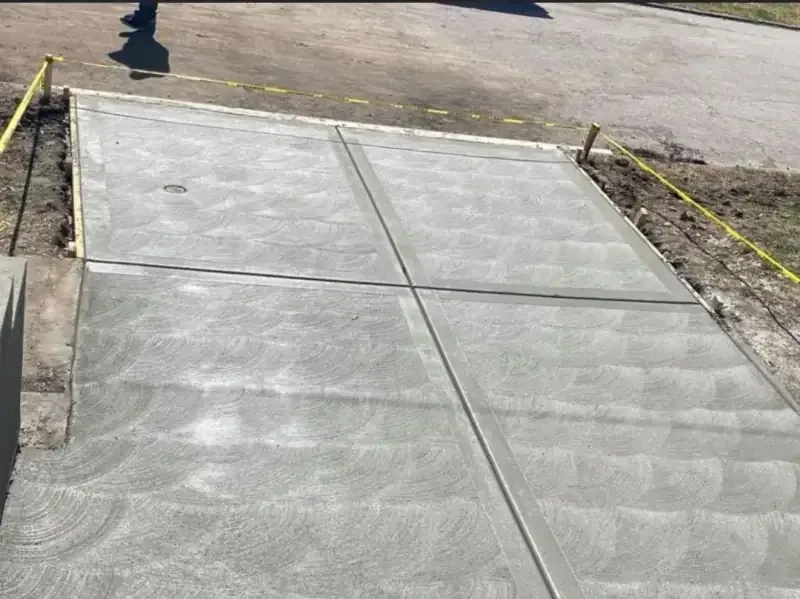
Once prep is complete, we apply a bonding primer and then the overlay material itself. Application is fast — a typical two-car driveway takes about two hours to coat and texture. If you chose a decorative stamp or stain, that happens while the material is still workable. You'll see the transformation in real time. We finish with a curing compound that protects the surface while it hardens. Wyandotte County does not require a permit for residential overlay work that doesn't alter drainage or footprint, so there's no inspection delay.
You can walk on the surface in about 24 hours. Vehicle traffic is safe after 48 to 72 hours depending on temperatures. We'll leave you with specific care instructions for the first two weeks, including when to avoid dragging heavy items across the surface. A follow-up sealer application is recommended at the 30-day mark, and we schedule that before we leave your property.
A Tiblow Mills Patio Gets a Second Life Before Fall Entertaining Season
A homeowner on Morse Avenue in the Tiblow Mills neighborhood called us about a backyard patio that had seen better days. The original slab was poured in 1994 — a basic gray broom-finish pour that had developed surface scaling across about 60 percent of the area. Years of ice-melt application had accelerated the deterioration. The edges nearest the house had minor spalling where a downspout had been directing water onto the concrete for over a decade. The homeowner wanted the patio ready for a family reunion in early October.
We started with a full surface grind to remove the loose scaling and create a bonding profile. Two small sections near the downspout corner sounded hollow when tapped, indicating voids below. We injected polyurethane foam to stabilize those areas before proceeding. The downspout was redirected into a splash block aimed toward the yard — a five-minute fix that prevents the same problem from recurring. After priming, we applied a polymer-modified overlay in a warm sandstone color with a hand-troweled slate texture.
The finished patio looked nothing like the original. The homeowner gained a surface that matched the limestone accents on the house, with a texture that's slip-resistant even when wet from the evening sprinkler overshoot. Total project time was two days — one for prep and stabilization, one for overlay application and texturing. The family reunion happened on schedule, and the patio handled 30 guests without a scratch.
How Much Does Concrete Overlays & Resurfacing Cost in Bonner Springs?
| Type | Cost / Sq Ft | Typical 300 Sq Ft |
|---|---|---|
| Basic Resurfacing | $5–8 | $1,500–$2,400 |
| Decorative Overlay | $8–12 | $2,400–$3,600 |
| Micro-Topping / Skim Coat | $6–10 | $1,800–$3,000 |
Most Bonner Springs residential overlays fall between $3 and $7 per square foot, depending on surface prep and finish selection. Properties near the river bottoms sometimes require extra subbase stabilization, which adds $1 to $2 per square foot for foam injection.
Concrete Overlays & Resurfacing FAQ for Bonner Springs, KS
Do I need a permit for a residential overlay in Bonner Springs?
Wyandotte County does not require a building permit for cosmetic resurfacing that doesn't change the slab footprint, thickness by more than an inch, or alter drainage patterns. A standard overlay at three-eighths to one-half inch falls well within that range. If your project involves adding square footage — like extending a patio — that's different and may require a permit. We'll flag this during the initial consultation if it applies to your situation.
My Saratoga Park driveway has a long diagonal crack and some corner spalling. Is it too damaged?
Probably not. Diagonal cracks typically indicate minor subbase settlement, not structural failure. We route the crack, fill it with flexible polyurea, and apply the overlay over it. The joint filler moves with the slab so the crack doesn't telegraph through. Corner spalling is surface damage — exactly what overlays are designed to fix. We'd need to check that the slab isn't rocking or hollow-sounding, which would indicate a void below. If it's solid when you walk on it, you're almost certainly a candidate.
How does the overlay handle salt and deicers in winter?
Our overlay systems are rated for freeze-thaw exposure and resist calcium chloride and magnesium chloride deicers. We do recommend avoiding rock salt with dye additives, which can stain lighter-colored finishes. The sealed surface sheds water rather than absorbing it, which is the primary defense against freeze-thaw damage. We apply a penetrating sealer at the 30-day mark that adds another layer of chemical resistance. Resealing every two to three years keeps that protection at full strength.
Can the overlay handle my boat trailer sitting on it all winter?
Yes. Point loads from trailer jacks and tongue stands are the main concern, not the trailer tires. We recommend placing a plywood pad or rubber mat under the jack foot to distribute the weight. A standard overlay cures to 4,000-plus PSI compressive strength, which handles static loads well beyond what a residential trailer produces. If you're regularly parking heavy equipment — like a loaded landscape trailer — let us know during the consultation so we can spec a higher-performance mix.
What finish works best for a patio that gets direct afternoon sun?
Lighter colors reflect more heat and stay more comfortable underfoot. A sandstone or buff-toned knockdown texture is popular with Bonner Springs homeowners because it stays cooler than dark grays or charcoal stains. Stamped patterns with texture — like flagstone or travertine — also help because the surface isn't perfectly flat, reducing skin contact area. We can bring color samples during the consultation so you can see how each option looks against your home's exterior.
I live off K-7 and the vibration from truck traffic shakes my house. Will that affect the overlay?
Traffic vibration from K-7 is real — we've seen it in homes along Nall Ave and the streets bordering the industrial park. The good news is that an overlay bonded to a stable slab moves as a single unit with the existing concrete. Vibration doesn't create shear forces at the bond line the way thermal cycling does. We use fiber-reinforced mixes in high-vibration areas as extra insurance. The bigger risk is if vibration has already caused your slab to crack or settle. We evaluate that during prep and address it before the overlay goes on.
How long until the color starts fading?
Integral color in the overlay mix holds up well for five to seven years before any noticeable lightening occurs. UV exposure is the main factor, so south-facing driveways and open patios fade slightly faster than shaded areas. A quality acrylic sealer blocks UV penetration and keeps colors vivid. We recommend resealing every two to three years — it's a simple process that takes an hour for a typical driveway. Stain-based color systems tend to last longer than surface-applied color hardeners, and we'll recommend the best option for your specific exposure.
Other Concrete Services in Bonner Springs, KS
Schedule Your Free On-Site Consultation in Bonner Springs
During the visit, we'll inspect your slab, check for subbase issues, show you finish and color samples in your actual lighting, and give you a written estimate — typically within 48 hours of the walkthrough.