Warehouse & Industrial Floors in Leavenworth, KS
Leavenworth's warehouses run on concrete that can take a beating. We pour floors built for the loads your operation actually moves — not guesswork from a spec sheet.
What's Happening Under Your Warehouse Floor on Limit Street?
Drive down Limit Street toward the Leavenworth Business & Industrial Park and you'll pass rows of distribution centers, machine shops, and storage facilities that keep this city running. Behind those roll-up doors, forklifts hammer the same concrete paths eight hours a day. Floors that were poured decades ago — some dating back to the 1960s — are cracking, dusting, and holding back your throughput.
We've watched Leavenworth's industrial corridors evolve since we started in 2015. The daily workforce surge toward Fort Leavenworth sends thousands of vehicles through the US-73 and K-7 corridor, and the businesses along that route need floors that handle heavy traffic without constant patching. Spalling, reflective cracking, and uneven joints aren't cosmetic problems. They slow your operation and create liability.
Our crew has completed 377-plus commercial concrete projects across the Kansas City metro. Thirteen five-star Google reviews back up what Leavenworth County facility managers already know — we pour warehouse floors that perform for decades, not just through the next inspection cycle.
Industrial-Grade Concrete Floors for Leavenworth's Busiest Facilities
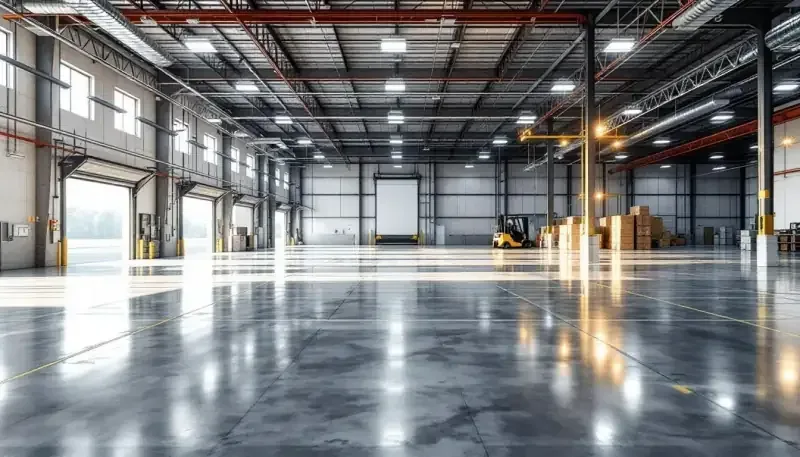
Leavenworth's warehouse stock sits in a mature lifecycle. Many slabs in the Industrial Park and along the 4th Street Retail Corridor were poured when Eisenhower was still in office. We tear out failed concrete, address compromised subbases, and install new high-strength slabs designed for modern loading. That means 5,000-plus PSI mixes, fiber or rebar reinforcement matched to your rack layout, and vapor barriers that stop moisture migration from Leavenworth County's clay-heavy subgrade.
Joint layout matters as much as the concrete itself. We coordinate directly with your racking vendor, material handling consultant, or facility engineer to place control joints and construction joints where they won't conflict with anchor bolts, AGV paths, or forklift traffic lanes. Every floor gets laser-screeded to FF/FL tolerances appropriate for your equipment — whether that's standard reach trucks or automated guided vehicles.
Surface treatment is the final layer of protection. We apply lithium-silicate densifiers to harden the wear surface and eliminate the white dusting problem common on older Leavenworth warehouse slabs. For food processing, chemical storage, or wash-down environments, we install seamless epoxy or urethane coating systems that meet your regulatory requirements.
Leavenworth-Specific Warehouse & Industrial Floors Considerations
Aging Subbase Conditions in the Leavenworth Industrial Park
Most industrial sites near Eisenhower Road and the Business & Industrial Park were graded and compacted in the mid-twentieth century. Over sixty-plus years, the underlying aggregate base has settled, shifted, and mixed with native clay soils. Before we pour a single yard of concrete, we excavate and evaluate the subbase. If compaction testing reveals voids or inconsistent density, we re-grade with clean crushed limestone and proof-roll the surface. Skipping this step is why so many Leavenworth warehouse floors develop random cracking within five years of a repour.
Fort Leavenworth Traffic and Scheduling Around Your Operations
The daily commuter surge toward Fort Leavenworth creates predictable congestion on US-73, Metropolitan Avenue, and surrounding streets. Concrete trucks staging for your pour need to arrive on schedule — not stuck behind gate traffic at 0700. We coordinate delivery windows and routing through less congested approaches like Limit Street or side access from K-7. For facilities operating multiple shifts, we schedule pours during your lowest-activity windows so your dock doors stay accessible and your people keep moving product.
What Your Warehouse Floor Timeline Looks Like in Leavenworth
Days 1 through 3 cover demolition and subbase prep. Our crew saw-cuts the existing slab into manageable sections and removes the concrete with skid steers. Debris hauls head out via Limit Street or Eisenhower Road to avoid downtown congestion. We excavate compromised subbase material, import and compact new aggregate, and install vapor barrier sheeting. If your Leavenworth County building permit is needed — interior floor replacements in existing structures typically require one — we submit plans in advance. Expect a 5- to 10-business-day permit review from the county.
Days 4 through 5 are for forming, reinforcement, and embedded items. We set steel forms to laser-verified elevations, tie rebar mats or install fiber reinforcement per the engineered spec, and place any embed plates, sleeve outs, or trench drain frames your operation requires. Joint locations are marked to match your racking and traffic plan.
Day 6 is pour day. Concrete trucks arrive in staged intervals — typically early morning before the Fort Leavenworth commuter wave hits K-7. Our laser screed levels each pour strip to tight FF/FL tolerances. Finishing crews follow immediately with power trowels to achieve the dense, hard surface your forklifts need.
Days 7 through 13 are cure time. We apply curing compound immediately after finishing. Kansas weather matters here — summer pours in Leavenworth can hit 95-plus degrees, so we schedule around heat windows and use evaporation retarders to prevent plastic shrinkage cracking. In cooler months, we protect fresh concrete with insulated blankets. Light foot traffic is typically safe by day 3 post-pour. Forklift traffic gets the green light around day 7 to 10 depending on conditions.
Day 14 and beyond covers joint sawing, densifier application, and final punch list. We saw control joints at 24 to 48 hours, then return after full cure to apply lithium-silicate densifier. Final walk-through with your facility manager confirms flatness, finish quality, and joint alignment before we hand you back a floor that's ready for full operations.
How Much Does Warehouse & Industrial Floors Cost in Leavenworth?
| Type | Cost / Sq Ft | Project Dependent |
|---|---|---|
| Standard Industrial Slab | $3–6 | Varies by scope |
| Polished Concrete | $5–10 | Varies by scope |
| Epoxy / Coating System | $4–8 | Varies by scope |
Warehouse floor pricing in Leavenworth typically runs $6 to $10 per square foot for a full tear-out and repour, depending on slab thickness, reinforcement, and subbase condition. Older Industrial Park sites with deteriorated aggregate bases add subbase remediation costs that newer sites along K-7 often avoid.
Warehouse & Industrial Floors FAQ for Leavenworth, KS
Does Leavenworth County require a permit for replacing a warehouse floor inside my existing building?
In most cases, yes. Leavenworth County typically requires a building permit for structural concrete work even inside an existing structure. We handle the permit application, structural drawings, and any required inspections. Plan for a 5- to 10-business-day review period before work begins. We submit your permit paperwork during the planning phase so it doesn't delay your project start date.
How do you deal with the clay soils common under Leavenworth warehouse buildings?
Leavenworth County sits on heavy clay subgrade that swells when wet and shrinks when dry. This movement is a primary cause of slab cracking in older warehouse floors. We over-excavate the native clay beneath your slab and replace it with compacted crushed limestone aggregate — typically 6 to 8 inches deep. We then install a polyethylene vapor barrier to block moisture migration. This combination creates a stable, well-drained base that isolates your new slab from seasonal clay movement. Proof-rolling with loaded trucks confirms compaction before we pour.
Can you pour my Leavenworth warehouse floor in sections so we keep shipping?
Absolutely. Phased pours are standard for operating facilities. We divide your floor into sections and pour one zone at a time while you continue using the rest. Temporary barriers and signage keep your staff and equipment away from fresh concrete. Most Leavenworth facilities we work with maintain 60 to 75 percent of their usable floor space throughout the project. We build the phasing plan around your busiest shipping days so dock access is never fully blocked.
What concrete strength and reinforcement should my Leavenworth distribution center floor have?
For standard warehouse and distribution center use with loaded forklifts up to 12,000 pounds, we specify 5,000 PSI concrete with number-4 rebar on 18-inch centers in both directions. Heavier operations — like facilities running loaded reach trucks or storing dense pallet loads — get 6,000 PSI concrete with tighter rebar spacing or post-tensioning. We base the recommendation on your actual load data, not assumptions. Slab thickness ranges from 6 to 8 inches for most Leavenworth industrial applications.
Other Concrete Services in Leavenworth, KS
Warehouse & Industrial Floors in Nearby Cities
Get a Free Warehouse Floor Estimate for Your Leavenworth Facility
Send us your facility address near the Industrial Park, 4th Street corridor, or anywhere in Leavenworth County. We'll walk your floor, assess the subbase, and deliver a detailed scope and price — no surprises, just straight numbers you can plan around.