
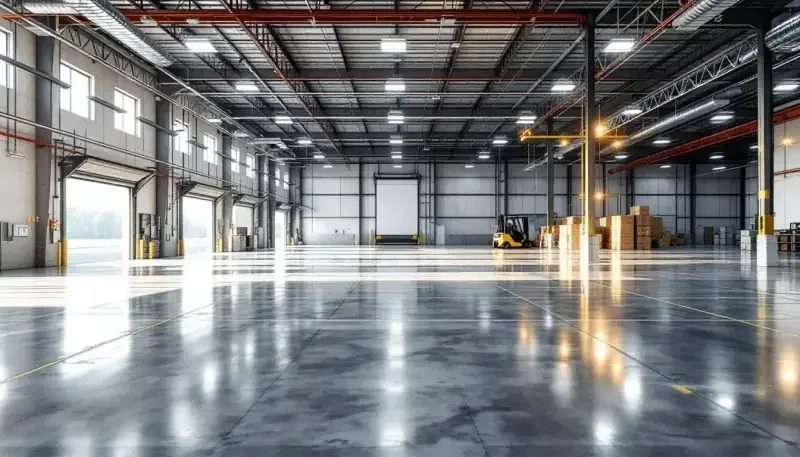
Warehouse & Industrial Floors in Saint Joseph, MO
Saint Joseph's industrial base runs on concrete that can take a beating. We build warehouse floors engineered for the heavy logistics traffic moving through the Stockyards District and beyond.
What Does a Warehouse Floor Actually Cost in Saint Joseph?
Let's talk numbers. A warehouse floor in Saint Joseph typically runs $4.50 to $8.50 per square foot, depending on thickness, reinforcement, and finish. That range surprises some business owners. The biggest cost drivers here are subbase preparation in older industrial zones near the river, where drainage problems and decades of contaminated fill demand extra excavation. Labor rates in Buchanan County stay more reasonable than Kansas City proper, but material costs for high-PSI concrete and fiber reinforcement have climbed 12 percent since 2022.
A 20,000-square-foot slab in the Stockyards Industrial District won't cost the same as one near the Belt Highway Corridor. Soil conditions, truck access, and demolition of existing slabs all shift the price. We quote every project after a site visit because guessing costs you money. Since 2015, we've completed 377-plus projects, and our pricing has stayed transparent from the first handshake.
Industrial-Grade Concrete for Saint Joseph's Hardest-Working Facilities
Saint Joseph has reinvented itself from a historic river town into a manufacturing and bioscience hub. That transformation means warehouse floors in this market face punishing demands — forklift traffic running 16-hour shifts, pallet jack abuse, chemical exposure in food processing facilities, and point loads from high-density racking systems. We pour slabs designed for these exact conditions, using 4,500 to 5,000 PSI concrete with steel fiber or welded wire reinforcement tailored to your operation.
Many of the industrial buildings along the north industrial districts and Stockyards area date to the mid-20th century. Their original floors were poured to standards that don't meet modern load requirements. Spalling, joint deterioration, and uneven surfaces create safety hazards and slow down operations. We handle full tear-out and replacement, structural overlays, and joint repair programs that bring aging facilities up to current FF/FL flatness standards.
Every warehouse floor we install includes proper vapor barrier placement, engineered joint layouts matched to your racking configuration, and cure-and-seal application for long-term durability. We also integrate trench drains, floor drains, and ADA-compliant transitions at dock doors when the scope requires it. The goal is a floor that performs for 25-plus years under real Saint Joseph industrial conditions.
Saint Joseph-Specific Warehouse & Industrial Floors Considerations
River-Adjacent Drainage and Subbase Challenges
Facilities in Saint Joseph's older industrial sectors near the Missouri River often sit on poorly compacted fill with chronic drainage issues. Decades of use have compressed some subbases while leaving others riddled with voids. We probe and test the subbase before every pour. If we find unstable material, we excavate and replace with compacted Class 5 aggregate to create a stable platform. Ignoring this step is the number-one reason warehouse floors fail prematurely in this part of Buchanan County.
Heavy Logistics Traffic on Stockyards District Floors
The Stockyards Industrial District and north industrial corridors handle massive logistics volume — loaded semis, forklifts running constantly, and heavy equipment staging. These loads demand thicker slabs, typically 6 to 8 inches, with reinforcement designed for specific wheel loads and point loads. We calculate slab thickness based on your actual equipment weights and traffic patterns, not generic tables. A distribution center running narrow-aisle turret trucks needs different specs than a cold storage facility with stationary racking.
Aging Building Infrastructure and Elevation Matching
Many Saint Joseph industrial buildings have settled unevenly over 40 to 60 years. Dock levelers, overhead doors, and column bases sit at elevations that a new floor must match precisely. We survey every connection point with laser levels before designing the slab. This prevents the costly surprises that happen when a new floor doesn't meet existing dock height or creates a trip hazard at column transitions. It's detail work, but it saves you thousands in post-pour modifications.
What to Expect During Your Saint Joseph Warehouse Floor Project
The project starts with a site visit where we measure the space, assess the existing slab, probe the subbase, and document every elevation point that matters — dock doors, columns, drains, and racking locations. If your building needs a permit from Buchanan County, we handle the application. Most interior floor replacements in existing structures require a building permit, and the county typically schedules inspections within 3 to 5 business days of request. We build inspection timing into the project schedule so it never causes a delay.
Demolition day is loud. Our crew uses concrete saws and skid steers to break out the old slab, and haul-off trucks will stage along your dock or in your parking area. If your facility is on a tighter site in the Stockyards District, we coordinate truck staging so we don't block neighboring operations. Dust control and debris containment are planned in advance. If you're running adjacent operations during the project, we install temporary barriers to keep your active areas clean.
Concrete trucks are large and heavy — they need solid access and room to maneuver. On Belt Highway Corridor sites, access is usually straightforward. In tighter north-side industrial areas, we sometimes use concrete pumps to reach interior pours. You'll see laser screeds leveling the slab to the specified FF/FL tolerances, followed by power troweling for a dense, smooth finish. The pour day moves fast. A 10,000-square-foot section typically pours in one shift.
After the pour, we apply curing compound and the floor needs 7 days minimum before light traffic. Forklift traffic and heavy equipment should wait 28 days for full strength. We'll walk you through the joint sealing schedule and provide documentation of mix design, test results, and as-built elevations for your records and your insurance carrier.
Repair the Existing Slab or Replace It Entirely?
This is the most common question we hear from Saint Joseph facility managers. Repairing joints, patching spalled areas, and grinding high spots costs $1.50 to $3.00 per square foot. Full replacement runs $4.50 to $8.50. The math seems obvious until you factor in how many times you'll repair before the old slab fails completely. Most mid-century industrial floors in Saint Joseph were poured at 4 inches with minimal reinforcement. They were never designed for modern forklift loads or high-density racking.
A repaired floor buys you 3 to 7 years in most cases. A properly engineered replacement lasts 25 to 30 years. If your operation plans to stay in the building long-term, replacement almost always wins on lifecycle cost. We've seen facilities near Frederick Avenue spend $40,000 on repairs over a decade, then pay $120,000 for a full replacement they should have done first.
There are cases where repair makes sense — if the slab is structurally sound, the subbase is stable, and you only have localized joint damage or surface wear. We'll tell you honestly which situation you're in after the site assessment. We don't push replacement when repair will perform.
How Much Does Warehouse & Industrial Floors Cost in Saint Joseph?
| Type | Cost / Sq Ft | Project Dependent |
|---|---|---|
| Standard Industrial Slab | $3–6 | Varies by scope |
| Polished Concrete | $5–10 | Varies by scope |
| Epoxy / Coating System | $4–8 | Varies by scope |
Warehouse floor costs in Saint Joseph typically run lower than Kansas City metro rates due to more competitive labor, but older Stockyards District buildings often need extensive subbase remediation that can add $1.00 to $2.00 per square foot to the project.
Warehouse & Industrial Floors FAQ for Saint Joseph, MO
What PSI concrete do you pour for Saint Joseph warehouse floors?
We typically specify 4,500 to 5,000 PSI concrete for warehouse and industrial applications in Saint Joseph. The exact mix design depends on your load requirements, exposure conditions, and whether the floor will see chemical contact. Food processing or cold storage facilities often need air-entrained mixes to handle freeze-thaw cycling. We work with local batch plants to dial in a mix that matches your specific operation, and we provide certified test results for every pour.
Does Buchanan County require permits for interior warehouse floor replacement?
Yes, most interior floor replacements in existing commercial buildings require a building permit from Buchanan County. The permit process typically takes 5 to 10 business days for approval. Inspections are required at the subbase stage before the pour. We handle the application, drawings, and scheduling so it doesn't slow down your project. If your facility is in a floodplain zone near the river, additional requirements may apply.
How do you keep our adjacent warehouse operations running during the pour?
We phase the work to keep your active areas operational. Temporary barriers separate the construction zone from your working space. Dust and debris stay contained. We schedule concrete deliveries to minimize disruption to your dock traffic and coordinate truck staging with your shipping schedule. Most Saint Joseph facilities we work with maintain 60 to 80 percent operational capacity throughout the project. We've poured floors in occupied distribution centers, active manufacturing plants, and food storage facilities without a single day of full shutdown.
What flatness specifications can you achieve for automated equipment?
We regularly achieve FF 35 to FF 50 and FL 25 to FL 35 on warehouse floors using laser-guided screeds. If your facility runs narrow-aisle turret trucks or automated guided vehicles, we can hit superflat specifications of FF 50-plus and FL 30-plus in defined traffic aisles. These tighter tolerances require additional crew and equipment but prevent the operational problems that come with uneven floors in high-precision warehousing. We verify every section with floor profiling equipment after the pour.
Can you pour during Saint Joseph winters?
Yes, but winter pours require cold-weather protocols. We use heated water in the mix, insulated blankets over the fresh concrete, and ground heaters when needed. Air temperatures below 35 degrees Fahrenheit trigger our cold-weather plan. Interior pours in heated buildings are simpler — we mainly need to protect the slab during the first 48 hours of curing. We don't pour when conditions would compromise the concrete. If a January cold snap drops temps below 20 degrees, we'll reschedule rather than risk your investment.
What happens to the old concrete when you tear out the existing floor?
We demolish and remove all existing concrete, rebar, and debris. Old material gets hauled to a local recycling facility where it's crushed and repurposed as aggregate. You don't handle any of the disposal. Our crew loads everything into roll-off containers staged at your dock or lot. On a typical 15,000-square-foot tear-out, we remove 150 to 200 tons of material. Demolition and haul-off costs are included in our project pricing — no surprise fees for extra truckloads.
Do you install vapor barriers, and why do Saint Joseph warehouse floors need them?
We install 15-mil vapor barriers under virtually every warehouse slab. Saint Joseph sits in the Missouri River valley, and groundwater moisture migration is a real problem — especially in the older industrial zones near the Stockyards and Northside districts. Without a proper vapor barrier, moisture moves through the slab and destroys coatings, causes adhesive failures under VCT or epoxy, and promotes mold growth in climate-controlled spaces. We lap and tape every seam and seal the barrier to all penetrations. It's a non-negotiable part of the assembly.
Other Concrete Services in Saint Joseph, MO
Schedule Your Free On-Site Consultation in Saint Joseph
We'll walk your facility, assess the existing slab, check subbase conditions, and give you a detailed scope and cost estimate — typically within one week of the visit. Call today to get on the schedule.