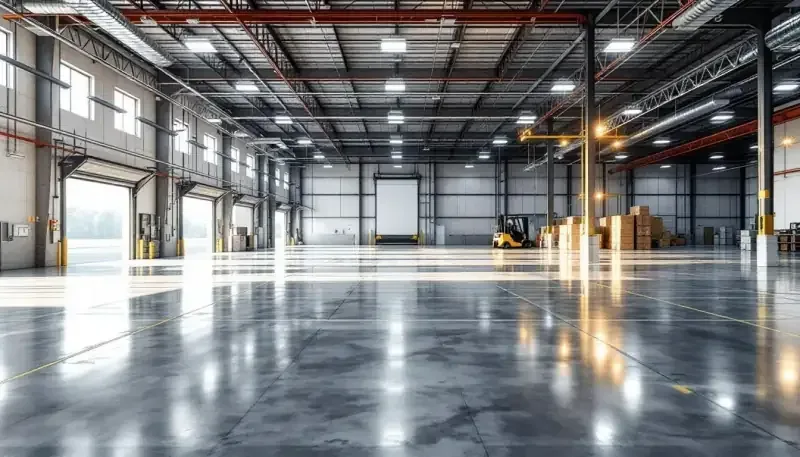
Warehouse & Industrial Floors in Liberty, MO
Liberty's logistics growth along I-35 and MO-152 demands industrial floors that perform under punishing daily loads — and we build them to last decades, not just years.
Is Summer the Right Time to Pour Your Warehouse Floor in Liberty?
Summer in Liberty means long pour windows, faster cure times, and predictable weather. That's ideal for warehouse and industrial floor work. But it also means every concrete contractor in the Northland is booked solid by mid-June. If you're planning a new slab or full replacement at your Liberty Commerce Center facility or a building off MO-152, the time to schedule is now — not when temperatures peak in July.
We've poured industrial floors across Clay County since 2015. That includes distribution centers near I-35, manufacturing spaces along US-69, and retail backrooms around Historic Liberty Square. Summer heat accelerates curing, which means your crew can get back on the floor faster. But it also demands precise moisture management during the pour. Our contractors handle that timing down to the hour.
Liberty's identity as a modern logistics hub keeps growing. New construction in the 152-Highway corridor and Liberty Commerce Center means more warehouse space coming online every quarter. If your existing floor is showing joint deterioration, surface scaling, or subbase failure, summer gives you the tightest turnaround for getting back to full operations. We've completed 377 projects and counting — many of them on aggressive summer timelines.
Industrial-Grade Concrete Floors Built for Liberty's Toughest Demands
Warehouse floors in Liberty take a beating. Forklift traffic, pallet jacks, heavy racking loads, and constant truck dock vibration wear down concrete faster than most business owners expect. We design slabs specifically for your operation — accounting for load weights, traffic patterns, joint spacing, and the specific subbase conditions found across Clay County's soil profiles. Every floor we pour meets or exceeds ACI 302.1R standards for flatness and levelness.
The Liberty Commerce Center and industrial corridors near I-35 and US-69 see some of the heaviest commercial traffic in the Northland. That means your floor isn't just supporting inventory — it's absorbing the constant impact of a high-volume supply chain. We use fiber-reinforced mixes, doweled joints, and densifier treatments that extend your floor's service life by years. Coatings and hardeners are available as integrated add-ons, not afterthoughts.
From cold storage facilities requiring vapor barriers to open distribution centers needing superflat tolerances for automated guided vehicles, we scale our approach to your specific use case. Liberty businesses operating near the MO-152 power centers know that downtime costs real money. Our phased pour strategies keep portions of your facility operational while we work, minimizing revenue disruption without cutting corners on cure time.
Liberty-Specific Warehouse & Industrial Floors Considerations
Subbase Conditions Along the I-35 Industrial Corridor
Liberty's I-35 corridor sits on clay-heavy soils prone to seasonal expansion and contraction. For warehouse floors, that means subbase preparation is non-negotiable. We excavate to stable material, install compacted aggregate base layers, and verify density with nuclear gauge testing before any concrete is placed. Skipping this step is why so many older industrial floors near the early I-35 developments show cracking and settlement. Our approach prevents the rutting and subbase failure already visible in some of Liberty's aging commercial zones.
Heavy Traffic Loads in Liberty's Logistics Hubs
Liberty isn't a sleepy county seat anymore. It's a Northland commuter and logistics powerhouse. Warehouses here handle Class IV and Class V forklifts, loaded semi trailers at dock level, and continuous pallet jack traffic across thousands of square feet. We engineer joint layouts and slab thickness based on your actual wheel loads — not generic charts. Facilities near Liberty Commons and Wilshire Plaza deal with constant delivery traffic that punishes transition zones. We reinforce those areas with thickened edges and armored joints.
Clay County Permitting and Inspection Requirements
Commercial concrete work in Liberty requires permits through Clay County. Inspections typically cover subbase compaction, rebar or fiber placement, and final slab thickness verification. We handle the permit application and coordinate inspector access so you're not chasing paperwork. The process usually adds two to five business days to the front end of a project. We factor that into every timeline we quote. No surprises, no delays caused by missed inspection windows.
What to Expect During Your Warehouse Floor Project in Liberty
It starts with a site visit. We walk your facility, measure the space, identify drainage points, dock elevations, and existing damage. If your building is near Liberty Commerce Center or along Kansas Street, we'll assess truck staging and concrete pump placement options — some sites require boom pumps due to tight lot configurations. You'll get a detailed proposal within a few business days that includes mix design, joint layout, timeline, and a phased pour plan if you need to keep operations running.
Once we break ground, demolition comes first. Saw-cutting and removal of your old slab generates noise and dust. We use dust suppression and coordinate haul-off trucks so debris doesn't block your dock doors or parking areas. Subbase prep follows — expect compactors running for one to two days depending on soil conditions. A Clay County inspector will verify compaction before we set forms and reinforcement. This inspection is typically scheduled with 48 hours' notice.
Pour day is the main event. Concrete trucks will stage on your lot or along the adjacent access road — we coordinate with your neighbors and Liberty traffic patterns to avoid blocking shared drives. For a typical 10,000-square-foot pour, expect four to six trucks arriving in sequence over several hours. Our crew handles placement, vibration, screeding, and finishing in a continuous operation. You'll hear generators, vibrators, and power trowels. By the end of the day, your new slab is placed and initial curing compounds are applied.
After the pour, we protect the slab during the curing window — typically seven days before light traffic and 28 days for full design strength. We'll mark off cured zones clearly so your staff knows where they can and can't operate. Joint sawing happens within 12 to 24 hours. Final walkthrough includes flatness verification with a digital floor profiler. We hand you documentation showing FF/FL numbers, mix design reports, and Clay County inspection sign-offs.
Repair the Existing Slab or Replace It? What Makes Sense for Liberty Warehouses
Not every damaged warehouse floor needs a full replacement. Surface scaling, minor spalling, and worn joints can often be repaired with grinding, joint re-caulking, and epoxy overlays at a fraction of replacement cost — typically $2 to $4 per square foot versus $6 to $12 for a full tear-out and re-pour. For buildings in Liberty's newer MO-152 developments that are only five to seven years old, targeted repairs often make the most financial sense.
However, if your slab shows widespread cracking, settlement exceeding a half inch, or subbase failure — common in older buildings along the early I-35 corridor — patching is a temporary fix at best. You'll spend money now and again in two years. A full replacement with proper subbase preparation gives you a 25-plus year floor designed for your current loads, not the loads the original builder assumed decades ago.
The deciding factor is usually the subbase. If compaction testing reveals stable, well-drained aggregate underneath, surface repairs and coatings can extend the floor's life by 10 years or more. If the subbase is compromised — and in Liberty's clay-heavy soils, it often is — replacement is the only path to a permanent solution. We evaluate both options during every consultation and give you honest numbers for each.
How Much Does Warehouse & Industrial Floors Cost in Liberty?
| Type | Cost / Sq Ft | Project Dependent |
|---|---|---|
| Standard Industrial Slab | $3–6 | Varies by scope |
| Polished Concrete | $5–10 | Varies by scope |
| Epoxy / Coating System | $4–8 | Varies by scope |
Industrial floor pricing in Liberty typically runs $6 to $12 per square foot depending on slab thickness, reinforcement, and surface treatment. Projects near the I-35 corridor may see slightly higher subbase costs due to deeper clay excavation requirements.
Warehouse & Industrial Floors FAQ for Liberty, MO
What mix design do you recommend for Liberty warehouse floors?
Most Liberty warehouse applications call for a 4,500 to 5,000 PSI mix with fiber reinforcement and a low water-to-cement ratio. For facilities handling heavy forklift traffic near the Liberty Commerce Center or I-35 corridors, we often specify a 5,000 PSI mix with synthetic macro fibers and a shrinkage-reducing admixture. The exact design depends on your load requirements, but we always provide the mix design documentation for your records.
How do you handle floor drainage in Liberty warehouse buildings?
We slope the slab to existing floor drains or install new ones as part of the project. Many older Liberty warehouses have inadequate drainage — especially buildings constructed in the early I-35 development era. We can core through existing slabs for new drain points, tie into existing sanitary or storm lines, and ensure proper slope across the entire floor. Clay County plumbing permits may apply if we're adding new drain connections.
Will the project affect neighboring businesses in my Liberty commercial park?
We plan truck staging, debris removal, and equipment placement to minimize impact on your neighbors. In tight commercial zones like Wilshire Plaza or Liberty Commons, we coordinate delivery windows with adjacent businesses. Concrete trucks are loud, but they're on-site for limited periods. We keep shared access drives clear and communicate the schedule to neighboring tenants in advance. Most business owners tell us the disruption was far less than they expected.
Can you pour a slab that supports heavy racking with point loads over 10,000 pounds?
Absolutely. High-density racking with significant point loads requires thicker slabs, often 7 to 8 inches, with reinforced footings beneath each base plate. We calculate the required bearing capacity based on your racking layout and maximum load weights. This is common in distribution facilities along US-69 and the MO-152 corridor. We provide engineered joint layouts that avoid placing saw cuts directly under rack uprights, which prevents cracking at the worst possible locations.
Do I need to vacate the entire building?
Not necessarily. We routinely pour warehouse floors in phases to keep portions of your operation running. The phased approach adds time to the overall project — typically one to two extra weeks depending on square footage — but it keeps revenue flowing. We install temporary barriers to control dust and protect inventory. Your staff will need to stay out of active pour zones, but we clearly mark boundaries and coordinate daily with your operations manager.
How do Liberty's freeze-thaw cycles affect a new warehouse floor?
Interior warehouse floors are largely protected from direct freeze-thaw exposure, but dock areas and transition zones near overhead doors take a beating from November through March. We use air-entrained concrete at dock openings and apply penetrating sealers to protect those vulnerable areas. If your facility has unheated sections, we factor that into the mix design. Properly designed joints also prevent the cracking that freeze-thaw cycling causes in unprotected concrete.
What documentation do you provide after project completion?
You receive a complete project file including the concrete mix design tickets from the batch plant, Clay County inspection reports, compaction test results, FF/FL flatness measurements, and photographs documenting each phase. If coatings or hardeners were applied, we include product data sheets and warranty information. This package is valuable for insurance purposes, future tenant buildouts, and property transactions. We keep digital copies on file for five years.
Other Concrete Services in Liberty, MO
Warehouse & Industrial Floors in Nearby Cities
Schedule Your Warehouse Floor Consultation in Liberty
During the site visit, we'll measure your space, evaluate the existing slab and subbase conditions, and discuss phased pour options that minimize your downtime. Most Liberty consultations take about an hour — and you'll have a detailed proposal within days.