
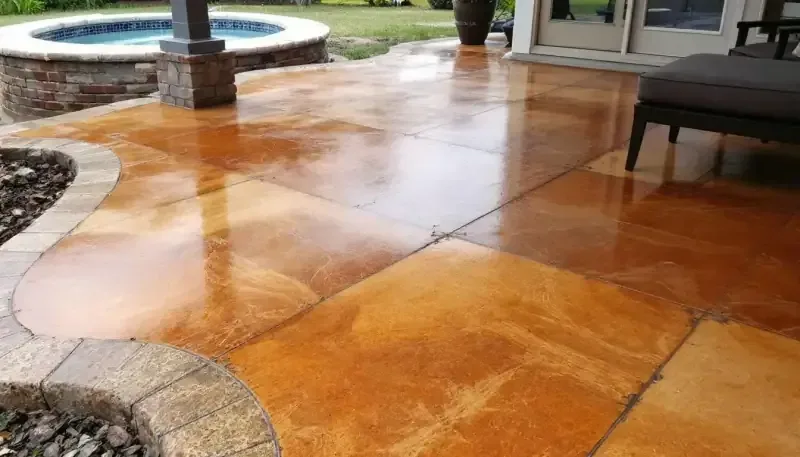
Stained & Colored Concrete in Liberty, MO
Your Liberty home deserves more than plain gray. We transform ordinary concrete into rich, color-saturated surfaces that complement the character of Clay County's most historic neighborhoods.
What Does Stained Concrete Actually Cost in Liberty?
Let's talk numbers first. In Liberty, most homeowners pay between $3 and $8 per square foot for concrete staining. Acid stains land on the lower end. Multi-layered water-based designs with custom scoring push toward the top. A 400-square-foot patio typically runs $1,200 to $3,200 installed. That's real pricing based on Clay County labor rates and the material costs we see right now in 2024. Your final number depends on surface condition, color complexity, and whether we're working on existing concrete or a fresh pour.
Why the range? Liberty's clay-heavy soil means existing slabs sometimes need repair before staining. Homes in Benson Place from the 1970s might have surface scaling that requires grinding. A newer Shoal Creek Valley patio poured on engineered fill might be stain-ready on day one. We price based on what your concrete actually needs — not a one-size estimate pulled from a national website.
How Stained & Colored Concrete Works on Liberty Properties
Concrete staining is a chemical or pigment-based process that penetrates your slab's surface to create permanent, translucent color. Acid stains react with the calcium hydroxide in concrete, producing earthy tones — ambers, tans, charcoal greens, and rustic browns. Water-based stains offer a broader palette, from deep slate blues to warm terracotta reds. Both methods bond with the concrete rather than sitting on top, which means the color won't chip or peel the way paint does.
In Liberty, we see strong demand for warm earth tones that complement the brick and limestone architecture around Historic Liberty Square. Homeowners near William Jewell College often choose scored geometric patterns with two-tone staining to echo the campus aesthetic. Out in Canterbury Estates and Woodneath Farms, larger patio footprints give us room for more dramatic color transitions and decorative saw-cut designs.
Colored concrete — where integral pigment is mixed into a fresh pour — is a different approach entirely. The color runs through the full depth of the slab. This is ideal for driveways along Kansas Street or MO-291 frontage where surface wear from road salt and traffic is a real concern. We use both techniques depending on whether we're enhancing an existing slab or building from scratch.
Liberty-Specific Stained & Colored Concrete Considerations
Clay County's Expansive Clay Soil and Your Existing Slab
Liberty sits on heavy clay soil that swells when wet and contracts when dry. This seasonal movement can crack older slabs, especially in neighborhoods like Clay Meadows where homes were built in the early 2000s on standard 4-inch pours. Before staining, we evaluate your slab for movement cracks and settlement. Minor cracks can be routed and filled to become part of the decorative design. Severe heaving might mean partial replacement before stain goes down. We'd rather tell you upfront than stain over a slab that's going to shift next spring.
UV Exposure Along Liberty's South-Facing Lots
Many homes in Shoal Creek Valley and Woodneath Farms feature south-facing patios and pool decks with full sun exposure. Missouri's intense summer UV accelerates color fading on improperly sealed stained concrete. We apply UV-resistant acrylic sealers on exposed surfaces and recommend resealing every two to three years for south-facing slabs. For covered patios and garage floors, a standard sealer holds up significantly longer. Orientation matters, and we factor it into every recommendation.
Matching Historic Liberty Architecture
If your home is within walking distance of Historic Liberty Square, you likely have brick, limestone, or clapboard siding with a traditional color palette. Bright or trendy stain colors can clash badly. We bring physical stain samples to your property and test them on an inconspicuous corner of your slab before committing. Warm walnut, sandstone, and cola brown acid stains tend to pair best with Liberty's red-brick Victorians and Craftsman-era bungalows. Getting the color right matters more than getting it bold.
From First Call to Finished Color: Your Liberty Staining Project
It starts with a phone call or form submission. We ask about your slab's age, size, location, and what you're hoping to achieve. Most Liberty homeowners reach out about patios, garage floors, or front walkways. Within a few days, one of our contractors visits your property to inspect the concrete in person. We're checking for cracks, spalling, efflorescence, previous coatings, and how level the surface is. In neighborhoods like Benson Place, we often find older slabs with a thin layer of deteriorated sealer that needs stripping first.
After the site visit, you receive a written proposal with stain options, color samples, and a clear scope of work. This is where decisions happen. Do you want a single acid-stain wash for a natural mottled look, or a multi-color water-based design with saw-cut borders? We walk you through the trade-offs — cost, maintenance, longevity, and how each option handles Liberty's freeze-thaw cycles. Most homeowners settle on their direction within a week.
On work day, our crew arrives early. We clean the slab with a commercial degreaser and diamond grinder if needed, then mask off adjacent surfaces — your siding, landscaping, and any exposed aggregate borders. Stain application is methodical. Acid stains need time to react, usually four to six hours. Water-based stains dry faster but require precise layering. We neutralize acid residue, rinse thoroughly, and let everything dry before applying two coats of sealer.
The reveal is the best part. Stained concrete looks fundamentally different from what was there before. That dull gray patio behind your Canterbury Estates home suddenly has depth, warmth, and character. We do a final walkthrough with you, explain the curing timeline, and leave you with a maintenance card that covers cleaning, resealing intervals, and winter care specific to Clay County weather.
How Staining Needs Differ Across Liberty's Neighborhoods
Benson Place features some of Liberty's oldest residential concrete — patios and walkways poured in the 1960s and 1970s on native clay subgrade with minimal compaction. These slabs often show hairline cracking and moderate efflorescence. Staining here requires thorough surface prep, crack routing, and sometimes a skim coat to create a uniform absorption base. The payoff is worth it: acid stain on these vintage slabs produces rich, one-of-a-kind color variation that newer concrete simply can't replicate.
Shoal Creek Valley and Woodneath Farms represent Liberty's 2005-2020 construction wave. Concrete here was poured on engineered fill with proper reinforcement, so structural issues are rare. The challenge is different — many of these newer slabs have a hard trowel finish that resists stain penetration. We diamond-grind or acid-etch the surface to open the pores before applying color. Homeowners in these neighborhoods tend to request contemporary gray-scale tones and geometric scoring that match their modern exterior finishes.
Canterbury Estates sits in a middle ground — homes mostly from the late 1990s with concrete that's showing its first signs of surface wear but remains structurally sound. This is the sweet spot for staining. The concrete has aged enough to accept stain beautifully but hasn't deteriorated to the point of needing major repair. We've completed several patio and pool deck staining projects in Canterbury Estates, and the warm sandstone and walnut tones pair perfectly with the neighborhood's earth-toned vinyl and stone facades.
How Much Does Stained & Colored Concrete Cost in Liberty?
| Type | Cost / Sq Ft | Typical 300 Sq Ft |
|---|---|---|
| Acid Stain (Existing Concrete) | $4–8 | $1,200–$2,400 |
| Water-Based Stain (Existing) | $3–6 | $900–$1,800 |
| Integral Color (New Pour) | $10–15 | $3,000–$4,500 |
Liberty pricing reflects Clay County's moderate labor market and the cost of hauling materials from suppliers along I-35. Expect to pay 10-15% less than comparable work in downtown Kansas City, with larger patios offering better per-square-foot rates.
Stained & Colored Concrete FAQ for Liberty, MO
What's the best time of year to stain concrete in Liberty?
Late spring through early fall gives us the best results. Stain application requires surface temperatures between 50°F and 90°F, and Liberty's humidity needs to be manageable so the sealer cures properly. We avoid staining during Clay County's wettest weeks in May and June when afternoon storms can interrupt the process. September and October are ideal — warm days, cool nights, and lower humidity. If you're planning a project, booking in late summer gives us the best scheduling flexibility.
Can you stain a concrete driveway that gets road salt exposure from Kansas Street or MO-291?
Yes, but the sealer selection is critical. Driveways near high-traffic Liberty roads like Kansas Street and MO-291 catch salt spray and runoff from November through March. We use a penetrating lithium silicate sealer under a topical acrylic finish for these applications. The penetrating sealer protects against chloride intrusion while the topical coat holds the color. You'll need to reseal the topical layer every two years in heavy-salt zones. We also recommend rinsing salt residue off your driveway monthly during winter.
How does stained concrete compare to pavers for a Liberty patio?
Stained concrete costs roughly 40-60% less than a paver patio of the same size. A 500-square-foot stained patio in Liberty might run $2,000 to $4,000 while pavers would cost $5,000 to $9,000 installed. Stained concrete also eliminates the weed growth and settling issues pavers develop on Clay County's expansive soil. Pavers shift. Stained concrete stays monolithic. The trade-off is that pavers offer easier individual repair, but most homeowners we work with in Woodneath Farms and Shoal Creek Valley prefer the clean, seamless look staining provides.
Will the stain look different on my 20-year-old slab versus a new pour?
Absolutely. Older concrete has more porosity, mineral deposits, and wear patterns that affect how stain absorbs. This isn't necessarily bad — acid stain on aged concrete often produces the most beautiful, organic-looking results because the variation in absorption creates natural marbling. However, areas with heavy wear, previous patches, or oil penetration will absorb stain differently. We test a small area during our site visit so you see exactly how your specific slab responds before we commit to the full application.
Do you stain interior concrete floors in Liberty homes?
We do. Interior staining is popular in Liberty basements and sunrooms, especially in Benson Place and Clay Meadows homes where homeowners are converting unfinished lower levels into living space. Interior work requires more prep — we need adequate ventilation and protection for walls, cabinetry, and HVAC returns. Water-based stains are our go-to for interiors because they produce fewer fumes. The results are stunning and give you a low-maintenance floor that handles foot traffic, pet claws, and furniture without the upkeep of hardwood.
Can colored concrete be poured in cold weather if my project timeline falls in late November?
We can pour integral-colored concrete into late November in Liberty, but it requires cold-weather protocols. We use heated blankets to maintain curing temperature and may add accelerators to the mix. The pigment itself isn't affected by cold, but the curing process slows dramatically below 40°F. If temperatures drop into the twenties overnight, we cover the slab with insulated blankets for 72 hours minimum. Late November is feasible but adds cost. If your timeline allows, waiting until March typically saves you 8-12% on the total project.
What maintenance does a stained patio need beyond resealing?
Day to day, very little. Sweep debris weekly and rinse with a garden hose monthly. Avoid pressure washing above 1,500 PSI — high pressure strips sealer prematurely. For organic stains from leaves or tree sap, a mild dish soap solution and soft-bristle brush works. In Liberty's fall season, clear leaves promptly because tannins can discolor light-colored stains if left sitting on wet concrete for weeks. Beyond resealing every two to three years, that's the full extent of maintenance. It's one of the lowest-effort flooring surfaces you can own.
Other Concrete Services in Liberty, MO
Stained & Colored Concrete in Nearby Cities
Schedule Your Free Liberty Property Assessment
We'll inspect your concrete's condition, test stain absorption on a small area, and give you a written estimate covering prep work, color options, and sealing — all specific to your slab and your Liberty neighborhood.