
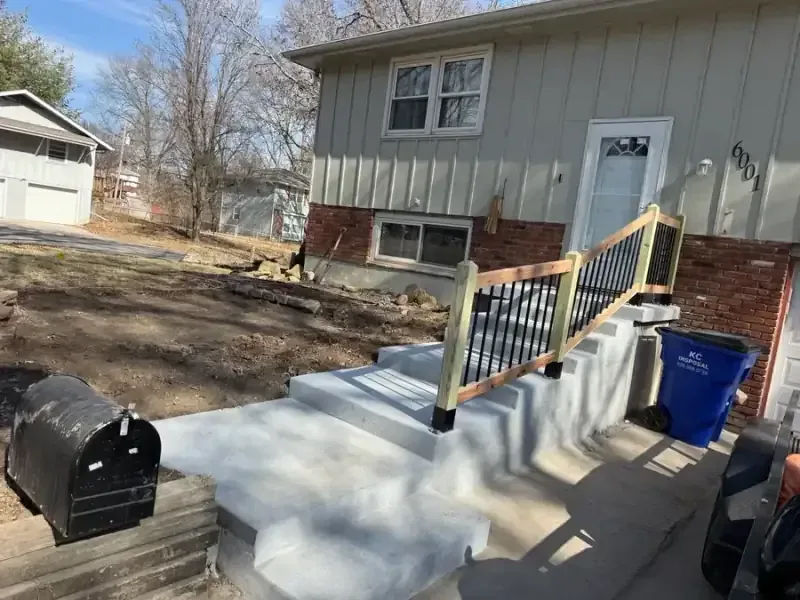
Sidewalks & Walkways in Liberty, MO
That crumbling front walkway isn't just ugly — it's a liability every time someone visits your Liberty home. We replace and install concrete sidewalks built to handle Clay County conditions.
When Was the Last Time You Actually Looked at Your Front Walkway?
You step over it every day without thinking. Then a neighbor trips on that heaved slab near the driveway. Or you notice the crack has widened another half-inch since spring. Homes across Benson Place, Canterbury Estates, and Woodneath Farms share the same story — walkways poured over Clay County's expansive soil that have shifted, cracked, and settled into something that looks neglected. It's not your fault. It's bad subgrade prep meeting aggressive freeze-thaw cycles.
Since 2015, we've completed 377+ concrete projects across the Kansas City metro, and Liberty keeps us busy. The soil here punishes shortcuts. We don't take them. Every walkway we pour in Liberty gets engineered for the ground beneath it — not just the surface you see. Our 13 five-star Google reviews reflect that approach.
What Goes Into a Liberty Sidewalk That Actually Lasts
A residential sidewalk in Liberty isn't just a path from point A to point B. It connects your driveway to your front door, wraps around to a patio, or gives your family a clean route through the yard. We build walkways from 3 feet to 6 feet wide, depending on your property layout and how you use the space. Homes in Shoal Creek Valley with sloped lots need different grading solutions than flat properties in Clay Meadows.
We pour residential sidewalks at a minimum 4-inch thickness with fiber mesh reinforcement. For walkways that cross areas with heavy root systems or particularly soft subgrade — common along the older neighborhoods near Historic Liberty Square — we go to 5 inches with rebar on 18-inch centers. Control joints get cut at intervals matched to the slab width, which controls where cracks form instead of letting them run wild.
Finish options range from standard broom finish to exposed aggregate and stamped patterns. Many homeowners near William Jewell College and the Historic Square area choose finishes that complement their home's character. We handle tear-out of old concrete, grading, forming, pouring, finishing, and curing protection — one crew from start to cleanup.
Liberty-Specific Sidewalks & Walkways Considerations
Clay County's Expansive Soil Demands Better Subgrade Work
The clay-heavy soil across Liberty expands when wet and contracts when dry. This seasonal movement is the number one reason sidewalks heave and crack prematurely. We excavate 6 to 8 inches below the slab, remove organic material, and compact a Class 5 gravel base in lifts. This creates a stable cushion that absorbs soil movement instead of transferring it into your concrete. Skipping this step is why so many walkways in Canterbury Estates and older Liberty subdivisions fail within 10 years.
Mature Tree Roots Along Established Liberty Streets
Liberty's older neighborhoods — especially those surrounding the Historic Square and along Kansas Street — have decades-old trees with aggressive root systems. Roots will exploit any weakness beneath a slab. When we encounter significant roots during tear-out, we work with arborists to trim safely, then install a root barrier membrane alongside the new walkway edge. This buys your sidewalk years of protection without killing the tree your property is known for.
Grading and Drainage on Liberty's Rolling Terrain
Liberty isn't flat. Neighborhoods like Shoal Creek Valley sit on terrain with meaningful elevation changes. A walkway poured without proper slope sends water toward your foundation or pools in low spots that turn icy in winter. We laser-level every form and maintain a minimum 2 percent cross-slope for drainage. On steeper lots, we integrate steps or terraced sections so the walkway stays safe and ADA-friendly without looking like an afterthought.
Freeze-Thaw Cycles and Air Entrainment
Liberty sees 40+ freeze-thaw cycles in a typical winter. Water seeps into microscopic pores, freezes, expands, and spalls the surface. We specify 6 percent air-entrained concrete in every residential pour. Those tiny air bubbles give expanding water somewhere to go instead of blowing apart the top layer of your walkway. Combined with a quality cure-and-seal coat applied after finishing, this mix design handles Missouri winters without the flaking you see on budget pours around town.
How We Build Sidewalks and Walkways in Liberty — A Craftsman's Walkthrough
Everything starts with the ground. On day one, our crew marks the layout with spray paint so you can see exactly where the walkway will run. We excavate to a depth of 10 to 12 inches below finished grade, removing topsoil and any organic material. In Liberty's clay soil, compaction matters more than anywhere else. We run a vibratory plate compactor over the native subgrade in two passes, then place and compact 4 to 6 inches of Class 5 crushed limestone. We source our aggregate from quarries in the Northland, keeping haul times short and material costs reasonable.
Forms go in next — 2x4 lumber for 4-inch pours, 2x6 for thicker sections. We stake every 3 feet and check level with a laser. Curves get formed with flexible hardboard, bent to match the radius you approved during layout. If your walkway ties into an existing patio or porch, we drill and epoxy dowel bars into the old concrete so the joint stays tight instead of separating over time. Expansion joint material gets placed at every hard connection — house foundation, garage slab, driveway edge.
Pour day is where the Clay County-specific details matter most. We order 4,000 PSI air-entrained ready-mix from a local batch plant, delivered in trucks that can access Liberty's residential streets without tearing up your lawn. Our crew screeds, bull-floats, and edges the concrete while it's still plastic. We cut control joints with a groover at intervals equal to the slab width — typically every 3 to 4 feet. After the bleed water disappears, we apply the chosen finish. Broom finish goes on perpendicular to the walking direction for maximum traction.
Curing is the step most contractors rush. We apply a spray-on curing compound within 30 minutes of finishing. In summer heat — Liberty regularly hits 95-plus degrees in July — we may also cover the slab with wet burlap for the first 24 hours. The concrete needs 7 days before foot traffic and 28 days to reach full strength. We leave clear instructions, set up caution tape, and schedule a follow-up visit to inspect the finished product and apply a penetrating sealer if you've opted for that upgrade.
How Much Does Sidewalks & Walkways Cost in Liberty?
| Type | Cost / Sq Ft | Typical 300 Sq Ft |
|---|---|---|
| Standard Sidewalk | $6–10 | $1,800–$3,000 |
| Decorative Walkway | $10–16 | $3,000–$4,800 |
| Trip Hazard Repair (per section) | $200–500 | $200–$500 |
Most residential sidewalk and walkway projects in Liberty run between $8 and $14 per square foot installed, depending on thickness, finish, and tear-out requirements. Properties in older neighborhoods near the Historic Square often cost slightly more due to root removal and tighter access for equipment.
Sidewalks & Walkways FAQ for Liberty, MO
Does Liberty require inspections for residential sidewalk work?
Liberty's building department typically requires a permit and footing inspection for new sidewalk installations, especially if the work connects to a public right-of-way. We pull the permit on your behalf and schedule inspections so you don't have to deal with city hall. The permit fee is usually under $100 for a standard residential walkway. If your project stays entirely on private property — like a backyard path — permit requirements may be waived, but we confirm with the city before breaking ground.
How do you handle a walkway that needs to cross a sloped yard in Shoal Creek Valley?
Sloped lots are common in Shoal Creek Valley and other Liberty neighborhoods with rolling terrain. We grade the walkway path to maintain a consistent slope under 5 percent where possible. For steeper sections, we integrate concrete steps with non-slip broom finish treads. Retaining curbs along the walkway edge prevent soil washout. Every project on a slope gets extra attention to drainage routing so water moves away from both the walkway surface and your home's foundation.
What if I want my walkway to match the color of my stamped patio?
We can match integral color and release agent combinations to blend your new walkway with an existing stamped patio. Bring us a photo or let us see the patio in person during your estimate visit. Exact color matching depends on the original contractor's mix and the age of the existing concrete — older surfaces fade and patina over time. We typically recommend a color that complements rather than attempts a perfect match, since new concrete will weather to a similar tone within one to two seasons.
Will salt damage my new concrete walkway during winter?
Rock salt can cause surface scaling on concrete, especially during the first winter. We recommend avoiding deicing salts entirely for the first 12 months. After that, use calcium magnesium acetate or sand for traction instead of sodium chloride. The air-entrained mix we use provides strong freeze-thaw resistance, but salt introduces a chemical attack that works differently. If you apply a penetrating sealer — which we offer as an add-on — your walkway gets additional protection against salt penetration and moisture absorption.
Other Concrete Services in Liberty, MO
Sidewalks & Walkways in Nearby Cities
Request a Callback About Your Liberty Walkway Project
Drop us your info and we'll call you back within one business day. We serve all Liberty neighborhoods from Benson Place to Woodneath Farms — no project too small to warrant a proper conversation.