
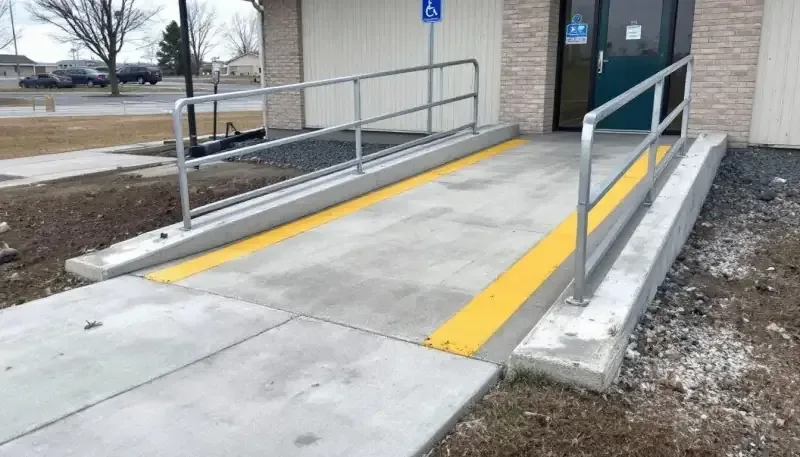
ADA Ramps & Compliance in Liberty, MO
Liberty's Historic Square and fast-growing commercial corridors both face ADA compliance gaps — we close them with precision-built concrete ramps and full property assessments.
Patch the Old Ramp or Pour a New One — Which Actually Protects Your Business?
We hear this debate constantly from Liberty property owners. A ramp near the Historic Square starts crumbling, slopes shift after a few Missouri freeze-thaw cycles, and the question lands: repair or replace? Patching saves money upfront but rarely fixes the underlying slope violations. Most ramps we inspect around Wilshire Plaza and Liberty Commons fail current ADA standards regardless of surface condition. A full replacement costs more today but eliminates the lawsuit exposure that a patched ramp quietly preserves.
The comparison matters because ADA enforcement doesn't grandfather old work. Your ramp built in 2005 gets judged by today's standards. We've completed 377-plus projects across the Kansas City metro since 2015, and the pattern is clear — property owners who invest in code-correct replacement spend less over a ten-year window than those who patch repeatedly. In Liberty's commercial zones, where foot traffic keeps climbing along MO-152 and I-35, getting it right the first time isn't optional.
What ADA Ramp Compliance Actually Looks Like in Liberty
Federal ADA requirements specify a maximum running slope of 1:12 with cross slopes no steeper than 1:2. Truncated dome detectable warning surfaces must extend the full width of the curb ramp. Handrails, landing dimensions, flared sides — every detail gets measured. In Liberty, the city's building department enforces these alongside Clay County permitting standards. Properties along the Historic Square face additional challenges because original sidewalk grades from the 19th century rarely align with modern slope requirements.
Liberty Commerce Center and the newer retail developments off MO-152 present a different problem. These properties were built between 2018 and 2024, and many ramps already show early settlement cracks from Clay County's expansive clay soils. A ramp that passed inspection four years ago can shift enough to fail today. We see this repeatedly at multi-tenant strip centers where heavy delivery traffic accelerates subbase compaction around curb cuts.
Our compliance work covers the full property — not just one ramp. We survey every accessible route, parking stall, signage placement, and pathway transition. You receive a documented assessment with photographs, measurements, and a prioritized remediation plan. That documentation becomes your defense file if a complaint ever surfaces.
Liberty-Specific ADA Ramps & Compliance Considerations
Clay County's Expansive Soil and Ramp Settlement
Liberty sits on heavy clay soils that expand when wet and shrink when dry. This seasonal movement pushes ramp slabs out of compliance within a few years if the subbase isn't engineered properly. We over-excavate and install compacted Class 5 aggregate beneath every ramp to create a stable platform that resists Clay County's soil behavior. Without this step, your ramp passes inspection today and fails next spring.
Historic Square Grade Challenges
The Historic Liberty Square was laid out in the 1800s with drainage grades that conflict with modern ADA slope maximums. Bringing a storefront entrance into compliance here often requires adjusting the entire sidewalk transition — not just adding a ramp. We've worked on multiple Square-adjacent properties where the solution involved regrading a 30-foot sidewalk section to achieve legal slope ratios without altering the building's historic threshold elevation.
High-Traffic Retail Wear Along MO-152
Commercial properties near MO-152 and Liberty Commons see enormous daily foot and vehicle traffic. Ramp surfaces in these zones wear faster, and truncated dome panels take a beating from shopping carts, power washers, and snow plows. We specify cast-in-place truncated domes with UV-stabilized polymer inserts rated for high-traffic commercial use. Surface-applied panels common in budget installs typically delaminate within three winters here.
ADA Lawsuit Exposure in Growing Markets
Liberty's population has grown past 31,000, and that growth attracts the serial ADA litigants who target expanding commercial markets. Properties along US-69 and Kansas Street with outdated ramps or missing detectable warnings are low-hanging fruit for demand letters. A single lawsuit typically starts at $4,000 to $8,000 in settlement costs — often more than the ramp replacement itself. Proactive compliance is the cheapest insurance available.
How We Build ADA Ramps That Pass Inspection in Liberty
Every project starts with a digital slope survey using a calibrated smart level. We measure the existing grade at six-inch intervals across the full ramp zone and document everything with timestamped photos. This baseline tells us exactly how much material needs to come out and where the new subbase elevation must land. On the Historic Square, we've encountered original limestone rubble layers beneath the sidewalk — knowing what's down there before the concrete truck arrives saves everyone time and money.
Excavation in Clay County demands respect for the soil. We dig 8 to 12 inches below finished grade depending on site conditions, then install a geotextile fabric barrier to prevent clay migration into the aggregate base. Our crew compacts 6 inches of Class 5 limestone in two lifts using a plate compactor rated for 5,500 pounds of force. We source aggregate from local quarries in the Northland to keep material costs down and delivery windows tight.
We pour 4,000 PSI air-entrained concrete with fiber mesh reinforcement. The air entrainment is non-negotiable in Missouri — it creates microscopic voids that absorb expansion pressure during freeze-thaw cycles. Forms are set with laser-verified slope measurements. Our finishers work the surface to a broom texture that exceeds the minimum slip-resistance coefficient. Truncated dome panels get cast directly into the wet concrete, not glued on after the fact.
After a minimum 7-day cure with wet-blanket protection, we re-survey every slope measurement and produce a final compliance report. That report includes cross slopes, running slopes, landing dimensions, and flared side ratios — everything an ADA inspector or attorney would check. We don't leave your property until the numbers are right.
Bringing a Historic Square Storefront Into Full Compliance
A property owner with a multi-tenant retail building on the south side of the Historic Liberty Square received a demand letter citing three ADA violations: a ramp slope measured at 1:10.4, missing truncated dome warnings, and a landing that fell two inches short of the required 60-inch depth. The building dates to the 1880s, and the existing ramp had been patched at least twice over the prior decade. The owner needed a solution that satisfied federal ADA standards without altering the building's historic limestone threshold.
Our crew excavated the full ramp area down to 10 inches, removing layers of old concrete and crumbled limestone rubble. We installed geotextile fabric over the native clay, then built up a compacted Class 5 base that allowed us to set the new ramp at a 1:12.8 slope — well within compliance — while meeting the existing threshold elevation exactly. Cast-in-place truncated domes in a contrasting brick-red color complemented the Square's historic aesthetic. The new landing measured 64 inches deep with proper flared sides.
Final survey confirmed every measurement passed. The owner used our compliance documentation to respond to the demand letter, and the complaint was withdrawn without settlement. Total project time from excavation to final cure was nine days. That building now has a ramp engineered to handle Clay County's soil movement and 60 freeze-thaw cycles per year — built to last, not just to pass.
How Much Does ADA Ramps & Compliance Cost in Liberty?
| Type | Cost / Range | Per Installation |
|---|---|---|
| Standard ADA Ramp | $2,000–5,000 | Per Installation |
| Curb Cut / Curb Ramp | $1,500–3,000 | Per Installation |
| Complex / Multi-Level | $5,000–8,000 | Per Installation |
ADA ramp costs in Liberty typically range from $2,800 to $7,500 per ramp depending on grade corrections and subbase conditions. Properties on the Historic Square often run higher due to the extra sidewalk regrading required by the original 19th-century drainage slopes.
ADA Ramps & Compliance FAQ for Liberty, MO
What Clay County permits do I need for ADA ramp construction in Liberty?
Most ADA ramp projects in Liberty require a building permit through the City of Liberty's Community Development Department. If your property sits within the Historic Square overlay district, you may also need design approval to ensure the ramp doesn't conflict with historic preservation guidelines. We handle permit applications as part of our scope. Typical permit turnaround in Liberty runs 5 to 10 business days. We factor this lead time into your project schedule so there are no surprises.
How do I prioritize ADA upgrades across a large Liberty commercial property?
We use a risk-based prioritization framework. Primary building entrances and the accessible route from designated parking stalls get addressed first — these are the most common complaint triggers. Next come secondary entrances, pathway transitions, and loading zone curb cuts. For multi-building properties like Liberty Commerce Center tenants, we create a phased plan that spreads construction across weeks or months to limit disruption. Each phase delivers independently compliant sections so your liability drops incrementally.
What happens during a freeze-thaw cycle to improperly built ramps?
Water penetrates surface cracks, freezes, and expands with roughly 30,000 PSI of force. In Clay County, we cycle through freeze-thaw 40 to 60 times per winter. A ramp poured without air-entrained concrete or with an inadequate subbase will spall, crack, and heave. Heaving changes the slope — sometimes by a full degree in a single season. That's enough to push a compliant ramp past the 1:12 maximum. We've torn out ramps less than two years old along Kansas Street that failed specifically because the original contractor skipped air entrainment.
Can you work around my business hours to avoid shutting down customer access?
Absolutely. Most of our Liberty commercial projects are scheduled during off-peak hours. For retail properties along MO-152 and Liberty Commons, that usually means early morning pours starting at 6 AM with forms set the previous afternoon. We maintain pedestrian access through adjacent routes and install ADA-compliant temporary signage directing customers. A typical single-ramp replacement takes one day of active construction. Your entrance stays functional throughout.
Do Liberty's newer commercial developments really have ADA problems already?
Yes, and it's more common than owners expect. Developments built between 2018 and 2024 near MO-152 and Liberty Commerce Center were constructed on freshly graded clay fill. That fill settles unevenly over the first three to five years. We've measured ramps at newer Liberty retail centers that have shifted half an inch vertically — enough to change the running slope from compliant to non-compliant. The original builder passed inspection, but soil movement doesn't care about paperwork. An updated survey is the only way to confirm current compliance.
Other Concrete Services in Liberty, MO
ADA Ramps & Compliance in Nearby Cities
Request a Callback From Our Liberty ADA Specialists
Leave your number and project details — we return calls within two hours during business days. Our crew covers all of Liberty from the Historic Square to Liberty Commerce Center and every commercial zone in between.