
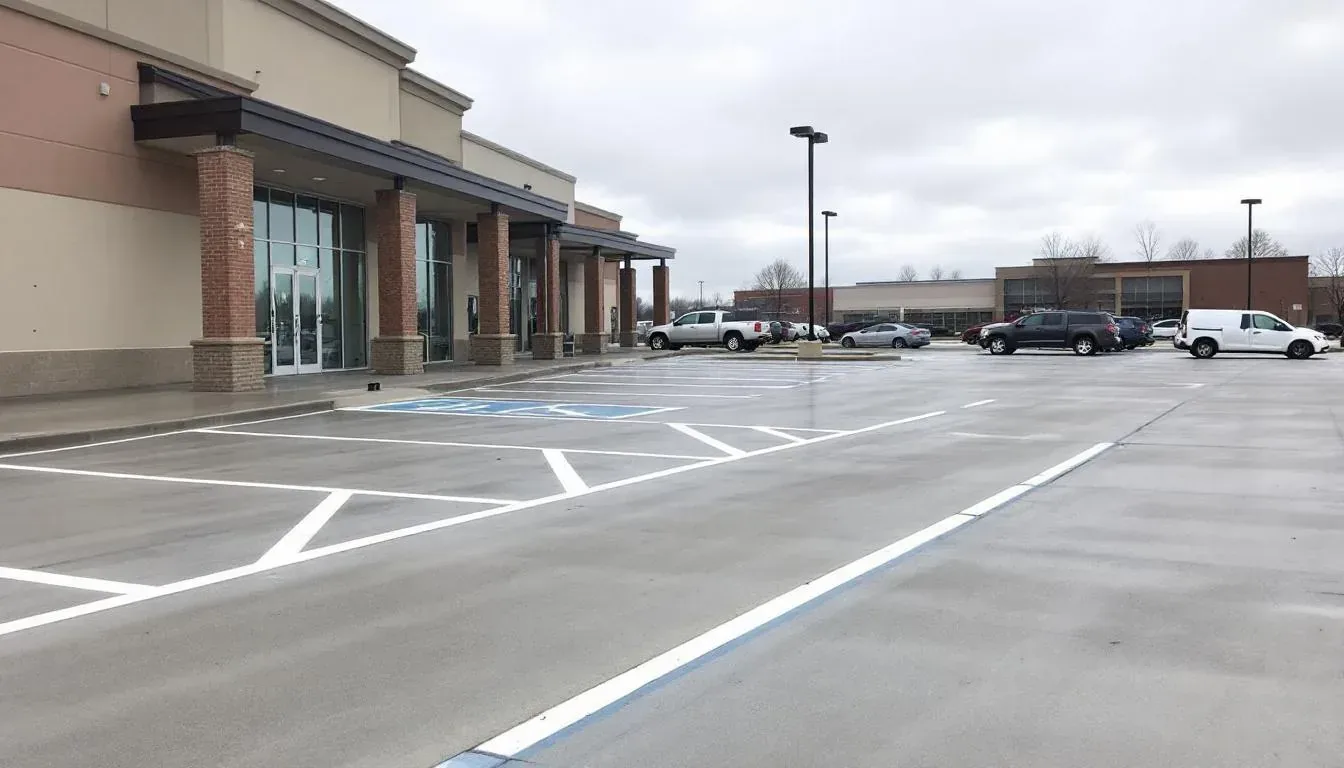
Parking Lots in Saint Joseph, MO
Saint Joseph's aging commercial corridors deserve parking lots built for the next 30 years — not patches that crumble after two Missouri winters.
What's Happening Under Your Belt Highway Parking Lot Right Now?
Drive down Belt Highway on any weekday afternoon and you'll see it. The crumbling asphalt in front of strip retail centers. The patched-over potholes near the East Hills Mall area. Faded striping that confuses drivers and creates liability headaches. These lots were poured decades ago for a different era of traffic. Today, they're absorbing punishment from regional hub traffic flowing in from North Missouri and heavy logistics rigs serving the Stockyards Industrial District. The surface tells you what the subbase already knows — it's past time.
Saint Joseph sits at the crossroads of I-29, US-169, and US-36. That positioning makes your commercial lot work harder than lots in smaller towns. Every delivery truck, every customer vehicle, every employee car adds load cycles. When the original concrete or asphalt dates back to the mid-20th century buildout, you're not dealing with surface problems. You're dealing with structural failure from 50-plus years of accumulated stress on aging substrates.
We've completed 377 projects since 2015, and a growing number are right here in Buchanan County. Business owners along Frederick Avenue and in the Stockyards district are replacing deteriorated lots with engineered concrete systems designed for modern traffic loads. The investment pays back in reduced maintenance, fewer slip-and-fall claims, and a property that looks like it belongs in Saint Joseph's economic future — not its past.
Concrete Parking Lots Engineered for Saint Joseph's Commercial Reality
Saint Joseph's commercial pavement lifecycle is mature. Most lots in the Belt Highway Corridor and Frederick Avenue Retail zone were built during the city's mid-century expansion. That means oxidized asphalt, spalled concrete, and subbase materials that have compacted beyond their useful life. We don't resurface over failure. We excavate to stable soil, proof-roll the subgrade, and build a new aggregate base designed to distribute modern axle loads evenly across the slab system.
Our standard commercial parking lot spec in Saint Joseph starts at 6 inches of reinforced concrete over compacted Class 5 aggregate. For lots serving the Stockyards Industrial District or logistics facilities near I-29, we increase thickness to 7 or 8 inches with fiber-mesh reinforcement and doweled joints. Joint spacing is calculated based on slab geometry and anticipated load patterns — not guessed at with a chalk line and a saw.
Drainage is critical in Saint Joseph, especially in older industrial sectors near the Missouri River where grade issues compound water problems. Every lot we pour includes engineered slope design with a minimum 1.5 percent cross-slope to collection points. We integrate curb-and-gutter systems, catch basins, and tie-ins to existing storm infrastructure. The goal is zero standing water within 30 minutes of a typical rain event.
Saint Joseph-Specific Parking Lots Considerations
Aging Subbase Conditions in Redevelopment Zones
Much of Saint Joseph's commercial core was built on fill material and compacted soils from the 1940s through the 1970s. Along Belt Highway and in the East Hills area, we frequently encounter degraded subbase layers — crushed limestone that has turned to powder, or old asphalt millings used as a cheap base decades ago. Our process includes subgrade testing with a nuclear density gauge before any concrete is placed. If the existing base fails proof-rolling, we remove and replace it. Skipping this step is why so many Saint Joseph lots crack within five years of resurfacing.
Heavy Logistics Traffic from the Stockyards and North Industrial Districts
Saint Joseph's industrial economy generates serious truck traffic. If your lot serves a warehouse, distribution center, or manufacturing facility near the Stockyards Industrial District, standard 6-inch residential-grade concrete won't survive. Loaded semi-trailers exert 18,000 to 34,000 pounds per axle. We design truck aprons, loading dock approaches, and drive aisles with thickened-edge slabs and #4 rebar on 12-inch centers. The concrete mix itself is a 4,500 PSI design with air entrainment for freeze-thaw durability — because Saint Joseph winters don't care about your budget.
What Your Parking Lot Timeline Looks Like in Saint Joseph
Days 1–3: Pre-Construction and Permits. We submit your permit application to the City of Saint Joseph and coordinate any required utility locates through Missouri One Call. Buchanan County permit turnaround typically runs 5 to 10 business days, so we file early and use that window for material scheduling, traffic control planning, and phasing strategy. If your business needs to stay open — and most do — we finalize which sections pour first and where temporary customer access routes go.
Days 4–7: Demolition and Excavation. Our crew removes existing pavement in planned phases. Old asphalt gets hauled to a recycling facility. Old concrete is broken and removed. We excavate to the required depth — typically 12 to 14 inches below finished grade — and begin subgrade preparation. Proof-rolling with a loaded dump truck identifies soft spots. Any failed areas get over-excavated and backfilled with compacted aggregate.
Days 8–10: Base Installation and Forming. We place and compact 6 to 8 inches of Class 5 aggregate base, verify compaction with density testing, and set steel or aluminum forms to grade. Rebar and dowel bars go in according to the engineered joint layout. Expansion joints at building interfaces and isolation joints at utility structures are positioned now — they prevent the random cracking that plagues lots poured without proper detailing.
Days 11–14: Concrete Placement. We pour in sections to keep portions of your lot accessible. A typical 15,000-square-foot lot takes 2 to 3 pour days. Concrete arrives from a local batch plant and is placed, vibrated, screeded, and finished within the workability window. Saw-cut control joints are cut within 6 to 12 hours. Missouri's spring and fall windows — late April through June and September through October — give us ideal cure temperatures. Summer pours require misting and evaporation retarders.
Days 15–21: Curing, Striping, and Handoff. Concrete needs 7 days of wet curing before vehicle traffic. We apply curing compound immediately after finishing and keep barricades in place. At day 7, we stripe lanes, fire lanes, and ADA-compliant accessible spaces. Final walk-through happens around day 14 to 21. Your lot is fully open to normal traffic at 28 days when the concrete reaches design strength.
Belt Highway Strip Center Gets a Second Life
A property owner managing a 12,000-square-foot strip retail center on Belt Highway near the Mitchell Avenue intersection called us about a parking lot that had become a liability. The asphalt surface — original to the 1978 construction — had deteriorated to the point where potholes were forming weekly. Tenants reported customers driving past the center because the lot looked abandoned. Two slip-and-fall claims in one winter made the situation urgent.
We removed the entire asphalt surface and discovered what we suspected: the original limestone subbase had pulverized into fine material with almost no load-bearing capacity. Our crew excavated an additional 4 inches, replaced the failed base with compacted Class 5 aggregate, and proof-rolled every square foot. The new 6-inch reinforced concrete lot was poured in three phases over 6 days, keeping at least 60 percent of parking available to tenants at all times.
The finished lot included new ADA-compliant spaces, LED-compatible light pole bases, concrete curb-and-gutter with integrated drainage to Belt Highway's storm system, and fresh thermoplastic striping. The property owner told us two vacant units leased within 90 days of completion. A parking lot doesn't just hold cars — it tells customers whether a business is worth walking into.
How Much Does Parking Lots Cost in Saint Joseph?
| Type | Cost / Sq Ft | Project Dependent |
|---|---|---|
| Standard Concrete Lot | $4–8 | Varies by scope |
| Heavy-Duty (Truck Traffic) | $6–10 | Varies by scope |
| Repair / Section Replace | $8–14 | Varies by scope |
Parking lot pricing in Saint Joseph typically runs $6.50 to $9.50 per square foot for a standard 6-inch commercial slab, depending on subbase condition and access complexity. Lots in older sections along Frederick Avenue or near the river often cost more due to subgrade remediation and drainage engineering requirements.
Parking Lots FAQ for Saint Joseph, MO
What permits does Saint Joseph require for a commercial parking lot project?
The City of Saint Joseph requires a commercial building permit for any new concrete parking lot or full replacement. If your project alters drainage patterns or connects to the municipal storm system, you'll also need a grading and stormwater permit. ADA compliance review is part of the permitting process for any lot with public access. We handle the full permit submission, including site plans and engineering documentation. Typical approval in Buchanan County takes 5 to 10 business days, though complex projects near the floodplain may require additional review.
Why are so many parking lots along Belt Highway falling apart?
Most Belt Highway commercial lots date to the 1960s through 1980s buildout of that corridor. The original asphalt was designed for lighter traffic volumes and smaller vehicles. Decades of freeze-thaw cycling, deferred maintenance, and increasing truck traffic have pushed these lots past their structural limits. The subbase material underneath has often degraded to the point where overlays just mirror the cracks below. A proper fix means full removal, subgrade correction, and a new engineered concrete system — not another layer of asphalt over a failed foundation.
Can you phase the project so my Frederick Avenue retail business stays open?
Absolutely. Phased pours are standard for our retail and restaurant clients along Frederick Avenue. We divide your lot into sections and pour them sequentially, maintaining customer parking and safe pedestrian access throughout. Temporary signage directs traffic to open sections. Most businesses report minimal revenue impact during construction. We schedule the noisiest work — demolition and excavation — during off-peak hours when possible. The key is a detailed phasing plan created before any equipment arrives on site.
How do you handle drainage problems on lots near the Missouri River floodplain?
Properties in Saint Joseph's older industrial sectors near the river often have poor natural drainage due to flat topography and high water tables. We engineer positive drainage into every lot using a combination of cross-slope grading, swales, curb-and-gutter systems, and strategically placed catch basins. For lots in flood-prone areas, we may recommend a thickened aggregate base layer to provide additional subsurface drainage capacity. Tie-ins to the municipal storm system are coordinated with the city during permitting. Standing water is the number one destroyer of concrete lots — we design it out from the start.
Other Concrete Services in Saint Joseph, MO
Get Your Free Parking Lot Estimate in Saint Joseph
Send us your lot address on Belt Highway, Frederick Avenue, or anywhere in Buchanan County, and we'll provide a detailed scope and pricing estimate — typically within 48 hours of a site visit.