
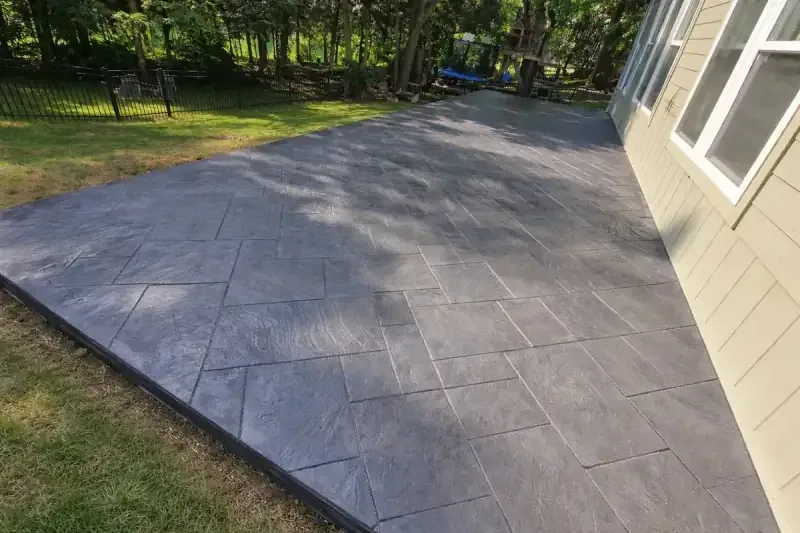
Stamped Concrete in Saint Joseph, MO
Your neighbors on Museum Hill didn't settle for plain gray slabs. Neither should you. We pour stamped concrete that matches Saint Joseph's historic character — without the maintenance headaches of real stone.
Is your patio crumbling where old brick meets new concrete?
You've seen it everywhere across Saint Joseph's older neighborhoods — that ugly line where a crumbling brick paver meets a cracked concrete slab. The edges chip. Water pools in the seam. Weeds push through every spring. Homes near Wyatt Park and the South Side deal with this constantly. Decades of patching and overlaying different materials have left patios, walkways, and driveways looking like a patchwork quilt nobody asked for.
Stamped concrete solves the transition zone problem in one clean pour. Instead of fighting mismatched surfaces, you get a single monolithic slab that mimics the look of natural stone, brick, or slate. No seams to separate. No joints to shift. We've completed over 377 projects since 2015, and Saint Joseph homeowners keep calling us back because the results hold up to Missouri weather year after year.
What Stamped Concrete Actually Looks Like in a River Town
Saint Joseph sits on Missouri River bluffs with soil that shifts more than most homeowners realize. That means standard decorative concrete work fails fast if the installer doesn't account for Buchanan County's silty clay loam. Stamped concrete done right starts with proper subgrade preparation — compaction, drainage gravel, and reinforcement designed for this specific ground. The decorative part is the finish line, not the starting point.
Pattern options range from ashlar slate and cobblestone to herringbone brick and wood plank. Color is integral — we mix pigment directly into the concrete rather than painting it on top. That means your patio near Hall Park or your driveway off Frederick Avenue won't fade to a washed-out ghost of itself after two winters. Accent colors, borders, and multi-pattern designs let you match your home's era, from 1920s Craftsman to 2020s new construction.
Stamped concrete works for patios, driveways, walkways, pool decks, and front porches. A 400-square-foot patio is a weekend pour. A full driveway replacement takes two to three days of active work. Either way, you get a surface that looks like hand-laid stone at roughly half the installed cost — and without the sand-filled joints that ants and weeds love to invade.
Saint Joseph-Specific Stamped Concrete Considerations
Buchanan County's Silty Clay and What It Does to Slabs
The soil along the Missouri River bluffs is heavy with silt and expansive clay. It swells when wet and shrinks when dry. This seasonal movement cracks thin or poorly supported slabs within a few years. We excavate deeper than most contractors — typically 6 to 8 inches of subgrade removal — and install compacted Class 5 aggregate before any concrete touches the ground. Fiber mesh and rebar reinforcement handle the rest.
Drainage Challenges in Northside and South Side Yards
Older neighborhoods near the river — especially along the Northside and South Side — sit on lots with inconsistent grading. Water runs toward the house instead of away from it. Every stamped concrete project we pour includes a slope calculation. We grade the slab at a minimum one-quarter inch per foot away from your foundation. In severe cases, we integrate French drain channels beneath the edge of the pour to redirect runoff entirely.
Matching Saint Joseph's Historic Architecture
Homes near Museum Hill and Mount Mora Cemetery carry serious architectural character — Victorian porches, limestone foundations, original brick walkways. A random flagstone stamp would clash. We work with you on color matching and pattern selection before the pour date. European fan cobblestone complements Queen Anne-style homes beautifully. Running bond brick stamps pair naturally with early 1900s bungalows found throughout Wyatt Park.
Missouri Freeze-Thaw Cycles and Sealer Selection
Saint Joseph averages around 100 freeze-thaw cycles per winter. Each one pushes moisture into microscopic pores in the concrete surface. Without proper sealing, that moisture expands and flakes the top layer — a process called spalling. We apply a high-solids acrylic sealer within 30 days of every pour. It blocks moisture penetration, enhances color depth, and needs reapplication every two to three years depending on sun exposure and traffic.
How We Build Stamped Concrete in Saint Joseph — A Craftsman's Walkthrough
Every project starts with a site visit and soil check. Buchanan County ground varies block by block — the clay content near Krug Park is different from the sandy fill used in some Northside lots. We probe the subgrade with a hand auger and check for soft spots, root systems, and buried utility lines. If the existing soil won't hold compaction, we haul in clean crushed limestone from a quarry south of town on US-169. This base layer gets compacted in two lifts with a vibratory plate tamper until it reads at least 95 percent standard Proctor density.
Forming comes next. We set aluminum or steel forms to exact grade using a laser level — not a string line. Stamped concrete demands dead-flat subgrade because every imperfection telegraphs through the finished surface. Rebar gets tied on 18-inch centers for driveways, 24-inch centers for patios. We add polypropylene fiber mesh to the mix design as secondary reinforcement. Our concrete comes from a local batch plant and we specify a 4,000 PSI mix with air entrainment — that extra air content is what survives Missouri's freeze-thaw punishment.
The pour itself is where the craft shows. We place concrete in sections, screed it level, and bull-float the surface while it's still plastic. Once the bleed water disappears and the concrete reaches the right firmness — what we call 'thumbprint hard' — we broadcast a color hardener by hand, then follow with a release agent that prevents the stamp mats from bonding. The stamps go down in a specific sequence to keep the pattern aligned across the full slab. One person positions mats. Another walks them in. A third person manages the edge work and texture touch-ups.
After 24 hours we strip the forms, wash off excess release agent with a low-pressure rinse, and inspect every square foot. Any texture voids get hand-tooled with a touch-up skin while the concrete is still green enough to accept detail. We cut control joints with a diamond blade at intervals calculated for the slab dimensions — typically every 8 to 10 feet — and place them along natural pattern lines so they virtually disappear. The final sealer coat goes on once the concrete has cured for three to four weeks, locking in color and protecting the surface through its first Saint Joseph winter.
A Wyatt Park Walkway That Replaced 60 Years of Cracked Brick
A homeowner on Ashland Avenue in the Wyatt Park neighborhood called us about a front walkway that had been falling apart for years. The original path was a mix of 1960s-era brick pavers and poured concrete patches — some sections sat an inch higher than others, creating a trip hazard from the sidewalk to the front porch. Tree roots from a mature silver maple had lifted one corner. Rain pooled against the foundation every time it stormed.
We removed the entire walkway down to bare dirt, cut back the offending roots cleanly, and installed a root barrier along the edge closest to the maple. After compacting 6 inches of crushed limestone base, we poured a 4-inch stamped slab in a running bond brick pattern with a Terra Cotta integral color and Charcoal release agent. The color matched the home's original brick exterior almost perfectly. We graded the walkway to shed water toward the street instead of the foundation.
The homeowner walked on it ten days after the pour. The finished path runs 42 feet from the public sidewalk to the front steps — one continuous surface with no mortar joints, no shifting pavers, and no more puddles against the house. Total project time was three days including demolition and haul-away. It cost less than re-laying the brick would have, and it'll outlast brick by decades.
How Much Does Stamped Concrete Cost in Saint Joseph?
| Type | Cost / Sq Ft | Typical 300 Sq Ft |
|---|---|---|
| Basic Patterns (1 color) | $12–15 | $3,600–$4,500 |
| Premium Patterns (2 colors) | $15–18 | $4,500–$5,400 |
| Multi-Color / Custom | $16–20 | $4,800–$6,000 |
Stamped concrete in Saint Joseph typically runs $12 to $18 per square foot installed, depending on pattern complexity and site access. Homes on hilly lots near Mount Mora or tight Northside streets may require additional grading or hand-carrying materials, which can add $1 to $3 per square foot.
Stamped Concrete FAQ for Saint Joseph, MO
What time of year is best for stamped concrete in Saint Joseph?
Late April through mid-October gives us the best working window. Concrete needs consistent temperatures above 50 degrees Fahrenheit for proper curing. We've poured as early as March using insulated blankets, but the ideal months are May, June, September, and early October. Summer pours work fine — we schedule them for early morning to avoid rapid surface drying in July and August heat. Avoid booking between Thanksgiving and late March unless you're flexible on timeline.
Can stamped concrete go over my existing slab?
Sometimes. If your existing slab is structurally sound — no heaving, no major cracks wider than a quarter inch, and good drainage — we can apply a stampable overlay at roughly 3/8 to 3/4 inch thickness. But if the old slab is failing, an overlay just masks the problem. We'll tell you honestly during the site visit. Most Saint Joseph projects we see in Wyatt Park and Hall Park neighborhoods involve full removal and replacement because the original concrete is 30 to 50 years old and past its useful life.
How do you handle color fading over the years?
Integral color — the pigment mixed directly into the concrete — doesn't fade significantly because it's present throughout the entire slab thickness. Surface-applied color hardener is even more UV-resistant because it contains iron oxide pigments bonded into a dense cement matrix. The main cause of perceived fading is sealer wear. When the sealer thins after two to three years, the surface looks muted. A fresh coat of acrylic sealer brings the color right back. We offer resealing as a standalone service for about $1.50 to $2.50 per square foot.
Will heavy flower pots or a grill leave marks on stamped concrete?
Sealed stamped concrete resists most surface marks. Heavy planters and grills won't scratch or dent a properly cured slab. The main risk is moisture trapping — a pot sitting in one spot for months can cause a slightly different weathering pattern underneath. We recommend using pot feet or furniture pads to allow airflow. Rubber grill mats prevent grease stains from penetrating the sealer. If a mark does occur, a light cleaning with a concrete-safe degreaser and a resealing touch-up will restore the finish.
Other Concrete Services in Saint Joseph, MO
Request a Callback — We'll Reach Out Before End of Day
Drop us your number and project details. Our crew covers all of Saint Joseph and Buchanan County, and we typically return calls within a few hours — not a few days.