
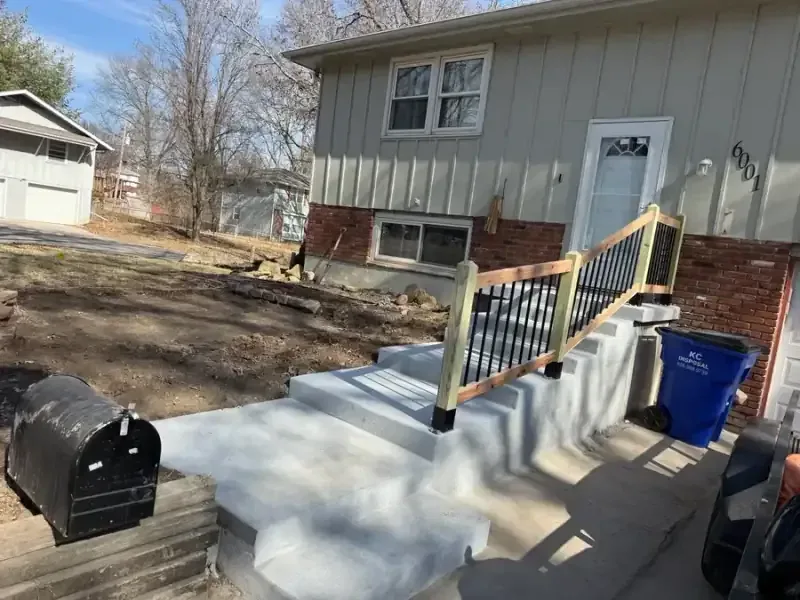
Sidewalks & Walkways in Saint Joseph, MO
Saint Joseph sidewalks take a beating from Missouri River valley freeze cycles and decades of settling soil. We pour walkways built to outlast the ones they replace.
Patch It or Pour New — Which Makes Sense for Your Saint Joseph Walkway?
We hear this question every week from homeowners across Wyatt Park, Museum Hill, and the South Side. That cracked front walkway has been catching your toe for two years now. You filled it with caulk last spring. Maybe you even leveled one slab with foam injection. But patching a walkway that was poured in the 1960s is like putting a new roof on a condemned building. At some point, the foundation underneath just can't support the fix. Knowing when you've crossed that line saves you real money.
A full replacement gives you a new compacted base, proper drainage pitch, and reinforced concrete rated for Buchanan County's freeze-thaw extremes. A patch buys you another season or two. We help Saint Joseph homeowners make that call honestly — and when replacement is the answer, we handle the tearout, grading, and pour in a single mobilization. No drawn-out timelines. No surprise charges halfway through.
What a New Sidewalk or Walkway Actually Involves in Saint Joseph
Saint Joseph's older neighborhoods — especially Northside and areas near Frederick Avenue — were built on Missouri River bluff soils that shift more than most homeowners realize. A walkway poured without addressing that subsurface movement will crack within five years. Our installations start with proper excavation down to stable material, followed by compacted aggregate base and wire mesh reinforcement. Every pour gets control joints spaced to manage the inevitable thermal movement that Buchanan County winters deliver.
Most of our Saint Joseph sidewalk work falls into two categories. Front entry walkways connecting the porch to the driveway or street — typically 4 feet wide and 30 to 50 linear feet. And side-yard connector paths linking front and back outdoor spaces — usually 3 feet wide and running 40 to 80 feet along the house. Both require careful grade work to move water away from your foundation and toward the yard or street.
Finish options range from standard broom texture for maximum traction to exposed aggregate that complements the historic character of neighborhoods like Hall Park and Museum Hill. We also pour colored and stamped walkways for homeowners who want their path to match an existing patio or coordinate with brick exteriors common in older Saint Joseph homes.
Saint Joseph-Specific Sidewalks & Walkways Considerations
Missouri River Bluff Soils and Slab Settling
Much of Saint Joseph sits on loess and alluvial deposits left by the Missouri River. These silty soils hold water and expand under freeze pressure. A walkway poured directly on undisturbed loess will heave and settle unevenly within a few seasons. We excavate 6 to 8 inches below grade and pack in Class 5 limestone aggregate to create a stable, draining base. This prep work adds a half day to the project but prevents the settlement cracks that plague older sidewalks throughout the Northside and South Side neighborhoods.
Matching Historic Home Aesthetics
Saint Joseph has a remarkable inventory of late-1800s and early-1900s homes, especially around Museum Hill and near Mount Mora Cemetery. A plain gray slab in front of a Victorian-era porch looks wrong. We offer integral color matching, brick-border stamping, and exposed aggregate finishes that respect the character of your home. Several of our 377+ completed projects involved matching new walkways to original brick-and-paver transition zones — the same areas where concrete spalling is a known issue in Saint Joseph's historic core.
City of Saint Joseph Right-of-Way Rules
If your sidewalk runs between the street and your property line, the city considers that a public right-of-way. Saint Joseph municipal code requires specific width, thickness, and ADA compliance for these installations and replacements. We handle the permit application and schedule the required inspection so your project stays code-compliant. Homeowners along Frederick Avenue and Belt Highway-adjacent streets often deal with stricter setback requirements. We verify all of this before the first shovel hits the ground.
Mature Tree Root Interference
Saint Joseph's tree canopy is one of its best features — until those roots push your walkway slabs two inches out of level. Neighborhoods like Wyatt Park and Hall Park have decades-old oaks and maples with root systems that extend well under existing concrete. We assess root proximity during the estimate visit. When roots are a factor, we adjust the walkway routing, install root barriers, or work with an arborist to trim without killing the tree. Ignoring roots means your new walkway fails in the same spot within a decade.
How We Build Sidewalks and Walkways in Saint Joseph
Every project starts with a site visit where we probe the existing soil conditions. Buchanan County ground varies block to block — you can hit dense clay near Krug Park and loose silt a mile south toward the river. We use a hand auger to check compaction and moisture content at the actual pour location. This tells us how deep to excavate and whether we need geotextile fabric under the aggregate base. Most Saint Joseph residential jobs require 6 inches of excavation, but river-adjacent properties sometimes need 8 to 10.
After excavation, our crew compacts the subgrade with a plate compactor and lays 4 inches of recycled Class 5 limestone sourced from quarries in the Platte-Buchanan County area. We compact this in two lifts — 2 inches at a time — because a single pass never achieves the 95% compaction density we need. Forms go in next, set with a laser level and pitched at a minimum quarter-inch per foot away from your foundation. We use steel stakes every 3 feet on radius walkways to hold smooth curves without form deflection.
The pour itself uses a 4,000 PSI air-entrained mix from local batch plants. Air entrainment is non-negotiable in Saint Joseph — those 5 to 15 freeze-thaw cycles every winter will destroy non-air-entrained concrete within three seasons. We place welded wire mesh on chairs to keep reinforcement in the middle third of the slab, then screed, bull float, and edge before cutting control joints at intervals equal to the slab width. A broom finish goes on once the bleed water disappears.
Final curing takes 7 days under plastic sheeting or liquid curing compound, depending on the ambient temperature. We don't let homeowners walk on the surface for 48 hours or drive across it for a full week. Before we leave the site, we backfill along the edges, clean up all form debris, and verify the drainage pitch one more time with a level. Your final walkthrough happens that same day.
How Much Does Sidewalks & Walkways Cost in Saint Joseph?
| Type | Cost / Sq Ft | Typical 300 Sq Ft |
|---|---|---|
| Standard Sidewalk | $6–10 | $1,800–$3,000 |
| Decorative Walkway | $10–16 | $3,000–$4,800 |
| Trip Hazard Repair (per section) | $200–500 | $200–$500 |
Most Saint Joseph residential sidewalk and walkway projects run between $8 and $14 per square foot installed, depending on finish and site prep. Properties near the river bluffs or in older Northside neighborhoods often require extra excavation for unstable soils, which can add $1 to $2 per square foot.
Sidewalks & Walkways FAQ for Saint Joseph, MO
Do I need to worry about ADA slope requirements for my home sidewalk in Saint Joseph?
If your sidewalk sits within the city right-of-way — the strip between the street and your property line — Saint Joseph requires ADA-compliant slopes and cross-slopes. That means no more than a 5% running slope and a 2% cross-slope. Private walkways on your property don't carry the same legal requirement, but we still pour them to ADA standards. A properly pitched walkway drains better and is safer for everyone who uses it. We verify slope compliance with a digital level before and after every pour.
How do you handle old sidewalk removal and disposal?
We saw-cut the old concrete into manageable sections, break them with a skid steer hydraulic breaker, and load the debris into dump trailers on site. All concrete waste goes to a local recycling facility in the Buchanan County area — it gets crushed into aggregate for road base. Removal and haul-off is included in our project price. If your old walkway was poured over brick or limestone — common in Museum Hill and other historic Saint Joseph neighborhoods — we sort those materials separately. The full tearout typically takes half a day for a standard front entry walkway.
What walkway thickness do you pour for Saint Joseph homes?
Standard residential walkways get a 4-inch pour. That's sufficient for foot traffic and the occasional wheelbarrow or lawn mower crossing. If your walkway doubles as a path for a utility cart, snow blower, or anything heavier, we bump to 5 inches. Walkways that cross a driveway apron or where vehicles might occasionally roll over the edge always get 5 or 6 inches with additional rebar reinforcement. We discuss load expectations during the estimate visit so the thickness matches your actual use.
Can you install a lighted walkway or embed conduit for future lighting?
We can embed PVC conduit in the base before pouring so you or your electrician can pull low-voltage landscape lighting wire later. This is far cheaper and cleaner than cutting into finished concrete after the fact. We position the conduit exits at the locations where you plan light fixtures and cap them until you're ready. Several homeowners in the Hall Park and Wyatt Park areas have used this approach to add path lighting months after their walkway was poured without disturbing the concrete at all.
My front walkway connects to a public sidewalk that the city owns — who's responsible for making them match?
You are responsible for the portion on your property. The city of Saint Joseph maintains the public right-of-way sidewalk, but they often require that your new private walkway meet the existing public sidewalk at the same elevation and alignment. We measure the existing city sidewalk grade before designing your walkway so the transition is flush and meets code. If the public sidewalk has settled or heaved, we document that during the permit process. In some cases, the city will schedule their own repair to match your new pour, especially along major corridors like Frederick Avenue.
Other Concrete Services in Saint Joseph, MO
Request a Callback About Your Saint Joseph Walkway
Leave your number and a few details about your project. We return calls within one business day and serve all Saint Joseph neighborhoods from Northside to the South Side and everywhere along Belt Highway.