
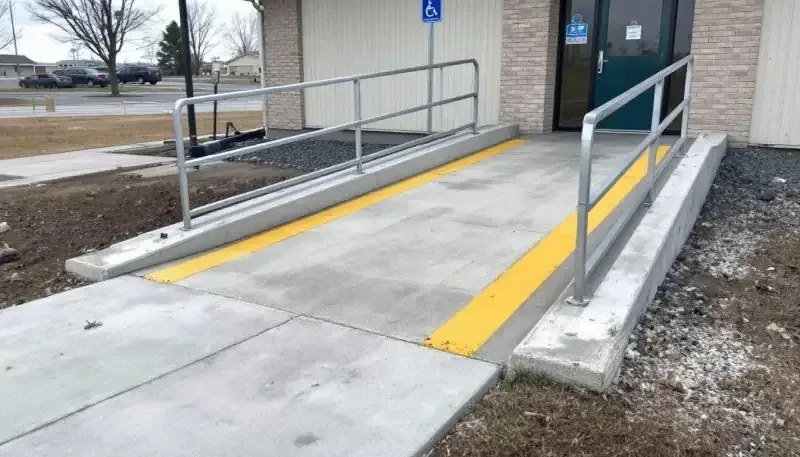
ADA Ramps & Compliance in Saint Joseph, MO
Saint Joseph's aging commercial corridors face mounting ADA exposure — and summer is the narrow window to get concrete poured, cured, and inspected before fall foot traffic peaks.
Is Your Belt Highway or Frederick Avenue Property One Complaint Away from a Lawsuit?
Summer in Saint Joseph means two things for commercial property owners: peak customer traffic and peak construction conditions. Right now, concrete cure times are optimal and Buchanan County inspection offices are processing permits faster than they will come October. If your property has ADA deficiencies — crumbling curb cuts along Frederick Avenue, missing truncated domes at the East Hills Mall area, slopes that exceed 8.33% at your Stockyards District loading dock — this is the season to act.
Serial ADA litigation is not just a Kansas City problem anymore. Plaintiffs' attorneys are filing demand letters against Saint Joseph businesses with documented violations. A single non-compliant ramp, a missing detectable warning surface, or a cross-slope that's off by half a degree can trigger a federal complaint. The average settlement runs $8,000 to $25,000 before you even touch the concrete.
We build ADA-compliant ramps, curb cuts, and accessible routes for commercial properties across Buchanan County. Since 2015, our crew has completed 377-plus projects in the Kansas City metro and surrounding region. Thirteen five-star Google reviews back up the work. We know Missouri code, federal ADA Standards for Accessible Design, and the specific ground conditions that make Saint Joseph jobs unique.
What ADA Compliance Actually Looks Like for Saint Joseph Commercial Properties
ADA compliance is not a single ramp bolted onto your front entrance. It covers every element of your accessible route — from the parking stall striping and signage to the curb ramp geometry, surface texture, landing dimensions, and door approach clearances. In Saint Joseph, we see widespread issues along the Belt Highway Corridor where 1970s and 1980s strip retail was built under outdated standards. Many of those ramps have spalled surfaces, improper running slopes, and zero detectable warning panels. Each deficiency is a separate violation.
The Stockyards Industrial District and older Northside commercial properties present different challenges. Heavy truck traffic has heaved and cracked adjacent sidewalks, destroying compliant grades that may have existed at original construction. River-adjacent drainage patterns push water across pedestrian routes, creating ponding that violates ADA surface requirements. We address root causes — not just surface symptoms — so your investment holds up for 20-plus years.
For multi-tenant properties along Frederick Avenue Retail or near Mosaic Life Care, we provide a full site accessibility assessment before any concrete is poured. You receive a prioritized deficiency report with photographs, measurements, code citations, and a phased remediation plan that fits your budget cycle. This documentation also serves as evidence of good faith if a complaint is filed while you are mid-project.
Saint Joseph-Specific ADA Ramps & Compliance Considerations
Buchanan County Soil Movement and Subgrade Prep
Saint Joseph sits on Missouri River alluvial soils with high clay content. These soils expand when wet and shrink during summer drought, creating the kind of subgrade movement that cracks ramp slabs and throws slopes out of compliance within a few years. We over-excavate and install compacted Class 5 aggregate base to isolate the slab from seasonal soil shifting. Every ramp we pour in Buchanan County gets a minimum 6-inch base layer — sometimes 8 inches near the river floodplain zones in the Stockyards District.
Aging Infrastructure Along Belt Highway and Frederick Avenue
Most of Saint Joseph's commercial concrete dates to the 1960s through 1980s. Advanced oxidation and spalling are visible on virtually every block of the Belt Highway Corridor. When we tie a new ADA ramp into existing sidewalk or parking lot concrete that is 40-plus years old, the transition zone requires careful joint detailing. We saw-cut clean edges, install proper isolation joints, and match slab thickness to prevent differential settlement. This is where cheap ramp installs fail — the ramp is fine, but the connection to your existing pavement cracks within two winters.
Heavy Logistics Traffic Impact on Accessible Routes
The Stockyards and north industrial districts see constant semi-trailer traffic. Trucks turning across curb ramps and accessible routes cause edge damage, surface wear, and base compaction that alters slope geometry over time. We specify 4,500-PSI concrete with fiber mesh reinforcement for any ramp adjacent to truck routes. Thickened edges and steel dowel connections to adjacent slabs prevent the corner breakage that plagues standard residential-grade installations.
Historic District Transition Zones Near Museum Hill
Properties near the Pony Express Museum and Museum Hill neighborhood often have brick or paver sidewalks that transition to concrete at the curb. ADA requires a stable, firm, and slip-resistant surface across the entire accessible route — and deteriorating brick-to-concrete transitions frequently fail that standard. We remove compromised pavers, pour monolithic concrete ramps with cast-in-place truncated dome panels, and create clean expansion joints at the material transition. The result passes inspection and respects the historic streetscape.
How We Build ADA Ramps in Saint Joseph — A Technical Walkthrough
Every project starts with a laser-level survey of the existing conditions. We measure running slope, cross slope, landing dimensions, and flare angles at every ramp location, then compare them against the 2010 ADA Standards for Accessible Design. In Saint Joseph, we consistently find running slopes between 9% and 12% on ramps that were originally built to the 1991 standard or earlier — well above the current 8.33% maximum. We document everything with photos, GPS coordinates, and a written deficiency report before we quote a dollar figure.
Once the scope is set, we pull Buchanan County permits and schedule the pour around your business operations. Our crew typically mobilizes with a skid steer, a plate compactor, and a concrete pump truck — the pump lets us place concrete in tight spots along Frederick Avenue storefronts without blocking customer parking. We excavate to a minimum 12 inches below finished grade, compact native soil to 95% Proctor density, then lay 6 to 8 inches of Class 5 limestone aggregate sourced from local Buchanan County quarries. This base layer is the most critical element. Without it, the alluvial clay beneath Saint Joseph's commercial zones will move your slab out of compliance within three freeze-thaw cycles.
We pour 4,500-PSI air-entrained concrete with synthetic fiber reinforcement. Air entrainment is non-negotiable in northwest Missouri — it creates microscopic voids that absorb expansion pressure during the 50-plus freeze-thaw cycles we see each winter. Forms are set using a digital smart level to hold running slope at 7.5% to 8.0%, giving us a built-in tolerance buffer below the 8.33% maximum. Truncated dome detectable warning panels are cast directly into the wet concrete, not glued on after the fact. Glued panels delaminate within two to three winters here. Cast-in-place panels become part of the slab and last the full 20-year lifecycle.
After the pour, we wet-cure for a minimum of seven days using curing compound and polyethylene sheeting. We return on day 28 to take final slope measurements with a calibrated digital level and compile your compliance documentation package — as-built drawings, slope certifications, material test reports, and photographs of every ramp. This package is what your attorney or insurance carrier needs if an ADA demand letter ever hits your desk.
How Much Does ADA Ramps & Compliance Cost in Saint Joseph?
| Type | Cost / Range | Per Installation |
|---|---|---|
| Standard ADA Ramp | $2,000–5,000 | Per Installation |
| Curb Cut / Curb Ramp | $1,500–3,000 | Per Installation |
| Complex / Multi-Level | $5,000–8,000 | Per Installation |
ADA ramp costs in Saint Joseph typically run $2,800 to $6,500 per ramp location, depending on demolition scope and subgrade conditions. Properties near the river or in the Stockyards District often require additional base prep due to the high-clay alluvial soils, which can add 10-15% to material costs.
ADA Ramps & Compliance FAQ for Saint Joseph, MO
What ADA deficiencies show up most at Saint Joseph's Belt Highway Corridor properties?
Running slopes exceeding 8.33% are the most common issue we find along Belt Highway. Most of these ramps were poured in the 1970s and 1980s under older standards. The second most frequent violation is missing or deteriorated truncated dome detectable warning surfaces. Many Belt Highway properties also have non-compliant cross slopes caused by decades of asphalt overlay buildup in adjacent parking lots. Each of these is a separate ADA violation and a separate basis for a complaint.
Does Saint Joseph enforce local accessibility codes beyond federal ADA?
Missouri follows the federal 2010 ADA Standards for Accessible Design as its baseline. Saint Joseph's municipal building code requires compliance at time of permit for new construction and significant alterations. The city's inspection process checks slope, landing size, surface condition, and detectable warning placement. We have not encountered Saint Joseph-specific requirements that exceed the federal standard, but Buchanan County permit reviewers do enforce the federal standard strictly. Our crew builds to tighter tolerances than the minimum so your ramps pass on the first inspection.
How do you handle phased ADA upgrades for large properties with limited annual budgets?
We create a prioritized remediation plan ranked by litigation risk. High-traffic entrances and primary accessible parking routes get fixed first — these are the locations most likely to trigger a complaint. Secondary entrances, employee routes, and low-traffic areas get scheduled for year two or three. We provide a signed assessment documenting the full scope and your phased timeline. Courts and plaintiffs' attorneys view a documented remediation plan as evidence of good faith, which significantly reduces your legal exposure during the transition period.
Will construction block customer access to my storefront?
We phase the work so at least one compliant accessible route remains open at all times. For Frederick Avenue retail locations with single-entrance storefronts, we typically pour early morning before your doors open, then barricade the curing ramp and route foot traffic through a temporary ADA-compliant path. Most single-ramp replacements are formed, poured, and finished in one day. Curing takes seven days before we remove barricades. We coordinate the schedule with you two weeks in advance so you can notify customers and adjust signage.
What documentation proves my property is ADA compliant after the project?
You receive a compliance package that includes as-built drawings with dimensions, certified slope measurements taken at 28 days post-pour using a calibrated digital level, concrete batch tickets showing mix design and air content, photographs of each ramp with truncated dome placement visible, and the Buchanan County inspection sign-off. This package is designed to withstand legal scrutiny. If a plaintiff's attorney files a demand letter, your counsel can respond with measured, documented proof of compliance on every element they challenge.
Other Concrete Services in Saint Joseph, MO
Request a Callback from Our Saint Joseph Crew
Leave your number and property address — we return calls within two hours during business days. We cover all of Saint Joseph from Northside to South Side and every commercial zone along Belt Highway, Frederick Avenue, and the Stockyards District.