
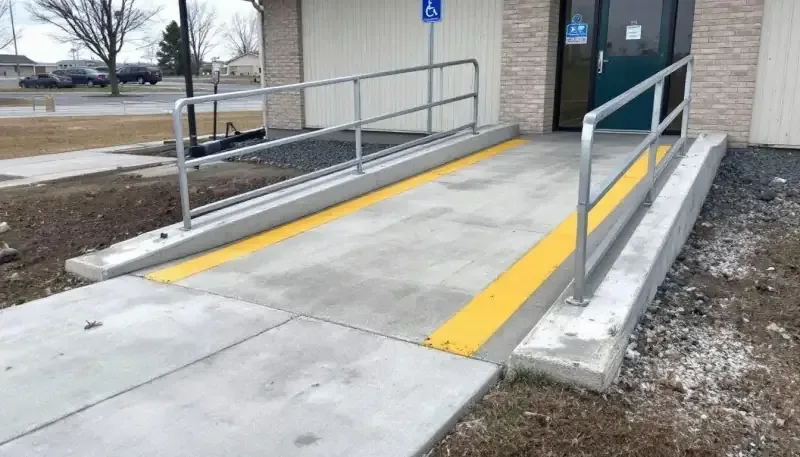
ADA Ramps & Compliance in Leavenworth, KS
Leavenworth's historic downtown and aging commercial corridors carry some of the highest ADA liability exposure in the metro — and fixing it costs less than most business owners assume.
What Does ADA Ramp Work Actually Cost in Leavenworth?
Let's talk numbers. A single commercial ADA ramp replacement in Leavenworth typically runs between $2,800 and $6,500, depending on the slope, soil prep, and whether we're tearing out old non-compliant work first. Properties along the Historic Downtown or 4th Street Retail Corridor often need two to five ramps addressed simultaneously. That puts most projects in the $8,000 to $25,000 range. Compare that to the $75,000 minimum exposure from a single ADA demand letter, and the math is straightforward.
Leavenworth's labor and material costs sit slightly below the Kansas City metro average, but your subgrade conditions add cost that other cities don't face. Many commercial lots near the Missouri River bluffs sit on compacted fill from decades-old grading projects. That fill shifts. It cracks ramps. We account for that in every bid, because a ramp that settles a quarter inch past tolerance isn't compliant anymore — it's a lawsuit waiting to happen.
ADA Ramp Construction Built for Leavenworth's Aging Commercial Infrastructure
Leavenworth earned its title as the First City of Kansas, but that heritage means your commercial properties carry mid-20th-century infrastructure that was never designed for modern accessibility standards. We see the same pattern across the Historic Downtown District and Metropolitan Ave corridor: original sidewalks with no detectable warnings, ramp slopes exceeding 8.33 percent, and landing areas too narrow for wheelchair turning radius. These aren't cosmetic issues. They're federal violations with real financial consequences.
Our ADA compliance work starts with a full-property assessment using digital slope measurement and documentation that holds up in court. We measure every transition, cross-slope, and landing against current ADA Standards for Accessible Design. For properties near Fort Leavenworth or the Riverfront Community Center, we also verify that public right-of-way transitions meet PROWAG guidelines, since those areas see heavy pedestrian traffic from both military personnel and visitors.
Every ramp we pour uses a 4,500 PSI air-entrained mix designed for Leavenworth County's freeze-thaw cycle. Truncated dome panels are cast-in-place or surface-applied depending on your existing grade and drainage patterns. We document slope percentages, concrete mix tickets, rebar placement photos, and final grade measurements — then compile everything into a compliance package your attorney or insurer can use.
Leavenworth-Specific ADA Ramps & Compliance Considerations
Historic Downtown ADA Gaps and Legal Exposure
Leavenworth's Historic Downtown District has some of the widest ADA compliance gaps in the metro. Many storefronts were built or last renovated before the 1990 ADA became enforceable. Original concrete walkways along Delaware and Shawnee Streets show spalling, settled joints, and ramp slopes well beyond legal limits. Serial ADA plaintiffs actively target historic districts because the violations are visible from the street. If your property sits within this core, a proactive compliance audit costs a fraction of a single demand letter settlement.
Subgrade Instability Near the Missouri River Bluffs
Properties along the eastern edge of Leavenworth — especially near Leavenworth Landing Park and the Riverfront Community Center — sit on bluff-adjacent fill soils that have been settling for decades. Standard 4-inch slabs poured on this ground develop differential settlement within a few years, pushing ramp slopes out of compliance. We excavate to stable subgrade, install compacted Class 5 aggregate base, and pour 6-inch reinforced slabs for any ramp within 800 feet of the bluff line. The extra cost upfront eliminates callbacks and re-compliance work later.
Fort Leavenworth Workforce Traffic and Access Demands
The daily workforce surge toward Fort Leavenworth pushes heavy foot and vehicle traffic through North Broadway, US-73, and the 4th Street corridor every morning and afternoon. Commercial properties along these routes face higher pedestrian volumes than their parking lot designs anticipated. That means more wear on ramp surfaces, more wheelchair and mobility device use, and more eyes on any deficiency. If your business serves military families or defense contractors, visible ADA compliance isn't just legal protection — it's the cost of doing business in this market.
What to Expect During Your ADA Ramp Project in Leavenworth
Your project starts with a site visit where we walk every entrance, ramp, curb cut, and parking transition on your property. We use a digital smart level to measure slopes and cross-slopes to the hundredth of a degree, and we photograph every deficiency. You'll receive a written report within 48 hours listing each violation, its location, and the priority level. This report alone gives you a defensible record that you've initiated compliance — useful if a demand letter arrives before construction starts.
On pour day, our concrete truck will stage on the nearest accessible portion of your lot or along the street frontage. For Historic Downtown properties, we coordinate with the City of Leavenworth for temporary street access if your lot doesn't allow truck staging. We set up barrier tape and ADA-compliant temporary signage to maintain accessible routes to your entrance during construction. Your business stays open. Customers can still get in.
Leavenworth County building inspections typically occur within two to four business days after we pull the permit. The inspector will verify ramp slope, landing dimensions, handrail placement if applicable, and detectable warning panel installation. We schedule the inspection ourselves and meet the inspector on site so you don't have to take time away from your business. If any measurement needs adjustment, we correct it before the inspector leaves.
After final inspection approval, we deliver your compliance documentation package. It includes the original assessment report, permit records, concrete batch tickets, rebar and reinforcement photos, final slope measurements, and the signed inspection card. This package is designed to be handed directly to your attorney or insurance carrier if you ever face an ADA claim.
Repair Your Existing Ramps or Replace Them — What Makes Sense in Leavenworth?
Business owners on Metropolitan Ave and the 4th Street corridor ask us this question constantly. Patching an existing ramp costs $400 to $1,200 depending on the damage. Full replacement runs $2,800 to $6,500. The price difference makes patching look attractive — until you measure the slope after the patch cures. Overlay patches change the ramp's surface grade. A ramp that was barely compliant at 8.2 percent before the patch can easily tip to 8.5 or 9 percent afterward. Now you've spent money and still have a violation.
For ramps poured before 2000 in Leavenworth, replacement almost always wins. The original concrete mix likely lacks adequate air entrainment for our freeze-thaw cycle. The subgrade beneath it has settled unevenly. The detectable warning panels, if they exist at all, are faded surface-applied tiles that no longer meet contrast requirements. Patching addresses the surface while ignoring the structural and compliance failures underneath.
We recommend repair only when the existing ramp was poured to current ADA standards, the slope still measures within tolerance, and the damage is limited to cosmetic surface spalling less than a quarter inch deep. If any of those conditions aren't met, replacement gives you a ramp with a documented 15-to-20-year service life and a compliance record that protects your business from day one.
How Much Does ADA Ramps & Compliance Cost in Leavenworth?
| Type | Cost / Range | Per Installation |
|---|---|---|
| Standard ADA Ramp | $2,000–5,000 | Per Installation |
| Curb Cut / Curb Ramp | $1,500–3,000 | Per Installation |
| Complex / Multi-Level | $5,000–8,000 | Per Installation |
Leavenworth's slightly lower concrete delivery costs compared to downtown Kansas City help keep per-ramp pricing competitive, but properties near the bluffs or on older fill soils should budget 10-15 percent more for subgrade preparation to ensure long-term compliance.
ADA Ramps & Compliance FAQ for Leavenworth, KS
Which Leavenworth commercial zones have the highest ADA violation rates?
The Historic Downtown District between Delaware and Shawnee Streets carries the most violations per block. Many of these buildings were constructed or last renovated before ADA enforcement began in 1992. Spalled sidewalks, missing truncated domes, and non-compliant ramp slopes are visible from the street. The 4th Street Retail Corridor also has significant issues, particularly at properties built in the 1970s and 1980s that have only received cosmetic updates since. The Leavenworth Business and Industrial Park generally has newer construction but still shows cross-slope violations at loading dock transitions.
Do I need a Leavenworth city permit for ADA ramp replacement?
Yes. Any concrete work in the public right-of-way or involving structural changes to commercial property access requires a building permit from the City of Leavenworth. We handle the permit application, plan submission, and inspection scheduling. Typical permit turnaround is five to eight business days. If your property is within the Historic Downtown overlay district, there may be additional design review requirements related to materials and appearance. We've navigated this process on multiple Leavenworth projects and build that timeline into your schedule.
How long will my parking lot or entrance be partially blocked during construction?
Most single-ramp replacements are poured and finished in one day. Concrete needs 24 to 48 hours before foot traffic and 72 hours before vehicle traffic. For multi-ramp projects, we phase the work so at least one accessible entrance remains open at all times. We install temporary ADA-compliant signage directing customers to the open route. On a typical three-ramp project, total disruption to any single entrance is two days. We schedule pours early in the morning to minimize overlap with your peak business hours.
What's the difference between a compliance assessment and a full accessibility audit?
Our compliance assessment focuses specifically on exterior concrete elements: ramps, curb cuts, parking lot slopes, sidewalk transitions, and detectable warnings. A full accessibility audit covers interior elements like door widths, restroom layouts, counter heights, and signage — that's typically handled by an accessibility consultant or architect. We often work alongside those professionals. Our concrete assessment and documentation cover the exterior elements that generate the majority of ADA demand letters against Leavenworth commercial properties.
Can you match new ramp concrete to the older walkways along my Historic Downtown storefront?
We can get close, but an exact match to decades-old concrete is unrealistic. Weathering, mineral deposits, and UV exposure change concrete color over years. We offer integral color additives and surface treatments that bring new pours within a reasonable range of your existing work. For properties in the Historic Downtown overlay, we've used exposed aggregate and broom finishes that complement the character of adjacent older concrete. After six to twelve months of weathering, the visual difference becomes minimal.
What if my property has ADA issues but I'm also planning a larger renovation next year?
This is common in Leavenworth, especially for building owners planning facade or interior renovations on older properties. We recommend addressing the highest-liability items now — particularly any ramp or curb cut that a serial plaintiff could photograph from the street. We design our ramp work to integrate with future site improvements so nothing gets torn out and redone. If your renovation triggers the ADA alteration threshold of 20 percent of project cost, you'll be required to upgrade path-of-travel elements anyway. Getting ramps done now counts toward that obligation.
How do freeze-thaw cycles in Leavenworth County specifically damage ADA ramps?
Leavenworth averages 100-plus freeze-thaw cycles per winter. Water enters surface pores and micro-cracks, expands when it freezes, and breaks apart the top layer of concrete. This is called scaling or spalling. On ADA ramps, even minor surface deterioration changes the effective slope and creates trip hazards that violate accessibility standards. We use 4,500 PSI air-entrained concrete with 6 percent air content to resist this cycle. Proper curing and sealing within 28 days of the pour adds another layer of protection. Ramps poured without air entrainment in this climate typically show compliance-level damage within three to five winters.
Other Concrete Services in Leavenworth, KS
Schedule Your Leavenworth Property Compliance Consultation
During your on-site visit, we'll measure every ramp, curb cut, and parking transition on your property with digital slope tools and deliver a written deficiency report within 48 hours — so you know exactly where you stand before spending a dollar on concrete.