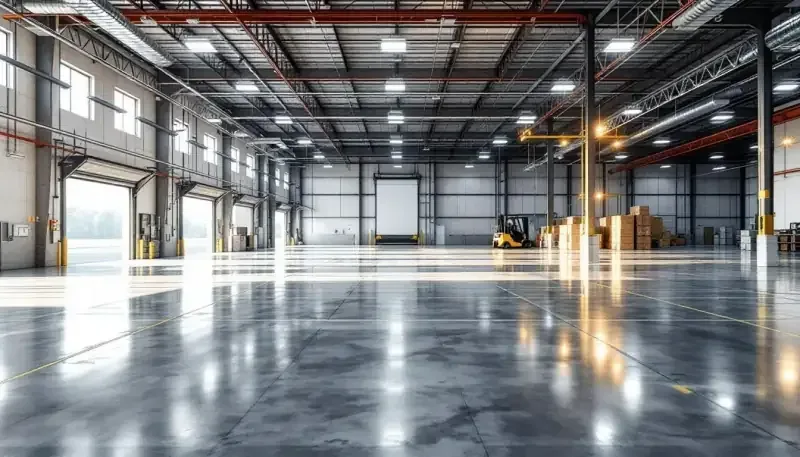
Warehouse & Industrial Floors in Leawood, KS
Your Leawood facility deserves a floor that matches the standards this city is known for — precision-flat, heavy-duty, and built to handle decades of forklift traffic without cracking or dusting.
Is Your Warehouse Floor Holding Your Operation Back?
You walk your Leawood warehouse floor every morning and see the same thing. Cracked joints near the dock doors. Dust coating your inventory. Forklift wheels catching on spalled edges where the old slab has given up. Maybe you're in the Town Center District or down near 135th, running a distribution operation that demands precision — and your floor is the weakest link in the chain.
Leawood businesses operate at a higher standard. Your clients expect it. Your insurance carrier expects it. The city expects it. A deteriorating warehouse floor isn't just an eyesore — it's a safety hazard, an efficiency drain, and a liability waiting to happen. Every uneven joint slows your pickers down. Every dusting slab contaminates product.
We've poured and replaced industrial floors across Johnson County since 2015. With 377 completed projects behind us, we understand the specific challenges Leawood facilities face. From the settlement-prone subbases near the Blue River basin to the high aesthetic bar set by neighboring retail zones at Park Place, we build floors that perform and look the part.
This isn't residential work. Industrial floors demand engineered subbases, high-PSI concrete, precision joint layouts, and curing protocols that most contractors skip. We don't skip anything. Our crew delivers floors rated for the loads you actually run — not the loads a generic spec sheet assumes.
Industrial-Grade Floors for Leawood's Most Demanding Facilities
Leawood's commercial zones — from Camelot Court to the South Professional District — house facilities ranging from light assembly to heavy distribution. Each demands a different floor profile. We pour slabs from 5 inches to 10 inches thick, reinforced with rebar mats or fiber mesh depending on your load requirements. Typical Leawood warehouse floors spec at 5,000 to 6,000 PSI with a vapor barrier beneath, critical for buildings near the Blue River basin where subsurface moisture migrates aggressively.
Joint layout is where most industrial floor projects succeed or fail. We coordinate directly with your racking vendor and material handling consultant to place saw cuts, construction joints, and isolation joints so they align with column grids and rack legs. Random joint placement leads to curling, cracking at anchor points, and premature failure under loaded pallet racks. Our layouts follow ACI 360 guidelines adapted for your specific equipment footprint.
Surface treatment options include power-troweled hard finishes, integral densifiers, and burnished surfaces rated for forklift traffic from day one. For food-grade or pharmaceutical environments in Leawood, we install seamless epoxy or urethane topcoats that meet FDA and USDA standards. Every floor gets laser-guided screeding to achieve the flatness tolerances your automated systems require.
Leawood-Specific Warehouse & Industrial Floors Considerations
Subbase Settlement Near the Blue River Basin
South Leawood developments along 135th Street sit on fill soils that have been compacting unevenly since the 1990s. Warehouse slabs in this area are especially vulnerable to differential settlement. We perform proof-rolling and dynamic cone penetrometer testing before any pour. Where soft spots exist, we over-excavate and replace with compacted AB-3 aggregate. Skipping this step is the number-one reason industrial floors crack within five years in this part of Johnson County.
Leawood's High Aesthetic and Code Standards
Leawood holds commercial properties to rigorous standards that extend beyond structural performance. If your facility is visible from State Line Road, Roe Avenue, or the Park Place corridor, exterior concrete must meet city appearance guidelines. Interior floors in mixed-use or customer-facing warehouse spaces also benefit from polished or densified finishes that reflect the 'country club' expectations Leawood is known for. We build floors that satisfy both your operations manager and your city inspector.
Heavy Daytime Traffic and Pour Logistics
Leawood's daytime population swells dramatically, creating intense traffic on I-435 frontage roads and retail arteries like 119th Street. Concrete truck staging and delivery timing matter. We schedule pours during early morning hours — typically starting at 5:00 AM — to avoid peak traffic windows. For facilities near Town Center Plaza or Park Place, we coordinate truck routes with the city to prevent disruption to neighboring businesses and ensure continuous delivery to the pour site.
What to Expect During Your Leawood Industrial Floor Project
Your project starts with a site visit where we laser-survey your existing floor, check for moisture vapor emission rates, and discuss your operational needs. We'll walk your facility, note column locations, dock door positions, drain placements, and equipment anchorage points. You'll get a detailed scope document within 48 hours. If your facility is inside city limits, we handle the Johnson County and Leawood building permit applications — including structural engineering submittals when required.
Demolition day is loud. Expect hydraulic breakers and skid steers inside your building for one to three days depending on floor size. We haul debris to a licensed recycling facility — typically 15 to 20 truckloads for a 20,000-square-foot slab. Concrete trucks will stage along your loading apron or adjacent parking area. If you're in a multi-tenant business park off Roe Avenue or near Camelot Court, we coordinate with property management to reserve staging areas and post signage for neighboring tenants.
The pour itself moves fast. Our crew places and finishes 5,000 to 8,000 square feet per day using laser-guided screeds. You'll see a large crew — eight to twelve people — working in coordinated sections. The concrete plant dispatches trucks every 15 minutes to maintain a continuous pour without cold joints. After finishing, we apply curing compound and rope off the area. Johnson County inspections typically occur within 24 to 48 hours of the pour for footing and slab checks.
Curing takes seven days minimum before light foot traffic and 28 days for full forklift loads. We'll give you a written timeline specific to your concrete mix and ambient temperatures. During winter months, we use insulated blankets and ground heaters to maintain proper curing temps. You'll receive weekly progress updates and a final walkthrough where we verify flatness with an F-number profiler before turning the floor over to your operations.
Repair the Existing Slab or Replace It Entirely? A Leawood Cost Breakdown
Many Leawood facility managers ask whether they can patch and overlay their existing floor instead of tearing it out. Surface repairs — grinding, epoxy patching, joint caulking — cost $2 to $4 per square foot and make sense when damage is cosmetic. But if your slab has structural cracks, subbase voids, or moisture vapor emission rates above 5 lbs per 1,000 square feet, repairs become a recurring expense that never solves the root cause. We see this constantly in North Leawood buildings from the 1960s and 70s where original slabs were poured on uncompacted fill.
Full replacement runs $7 to $12 per square foot in Leawood but gives you a new slab with modern vapor barriers, engineered subbases, and joint layouts matched to your current equipment. Over a 10-year window, replacement often costs less than repeated repairs — especially when you factor in operational downtime from recurring patch jobs. If your floor was poured before 1990, it almost certainly lacks a vapor barrier and may have inadequate reinforcement for today's heavier forklifts and denser racking systems.
The decision point is usually slab condition and business growth. If you're expanding operations, adding automation, or switching to heavier equipment, replacement is the clear winner. If your slab is structurally sound and you just need cosmetic improvements, targeted repair makes financial sense. We evaluate both options during our site visit and give you honest numbers so you can make the right call for your Leawood facility.
How Much Does Warehouse & Industrial Floors Cost in Leawood?
| Type | Cost / Sq Ft | Project Dependent |
|---|---|---|
| Standard Industrial Slab | $3–6 | Varies by scope |
| Polished Concrete | $5–10 | Varies by scope |
| Epoxy / Coating System | $4–8 | Varies by scope |
Leawood industrial floor projects typically run $7 to $12 per square foot installed, depending on slab thickness, reinforcement, and finish. The higher land values and strict city permitting requirements in Leawood add modest costs compared to neighboring cities, but the result is a floor built to a standard your facility deserves.
Warehouse & Industrial Floors FAQ for Leawood, KS
Does Leawood require permits for replacing a warehouse floor inside an existing building?
Yes. Leawood requires a building permit for structural concrete work inside commercial buildings. This includes full slab replacement and new pours over 200 square feet. We handle the entire permit process, including submitting engineered drawings to the Leawood Community Development Department. Johnson County also requires inspections at the subbase and post-pour stages. Typical permit turnaround in Leawood is 10 to 15 business days, and we factor that into your project timeline from the start.
What concrete strength should a Leawood warehouse floor have?
Most Leawood warehouse floors need 5,000 PSI minimum. Heavy distribution facilities with loaded pallet racks and reach trucks typically require 6,000 PSI. We adjust the mix design based on your specific loads — a 15,000-pound forklift with solid tires puts very different stress on a slab than a 5,000-pound electric pallet jack. We also spec fiber reinforcement or welded wire fabric depending on joint spacing and slab thickness. Every mix goes through batch plant testing to verify it meets the design spec before the first truck arrives.
How do you prevent moisture problems under the new slab?
We install a 15-mil vapor barrier directly beneath the slab, lapped and sealed at every seam. This is critical in Leawood, especially for facilities near the Blue River basin where groundwater tables fluctuate seasonally. Without a vapor barrier, moisture migrates through the slab and destroys adhesive-applied coatings, causes efflorescence, and creates slip hazards. We also test the existing subgrade moisture content before placement. If levels are too high, we install a granular capillary break layer beneath the barrier.
Can you pour a Leawood warehouse floor in phases so we keep operating?
Absolutely. Phased pours are standard for operating facilities. We divide your floor into sections — typically defined by column lines or natural workflow zones — and pour one section at a time. Each phase gets full cure time before we move equipment onto it. Most Leawood clients run two or three phases to maintain at least 60 percent of their usable floor space throughout the project. We build temporary barriers and dust walls between the active pour zone and your operating area to protect inventory and personnel.
What flatness levels do you guarantee for robotic or automated equipment?
We pour to FF 50/FL 35 as our standard for conventional warehouse floors. For facilities running automated guided vehicles, AS/RS systems, or robotic pallet movers, we achieve FF 80/FL 50 or higher using superflat placement methods. These numbers get verified with a Dipstick profiler after curing. The distinction matters — a floor that looks flat to the eye can still cause AGV navigation errors and product damage if the F-numbers aren't there. We provide certified floor flatness reports with every industrial project.
How long will my new Leawood warehouse floor last before it needs major maintenance?
A properly installed industrial floor in Leawood should deliver 25 to 30 years of heavy service before needing joint repairs or re-topping. That lifespan depends on three factors: subbase preparation, concrete quality, and joint maintenance. We use doweled construction joints, sealed saw cuts, and high-strength concrete to maximize longevity. Annual joint sealant inspection is the single best thing you can do to extend floor life. We provide a maintenance guide specific to your floor and offer annual inspection visits to catch small issues before they become expensive problems.
Other Concrete Services in Leawood, KS
Warehouse & Industrial Floors in Nearby Cities
Schedule Your Leawood Facility Floor Consultation
During our on-site visit, we'll laser-survey your existing floor, test for moisture, and walk through your equipment layout. You'll have a detailed scope and pricing proposal within 48 hours — specific to your Leawood facility, not a generic estimate.