
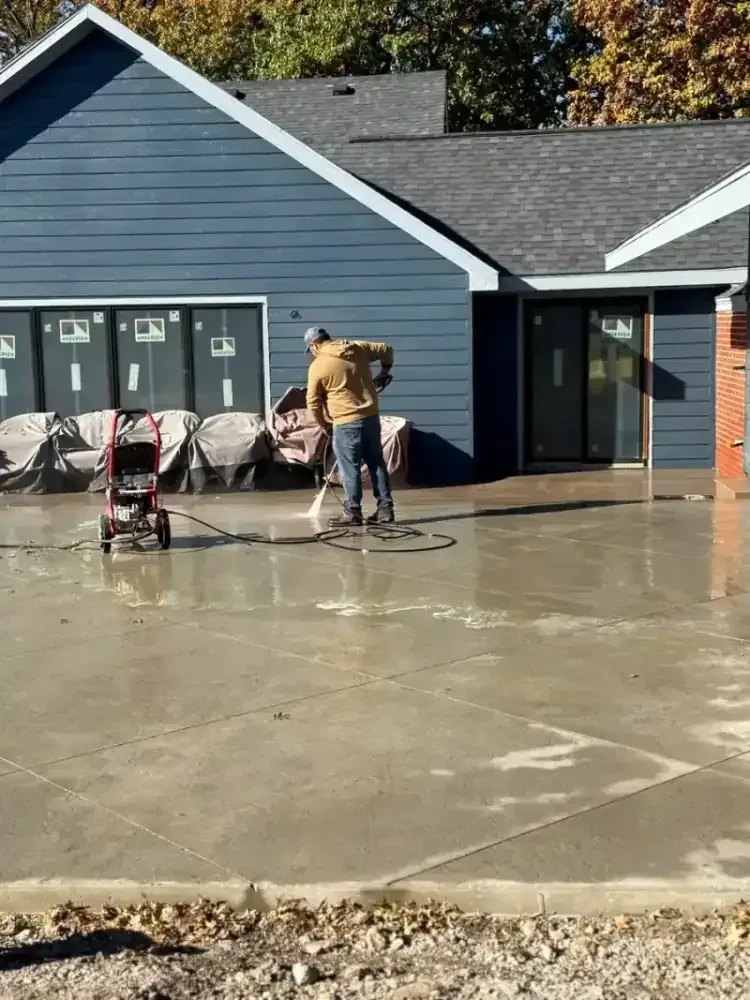
Concrete Patios in Leawood, KS
Your Leawood backyard deserves more than a slab — it deserves a surface that matches the standard your neighborhood already sets.
What Does a Concrete Patio Actually Cost in Leawood?
Let's talk numbers first. A standard 400-square-foot concrete patio in Leawood typically runs between $3,200 and $7,500, depending on finish, reinforcement, and site prep. Stamped or decorative patios push higher — sometimes past $10,000 for larger entertaining spaces. Those figures reflect real costs: Johnson County labor rates, the price of 4,000-PSI concrete delivered from local batch plants, and the extra subbase work that Leawood's clay-heavy soils demand. We don't hide behind vague ranges.
Leawood homeowners in neighborhoods like Hallbrook and Worthington often want finishes that complement high-end exteriors — exposed aggregate, ashlar slate stamps, custom color blends. Those upgrades cost more than a broom finish, but they hold their value in a market where curb appeal directly impacts property worth. Since 2015, we've completed 377 projects across the metro, and our Leawood work consistently reflects the elevated aesthetic this city expects.
Why Leawood Patios Demand a Higher Standard
Leawood is the gold standard of Johnson County living. Homes along 135th Street and deep into Whitehorse carry price tags that justify genuine craftsmanship — not corner-cutting. A patio here isn't just a flat pour behind the house. It's an extension of a curated outdoor space that might include a fireplace, a built-in grill station, or a view toward Ironwoods Park. We build with that context in mind, selecting finishes and edge details that feel intentional alongside your existing hardscape and landscaping.
The soil conditions across Leawood vary more than most homeowners realize. North Leawood lots from the 1950s through 1970s sit on decades of settled fill, while newer developments south of 119th Street — especially near the Blue River basin — deal with active subbase settlement. Both situations require different prep strategies. We adjust our gravel depth, compaction method, and reinforcement schedule based on the actual conditions under your yard, not a one-size formula.
Concrete spalling is common across Leawood's luxury pedestrian areas, and much of that damage traces back to aggressive de-icing during winter. We pour residential patios with air-entrained concrete rated for Kansas freeze-thaw cycles and recommend sealers that resist calcium chloride damage. Your patio should look as good in its fifth winter as it did the week we poured it.
Leawood-Specific Concrete Patios Considerations
HOA and Architectural Review in Leawood's Premier Neighborhoods
Hallbrook, Wilshire, and Worthington all have architectural review committees with specific guidelines for hardscape materials, setbacks, and even color palettes. Before we break ground, we help you identify what your HOA requires. Some committees want a site plan showing the patio's footprint relative to property lines and drainage easements. We've navigated these reviews on dozens of Leawood projects and can prepare the documentation your committee expects — saving you weeks of back-and-forth.
Subbase Settlement in South Leawood Developments
Homes built along the 119th to 135th Street corridor in the 1990s and early 2000s are now seeing their first round of ground settlement issues. The fill soils used during subdivision grading near the Blue River basin are still compressing. If you're in this area, we perform compaction testing before pouring and often install a thicker aggregate base — sometimes six inches instead of four — to prevent the cracking and tilting that plagues patios poured on unstable ground.
Matching Leawood's Aesthetic Expectations
A basic gray broom-finish slab looks out of place next to a $700,000 home. Most of our Leawood clients choose stamped patterns like Ashlar slate or herringbone, paired with integral color that complements their home's stone or brick. We bring physical samples to every consultation so you can see how a color looks against your actual exterior. This isn't a guessing game — it's a deliberate design choice that protects your investment and your neighborhood's visual standard.
What to Expect During Your Leawood Patio Project
The process starts with a site visit where we measure your space, check grade and drainage, and talk through your design preferences. We'll look at how water currently moves across your yard — especially important on Leawood lots where heavy irrigation systems can saturate the soil near patio areas. You'll receive a detailed proposal within a few days, including a scaled layout showing the patio's footprint, expansion joint placement, and any grade adjustments.
On pour day, a fully loaded concrete truck will need access to your property. In most Leawood neighborhoods, the truck parks along the street or in the driveway. For homes in Hallbrook or Mission Farms where driveways are longer or gated, we coordinate chute extensions or pump trucks in advance. Expect some noise from the truck and our vibrating equipment — usually wrapped up within a few hours. Our crew handles all forming, reinforcement, pouring, and finishing in a single day for standard-sized patios.
Johnson County does not typically require a building permit for a ground-level patio that isn't attached to a structure, but Leawood's municipal code has specific impervious surface limits and setback requirements. We verify these before your project starts. If your patio connects to a covered structure or sits within an easement, we handle the permit application and any required inspections through Leawood City Hall.
After the pour, we'll apply a curing compound and mark off the area with caution tape. You'll want to stay off the surface for at least 48 hours and avoid placing heavy furniture for seven days. We'll return to strip forms, backfill edges, and apply sealer once curing is complete — usually about a week later depending on weather.
A Worthington Backyard That Finally Earned Its View
A homeowner off Roe Avenue in the Worthington neighborhood had a ten-year-old stamped patio that was cracking along every control joint. The original contractor had poured directly onto native clay with minimal base prep. Seasonal movement had lifted one corner nearly an inch, creating a trip hazard and pooling water against the foundation. The homeowner wanted the old slab removed and a larger entertaining space installed — something that could handle a six-person dining set, a built-in gas fire pit, and a transition step down to the lawn.
We demolished and hauled off the existing 320-square-foot slab, then excavated an additional 200 square feet to expand the footprint. After testing soil compaction, we installed six inches of compacted limestone base and placed rebar on 16-inch centers throughout. The new 520-square-foot patio was poured in a single day with integral Charcoal color and a seamless Ashlar slate stamp. We formed a six-inch raised perimeter for the fire pit pad and coordinated the gas line stub-out with a local plumber before the pour.
The finished patio drains cleanly toward the south lawn with a consistent two-percent slope. No more standing water against the foundation. The homeowner hosted a neighborhood gathering three weeks after the pour, and the surface showed zero wear. That's what happens when the subbase work matches the finish work — a patio that performs as well as it looks, built for how Leawood homeowners actually live.
How Much Does Concrete Patios Cost in Leawood?
| Type | Cost / Sq Ft | Typical 300 Sq Ft |
|---|---|---|
| Standard Gray (Broom Finish) | $8–12 | $2,400–$3,600 |
| Stained / Colored | $10–15 | $3,000–$4,500 |
| Exposed Aggregate | $10–16 | $3,000–$4,800 |
| Stamped / Decorative | $12–18 | $3,600–$5,400 |
Leawood patio pricing reflects Johnson County's higher labor rates and the premium subbase prep required by local soil conditions. Expect to invest 10-15% more than the metro average, primarily because proper site preparation in this area takes longer and uses more material.
Concrete Patios FAQ for Leawood, KS
Does Leawood require a permit for a backyard patio?
Ground-level patios that aren't attached to a covered structure generally don't require a building permit in Leawood. However, the city enforces impervious surface coverage limits — usually 50% of your lot, depending on zoning. If your property already has a large driveway, pool deck, or walkway system, adding a patio could push you over that threshold. We calculate your current coverage during the site visit and confirm requirements with Leawood's planning department before starting work.
How do you handle the clay soils common in Leawood's newer subdivisions?
South Leawood developments near the Blue River basin sit on heavy clay fill that expands when wet and contracts when dry. This movement cracks patios that aren't properly supported. We excavate deeper than standard — typically eight to ten inches below finished grade — and install a compacted Class V limestone base at six inches minimum. We also use fiber-reinforced concrete with rebar on a grid for added tensile strength. This approach costs a bit more upfront but prevents the settlement cracking we see on patios poured with minimal prep in these areas.
What decorative finishes work best for Leawood homes?
Stamped concrete in Ashlar slate or European fan patterns is our most popular choice in Leawood. These pair well with the stone and brick exteriors common in Hallbrook, Worthington, and Wilshire. Exposed aggregate is another strong option — it hides minor wear and provides natural texture. We bring color charts and physical stamp samples to your consultation so you can match against your home's actual materials. Integral color combined with a secondary release color gives the most realistic stone appearance.
How long will my new patio last in this climate?
A properly poured and sealed concrete patio in the Kansas City metro lasts 25 to 30 years with routine maintenance. Johnson County's freeze-thaw cycles — roughly 40 to 50 per winter — are the primary stress factor. We pour with air-entrained concrete specifically designed for this climate, which creates microscopic air pockets that absorb expansion pressure when moisture freezes inside the slab. Resealing every two to three years and avoiding harsh chemical de-icers extends that lifespan significantly.
Can you build a patio with a built-in fire pit or seating wall?
Absolutely. Integrated fire pits, seating walls, and planter borders are common upgrades on Leawood projects. We pour the patio slab and these features as a unified system with shared footings and consistent finishes. Gas-line rough-ins for fire pits need to be coordinated with a licensed plumber before the pour — we can recommend contractors we've worked with locally. Seating walls typically add $80 to $120 per linear foot depending on height and finish.
Will heavy patio furniture or a large grill crack the concrete?
Standard residential patios are poured at four inches thick, which handles most outdoor furniture and grills without issue. For areas under heavy stone planters, a Big Green Egg on a rolling stand, or a full outdoor kitchen island, we thicken the slab locally to six inches and add extra rebar beneath load points. This targeted reinforcement prevents point-load cracking without overbuilding the entire patio. We plan these details during the layout phase so the extra concrete and steel are placed exactly where needed.
What's the best way to keep ice melt from damaging my patio surface?
Calcium chloride and rock salt are the biggest culprits behind surface spalling on Leawood patios and walkways. We recommend using magnesium chloride-based products or sand for traction instead. Applying a penetrating silane-siloxane sealer every two to three years creates a moisture barrier that limits salt absorption into the concrete. If you currently use a lawn service that applies de-icer near your patio, let them know to switch products. Most surface damage we repair in Leawood traces directly back to aggressive chemical de-icing in the first two winters.
Other Concrete Services in Leawood, KS
Schedule a Site Consultation in Leawood
During the visit, we'll measure your space, evaluate soil and drainage conditions, and walk through finish options with physical samples — right in your backyard. Most Leawood consultations take about 30 minutes, and you'll have a detailed proposal within days.