
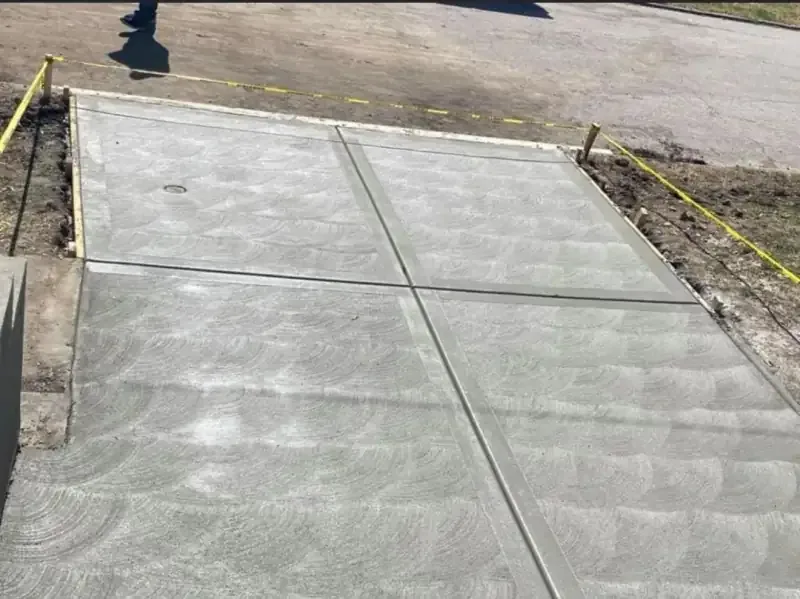
Concrete Overlays & Resurfacing in Leawood, KS
Your Leawood driveway should look like it belongs in Leawood. If spalling, flaking, or gray discoloration has stolen that curb appeal, a concrete overlay restores it without the cost or disruption of a full tearout.
What's That White, Flaking Surface Doing to Your Leawood Curb Appeal?
You notice it every time you pull in. The surface of your driveway or patio is peeling apart in thin, chalky layers. In Hallbrook and Worthington, where every home looks like it was detailed by hand, spalling concrete stands out like a stain on a white shirt. Years of rock salt, freeze-thaw cycles, and Johnson County's clay-heavy moisture swings have chewed through the top layer. The slab underneath might be perfectly sound. But what people see is deterioration.
A concrete overlay solves exactly this problem. We bond a new, engineered surface directly over your existing slab — typically three-eighths to three-quarters of an inch thick. No jackhammering. No hauling away tons of broken concrete. No two-week rebuild. You get a surface that looks freshly poured, with options for decorative finishes that match the country-club aesthetic Leawood homeowners expect.
How Concrete Resurfacing Works on Leawood's Aging Slabs
North Leawood homes built in the 1950s through 1970s carry slabs that are deep into their maintenance-heavy phase. The concrete is structurally intact in most cases, but decades of surface wear, UV exposure, and de-icing chemicals have eroded the finish. Resurfacing gives these mature slabs another 15 to 20 years of life without disturbing landscaping, drainage lines, or adjacent stonework. We see this constantly along Roe Ave and in the Wilshire neighborhood — solid foundations with surfaces that just need a reset.
South Leawood is a different story. Developments near 119th and 135th built in the 1990s are hitting their first major lifecycle threshold. Original concrete is showing control joint separation, surface pop-outs, and early spalling. These slabs are ideal overlay candidates because the subbase is still relatively stable. We prep the surface with diamond grinding, apply a bonding agent, and pour a polymer-modified overlay that flexes with the Kansas temperature swings instead of cracking against them.
Finish options matter in a community like Leawood. We offer smooth troweled finishes, exposed aggregate looks, and stamped patterns that replicate natural stone or brick. Color matching is part of every consultation — if your home near Mission Farms features warm limestone accents, your new driveway surface should complement that palette, not clash with it. Every overlay we install includes an acrylic cure-and-seal coat that resists salt damage and simplifies seasonal cleaning.
Leawood-Specific Concrete Overlays & Resurfacing Considerations
De-Icing Salt Damage Is Accelerating Surface Failure
Leawood's commitment to spotless pedestrian walkways and driveways means heavy de-icing every winter. Calcium chloride and rock salt penetrate the concrete pore structure and accelerate spalling — that familiar white, flaky surface you see on driveways across Whitehorse and Hallbrook by February. Our overlays use a polymer-modified mix with a lower water-to-cement ratio. This creates a denser surface with fewer pores for salt to exploit. Combined with a quality sealer reapplied every two to three years, your overlay resists the chemical attack that destroyed the original finish.
Subbase Settlement in Newer Developments Near the Blue River Basin
Homes south of 135th St sit on fill soil placed during the development boom of the 1990s and early 2000s. Some of that fill has continued to compress, especially near the Blue River basin where clay content runs high and water tables fluctuate seasonally. Before we overlay any slab in these areas, we check for active settlement using a straightedge and level. Minor settlement — under three-quarters of an inch — can be corrected with a leveling coat before the overlay goes down. Anything beyond that, and we recommend mudjacking or polyfoam injection first. We won't put a new surface on a slab that's still moving.
What Your Concrete Overlay Timeline Looks Like in Leawood
Day one is all about preparation. Our crew arrives early morning, moves any planters or furniture off the slab, and begins surface prep. We diamond-grind the existing concrete to create a rough profile for bonding. Any cracks wider than a hairline get routed and filled with a flexible polyurethane sealant. Loose or delaminated patches are chipped out and patched with rapid-set repair mortar. This phase takes a full day for a standard two-car driveway. You'll hear grinding noise for about four hours — we let your neighbors on either side know ahead of time.
Day two is the pour. We apply the bonding slurry first, then spread the overlay mix in a single continuous application. If you've chosen a stamped or textured finish, our crew works the stamps while the material is still plastic — timing is everything on this step. A typical Leawood driveway overlay cures enough for foot traffic by late afternoon. We barricade the area and leave curing compound on the surface overnight. You'll park on the street for this phase. In the Worthington and Hallbrook neighborhoods where street parking is limited, we coordinate timing so both garage bays aren't blocked simultaneously.
Day three covers sealing and cleanup. Once the overlay has reached initial cure strength — usually 18 to 24 hours depending on temperature — we apply a two-coat acrylic sealer. This protects the new surface from moisture intrusion and gives it that clean, finished sheen. We remove all barricades, clean up any overspray on adjacent surfaces, and walk you through the curing instructions. Full vehicle traffic is safe after 72 hours total cure time.
Weather is the one variable we can't control. Leawood's ideal overlay window runs from mid-April through mid-October, when overnight temps stay above 50 degrees. We monitor forecasts 72 hours ahead of every pour. If rain or a cold snap threatens during your scheduled week, we call you directly to reschedule rather than risk a compromised bond. Johnson County residential concrete work doesn't require a permit for overlays under one inch thick, so there's no permit wait to factor in.
Total disruption to your household: about three days of active work, plus the 72-hour cure window before you drive on it. Most Leawood homeowners schedule the project mid-week so the driveway is ready for weekend use.
A Worthington Driveway That Looked Twenty Years Older Than the House
A homeowner on 124th Terrace in the Worthington neighborhood called us about a driveway that had become an eyesore. The home was built in 1998, and the original concrete had taken 25 years of Kansas winters, heavy salt applications, and daily SUV traffic. The surface was spalling across roughly 60 percent of the two-car-wide slab, with white flaking patches and exposed aggregate showing through. Two expansion joints had separated enough to catch shoe heels. The homeowner had gotten a full tearout quote north of $9,000 and wanted to know if there was a better option.
We assessed the slab and found it structurally sound — no active settlement, no heaving, no subbase voids. The damage was entirely surface-level, exactly the scenario overlays are designed for. We ground the entire surface, repaired the separated joints with flexible polyurethane, patched three spalled areas deeper than a quarter inch, and applied a polymer-modified overlay with a light broom texture. The homeowner chose a warm sandstone color to complement the home's buff brick exterior.
Total project time was two and a half days. Final cost came in under $4,200 — less than half the tearout estimate. The Worthington HOA approved the project in nine days. Six months later, through a full Johnson County winter with multiple freeze-thaw cycles and regular de-icing, the surface showed zero cracking or delamination. That driveway now looks like it was poured last month.
How Much Does Concrete Overlays & Resurfacing Cost in Leawood?
| Type | Cost / Sq Ft | Typical 300 Sq Ft |
|---|---|---|
| Basic Resurfacing | $5–8 | $1,500–$2,400 |
| Decorative Overlay | $8–12 | $2,400–$3,600 |
| Micro-Topping / Skim Coat | $6–10 | $1,800–$3,000 |
Most Leawood driveway overlays fall between $3 and $7 per square foot, depending on finish complexity and surface prep needs. Homes in north Leawood with 1960s-era slabs often require more crack repair and leveling work, which pushes costs toward the higher end of that range.
Concrete Overlays & Resurfacing FAQ for Leawood, KS
Does my Hallbrook HOA need to approve an overlay before work starts?
Yes. Hallbrook, Whitehorse, Worthington, and most Leawood HOAs require architectural review for exterior modifications — even resurfacing. We provide a project description letter, material spec sheet, and color samples formatted for HOA submission. Most Leawood HOAs respond within 10 to 14 business days. We recommend submitting before you schedule the project so approval doesn't delay your preferred installation window. We've completed overlay projects in each of these communities and have never had an HOA rejection when the scope was presented clearly.
Can you overlay a pool deck without damaging the coping or getting material in the water?
Absolutely. We mask all coping edges with poly sheeting and painter's tape, then build a temporary dam along the pool edge using foam backer rod and caulk. Material stays on the deck. For textured pool deck finishes, we use a slip-resistant broadcast aggregate embedded in the sealer coat — critical for safety and required by most Johnson County residential codes. The overlay feathers cleanly against existing coping stone. If your coping is limestone or travertine, we use a release agent on the edge to prevent bonding and staining.
My 1960s-era patio near Roe Ave has expansion joints filled with old tar. How do you handle those?
We remove the old tar filler completely using a heat gun and scraper, then clean the joint channel with a wire wheel. The joint gets refilled with a flexible, self-leveling polyurethane sealant before the overlay goes down. Here's the key: we honor every original expansion and control joint in the overlay itself. We cut matching joints through the new surface within 24 hours of the pour. Bridging over an expansion joint with rigid overlay material is a guaranteed crack within the first winter. Every joint in the old slab gets transferred to the new surface.
How does a decorative overlay compare to pavers for a Leawood front walkway?
Cost is the biggest difference. A stamped or textured overlay runs $5 to $8 per square foot installed on an existing slab. Pavers over a new base run $12 to $20 per square foot in Leawood, depending on the material. Overlays also sit flush with your existing garage floor and porch transitions — no height adjustment needed. Pavers can shift and settle over time, especially in Johnson County's expansive clay soils, creating trip hazards. The trade-off is that individual damaged pavers can be replaced, while overlay repairs require blending work. For most Leawood front walkways, an overlay delivers the upscale look at roughly half the installed cost.
Other Concrete Services in Leawood, KS
Concrete Overlays & Resurfacing in Nearby Cities
Get Your Free Leawood Overlay Estimate This Week
We'll assess your slab on-site, walk you through finish options, and give you a written quote — usually within 48 hours. Most Leawood projects from Hallbrook to the 135th St corridor can be scheduled within two to three weeks of approval.