
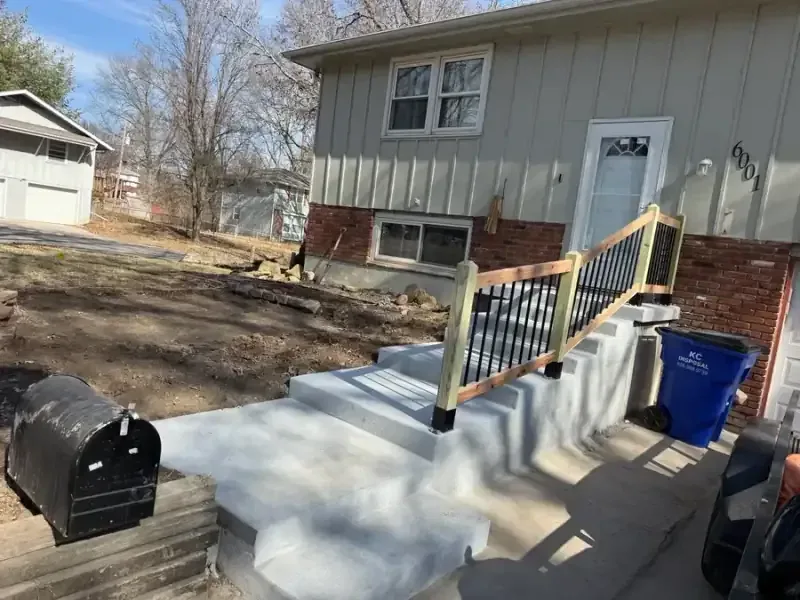
Sidewalks & Walkways in Leawood, KS
Leawood holds itself to a higher standard — and so do we. Every walkway we pour here is designed to match the polished aesthetic your neighborhood demands, from Hallbrook estates to Whitehorse front entries.
What Does a New Walkway Actually Cost in Leawood?
Let's talk numbers first. A standard 4-foot-wide concrete walkway in Leawood typically runs between $12 and $18 per square foot installed. Decorative options — stamped, exposed aggregate, colored — push that closer to $20 to $28 per square foot. Those figures are real, and they're slightly higher than the Kansas City metro average. There's a reason for that, and it has nothing to do with your zip code markup.
Leawood's cost premiums come from the ground up. Johnson County's clay-heavy soils require more aggressive subbase preparation than sandy loam regions. We're hauling in compactable Class 3 aggregate, running plate compactors across every square inch, and sometimes adding geotextile fabric in areas near the Blue River basin where settlement risk is highest. That prep work isn't optional here. Skip it and you'll see cracks within three winters.
Labor costs factor in too. Leawood's residential standards demand cleaner form work, tighter finishing tolerances, and careful attention to grading near established landscaping. A walkway next to mature boxwoods in Worthington takes more care than a straight shot across a new-build lawn off 135th Street. Our crew prices the project honestly based on actual site conditions, not a one-size quote from a website calculator.
Material costs have climbed roughly 15 percent since 2021 in the Kansas City metro. Ready-mix concrete from local batch plants, reinforcement steel, and joint sealants all reflect that reality. We source locally from Johnson County suppliers to keep freight costs reasonable. The result is a walkway that costs what it should — no hidden fees, no surprise change orders after we start digging.
Sidewalks & Walkways Built to Leawood's Exacting Standards
Leawood isn't a city where a basic gray slab disappears into the landscape. Homeowners here expect walkways that complement custom stonework, professionally designed gardens, and architectural facades worth protecting. We pour walkways that hold up to that expectation — clean edges, consistent color, properly spaced control joints, and slopes that move water away from your foundation without creating puddles on the path.
Every walkway starts with a site assessment. We check existing drainage patterns, irrigation line locations, soil compaction, and the condition of any adjacent concrete. In north Leawood neighborhoods built during the 1960s and 70s, we often find old walkways sitting on nothing more than native clay with zero base material. In south Leawood developments near 135th Street, the original builder-grade walks are hitting their 25-year mark and showing the first signs of spalling and joint failure.
We handle everything from a simple 30-foot front entry walk to complex multi-section pathway systems that wrap around patios, connect to driveways, and navigate grade changes across sloped yards. Decorative finishes are popular in Leawood — exposed aggregate and stamped patterns that echo the texture of natural stone. We also pour standard broom-finish sidewalks for homeowners who prefer a clean, classic look that ages gracefully.
Leawood-Specific Sidewalks & Walkways Considerations
De-Icing Damage and Finish Selection
Leawood homeowners and HOA-managed landscape crews apply de-icing products aggressively through winter. Calcium chloride and rock salt accelerate surface spalling on unsealed concrete. We address this by applying a penetrating silane sealer after the 28-day cure period and recommending annual resealing. We also advise on finish choices — broom finishes and exposed aggregate resist de-icing damage better than smooth troweled surfaces. If your Hallbrook or Wilshire walkway shows pitting and flaking, heavy de-icer use on an unsealed surface is almost always the cause.
HOA and Architectural Review Requirements
Several Leawood neighborhoods — Hallbrook, Worthington, Whitehorse among them — have architectural review committees that govern exterior improvements. That includes walkway materials, colors, and even control joint patterns. We've navigated these approval processes across Johnson County since 2015. We provide detailed drawings and material specs formatted for committee submission. Starting the approval process early prevents delays. We'll coordinate timing so your approved project doesn't sit in a queue waiting for a pour date.
Subbase Settlement Near the Blue River Basin
Newer developments in south Leawood sit on fill soil that hasn't fully consolidated. Homes near the Blue River basin and along the 135th Street corridor are especially vulnerable to subbase settlement. We've seen walkways sink a full inch within five years when the original builder skipped proper compaction. Our approach adds 6 inches of compacted Class 3 aggregate beneath the slab and, where conditions warrant it, a layer of geotextile fabric to stabilize soft spots. This adds cost upfront but prevents the sunken, cracked walkways we routinely tear out across south Johnson County.
Mature Landscaping and Root Intrusion
North Leawood properties feature decades-old oak, maple, and sweetgum trees with root systems that extend well beyond the canopy line. Pouring a walkway within 15 feet of a mature tree means dealing with roots — sometimes 3 to 4 inches in diameter — just below grade. We excavate carefully, reroute the walkway alignment where possible, and install root barriers when the path must run close to large trees. Cutting major roots risks killing the tree and creating liability. Near Ironwoods Park and the older Mission Farms lots, root assessment is part of every site visit.
How We Build Sidewalks & Walkways in Leawood
Every Leawood walkway project starts with a physical site visit — not a satellite image estimate. We walk the property, check soil conditions with a probe, identify irrigation lines using your system map or a locator, and flag any drainage issues. Johnson County clay expands and contracts with moisture swings, so we need to know exactly what's happening below grade before we set a single form board. We mark out the walkway path with paint, confirm the layout with you, and note any obstacles like meter boxes, downspout drains, or shallow utility runs.
Excavation goes 8 to 10 inches below finished grade. We remove native clay and organic material completely — no mixing it back in as fill. Our crew hauls in Class 3 limestone aggregate from a Johnson County quarry and compacts it in 3-inch lifts using a reversible plate compactor. In areas with known settlement risk, particularly south of 119th Street, we add a woven geotextile layer between native soil and aggregate. This isn't a step most contractors take on a residential walkway, but Leawood's soil conditions demand it.
Forms go in next — typically 2x4 lumber for a standard 4-inch-thick pour, or 2x6 for thickened edges and areas that carry occasional vehicle traffic like golf cart crossings. We set forms to a tight string line and stake them every 24 inches. Grade is checked with a laser level to ensure consistent 1/4-inch-per-foot slope for drainage. Control joints are planned at 4-to-6-foot intervals depending on slab width. For decorative work, we discuss joint placement carefully so patterns break at natural visual points rather than arbitrary intervals.
Pour day is where craftsmanship shows. We use 4,000 PSI ready-mix with air entrainment — critical for Leawood's freeze-thaw cycles. Concrete is screeded, bull-floated, and then finished according to the selected texture. Broom finishes get pulled in one consistent direction. Stamped patterns are applied with release agent and pressed while the concrete is at exactly the right plasticity — too early and the impressions are shallow, too late and the stamps won't penetrate. Edges are hand-tooled with a radius edger for a clean, rounded profile. We cut control joints with a groover the same day and return to apply sealant once the concrete has cured properly — typically 28 days in Kansas City's climate.
How Walkway Needs Differ Across Leawood's Neighborhoods
Hallbrook properties sit on some of Leawood's most heavily wooded lots with mature hardwoods that create serious root intrusion challenges. Walkways here often need realignment around root zones, thickened edges, and root barriers. The homes date primarily to the late 1980s and 1990s, meaning original builder-grade walks are at or past their useful life. Most Hallbrook projects involve full tear-out and replacement with decorative finishes that match the estate-level landscaping.
Whitehorse and Wilshire represent the heart of north Leawood's 1960s-70s development. Walkways here sit on decades-old native clay subbase with little to no aggregate. Settlement, heaving, and diagonal cracking are common. Many of these homes have narrow 3-foot walkways that feel dated next to updated facades. We frequently widen these to 4 or 5 feet during replacement, which requires regrading and sometimes relocating landscape lighting or foundation plantings.
South Leawood neighborhoods along the 119th and 135th Street corridors — including Worthington and newer subdivisions near the Blue River basin — were built on fill soil that's still settling. Walkways poured during original construction in the mid-1990s to early 2000s are showing their first wave of failure: sunken sections, wide joint separations, and spalling from de-icer exposure on unsealed surfaces. These projects demand the most aggressive subbase work, often including geotextile stabilization and deeper aggregate layers to prevent a repeat of the same settlement pattern.
How Much Does Sidewalks & Walkways Cost in Leawood?
| Type | Cost / Sq Ft | Typical 300 Sq Ft |
|---|---|---|
| Standard Sidewalk | $6–10 | $1,800–$3,000 |
| Decorative Walkway | $10–16 | $3,000–$4,800 |
| Trip Hazard Repair (per section) | $200–500 | $200–$500 |
Leawood walkway costs run 10 to 15 percent above the broader Kansas City average, largely due to deeper subbase requirements in Johnson County clay and the finish quality expectations in neighborhoods like Hallbrook and Worthington. Expect to invest $12 to $28 per square foot depending on finish, width, and site complexity.
Sidewalks & Walkways FAQ for Leawood, KS
Does Leawood require a permit for a private walkway on my property?
Leawood generally does not require a building permit for a walkway that stays entirely on private property and doesn't connect to public right-of-way. However, if your walkway crosses a utility easement, the city may require documentation. Neighborhoods with active HOA architectural review boards — Hallbrook, Whitehorse, Worthington — typically need project approval before construction begins. We handle the research for your specific lot and let you know exactly what's needed before we schedule the pour.
My Worthington front walkway has heavy surface spalling but the slab is structurally sound — can you fix the surface without full replacement?
Sometimes. If the spalling is limited to the top quarter-inch and the slab hasn't settled or cracked through, we can apply a bonded concrete overlay — essentially a new wearing surface poured directly onto the existing slab after profiling. The key is adhesion. We grind the existing surface, apply a bonding agent, and pour a thin polymer-modified overlay. This works well for Worthington walkways where de-icing damage caused surface deterioration but the base and slab are intact. If we find delamination during testing, full replacement is the more honest recommendation.
How wide should a Leawood front walkway be?
We recommend 4 feet minimum for a front entry walkway and 5 feet if your home's facade and landscaping support the wider proportions — which most Leawood homes do. A 3-foot walkway feels cramped next to a double-door entry or a home with columns and a covered porch. For Hallbrook and Mission Farms properties with grand entries, 6-foot walkways with flanking landscape beds are common. Wider walkways also handle two people walking side-by-side comfortably, which matters for entertaining.
Will a new walkway damage my irrigation system?
Not if we locate every line first. During the site visit, we map your irrigation zones using your system controller and physically flag heads and valve boxes along the proposed path. Lines that cross the walkway route get rerouted beneath the excavation depth or sleeved through PVC conduit under the slab so they remain serviceable. In Leawood, most homes have extensive irrigation — especially south Leawood properties with newer systems. We coordinate with your landscape company if needed to ensure nothing gets cut or capped incorrectly.
What's the best concrete finish for a walkway near Park Place or Town Center Plaza where foot traffic is heavy?
For high-traffic residential walkways in those areas, exposed aggregate is a strong choice. It provides excellent traction in wet conditions, hides minor wear, and complements the upscale commercial aesthetics nearby. Broom finish is also very durable and lower cost. We'd steer away from a smooth steel-trowel finish in any outdoor application — it gets dangerously slick when wet. Stamped concrete works well aesthetically but requires periodic resealing to maintain appearance under heavy foot traffic.
How long do I need to stay off the walkway after it's poured?
Foot traffic is safe after 24 to 48 hours depending on weather conditions. Full cure takes 28 days — during that period, avoid dragging heavy items across the surface, placing furniture on it, or applying any sealers or chemicals. We'll place barricades and caution tape on pour day. In Leawood's summer heat, concrete gains strength faster. In October or November pours, we extend the light-traffic window to 72 hours and use curing blankets overnight if temperatures drop below 40 degrees.
Other Concrete Services in Leawood, KS
Request a Callback About Your Leawood Walkway
Leave your name and address, and we'll call you back within one business day. We serve all Leawood neighborhoods from Hallbrook to the 135th Street corridor — and we'll give you a straight answer on scope, timeline, and cost.