
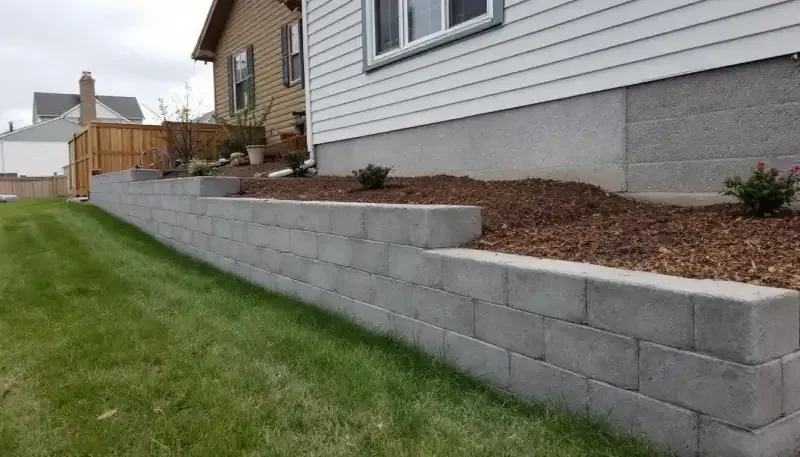
Retaining Walls in Leawood, KS
Your Hallbrook slope or Worthington grade change deserves more than a garden-center block wall. We build engineered concrete retaining walls that match the standard Leawood homeowners actually expect.
Summer booking is already filling — is your Leawood slope ready before fall rains hit?
Kansas City summers bring the best building conditions for retaining walls, but they also bring our busiest schedule. By mid-July, we're typically booked four to six weeks out. If your Leawood property has a slope washing out or a grade change threatening your foundation, now is the window. Waiting until September means competing with fall drainage emergencies across Johnson County — and rain delays that push timelines into November.
Leawood yards don't have small problems. The lots in Hallbrook and Whitehorse are larger, the grades are steeper, and the expectations are higher than anywhere else in the metro. A retaining wall here isn't just functional — it's a visible part of your landscape architecture. We've completed 377-plus projects since 2015, and the walls we build in Leawood consistently need to meet HOA standards, neighbor scrutiny, and the aesthetic bar set by the rest of your hardscape.
We work exclusively with poured concrete and engineered concrete block systems. No timber walls. No cheap stack-stone that shifts after two freeze-thaw cycles. Every wall we build in Leawood includes proper drainage, compacted subbase preparation, and reinforcement designed for Johnson County's expansive clay. The result is a wall that holds grade for decades — not just until the next heavy spring rain.
What Makes a Retaining Wall in Leawood Different from the Rest of KC
Leawood is the gold standard in Johnson County, and that applies to what goes in the ground as much as what sits above it. Retaining walls here serve double duty: they solve real engineering problems — erosion, hydrostatic pressure, foundation drainage — while also meeting the visual expectations of neighborhoods where landscape budgets regularly exceed six figures. We design walls that integrate with existing stone patios, outdoor kitchens, and pool surrounds common throughout Worthington and Mission Farms.
The soil profile across Leawood is predominantly heavy clay, which expands when wet and contracts during dry spells. South of 119th Street, newer developments built on graded fill near the Blue River basin present additional settlement challenges. We account for both conditions with deeper footings, proper aggregate backfill, and perforated drain tile behind every wall. Skipping drainage in Leawood clay isn't a shortcut — it's a guarantee your wall moves within five years.
Wall heights in Leawood commonly range from two feet to eight feet. The city requires engineered plans for walls exceeding four feet in exposed height, and many HOAs in Hallbrook and Wilshire have their own architectural review processes. We handle permit applications, engineering coordination, and HOA submittals so you're not chasing paperwork while trying to save your yard from erosion.
Leawood-Specific Retaining Walls Considerations
HOA and Architectural Review Requirements
Most Leawood subdivisions enforce architectural standards that go well beyond city code. Hallbrook, Whitehorse, and Wilshire all require design approval before any retaining wall construction begins. Material choices, cap styles, color, and even the finished height can be subject to review. We prepare submittals with scaled drawings, material specifications, and photos of comparable completed projects so your application moves through committee without delays or redesigns.
Blue River Basin Settlement in South Leawood
Homes south of 119th Street — especially along the 135th Street corridor — sit on graded fill that's now 25 to 30 years old. This fill is reaching the point where settlement becomes visible: cracks in existing walls, gaps between patios and foundations, and slopes that seem steeper than when the house was built. We probe the subbase during our site visit and adjust footing depths to reach stable material below the fill layer. It costs a bit more upfront but prevents the wall from chasing the settling ground downhill.
Integration with High-End Landscape Design
A retaining wall in Leawood rarely stands alone. It typically ties into an outdoor living space, a pool deck, or a tiered planting bed designed by a landscape architect. We coordinate directly with your landscape designer or architect to match wall textures, cap profiles, and elevation transitions. If you're working with a designer near Town Center Plaza or Park Place who has specific finish requirements, we can pour or build to their exact specifications — including custom form liners and integral color matching.
From First Call to Finished Wall — Your Leawood Project, Step by Step
Your first call usually starts with a slope, a drainage problem, or a landscape architect's plan that needs a concrete contractor. We ask a few quick questions — wall location, approximate height, what's at the top and bottom of the slope — and schedule a site visit within a few days. Most of our Leawood visits happen early morning before crews start for the day, so we can walk your property without rushing.
During the site visit, we measure the grade change, check soil conditions, and look at access points for equipment. In Worthington, that might mean navigating a side yard between the house and a privacy fence. In Hallbrook, we might have a wide-open backyard but a 200-foot haul from the street to the wall location. We note every detail that affects cost: proximity to utilities, existing irrigation lines, mature trees with root zones near the wall path, and whether your HOA requires a specific material or finish. You get a written proposal within a week — not a ballpark over the phone.
Once you approve the scope and we pull the city permit, we schedule your build in the next available window. Excavation typically takes one day. Footing pours happen next, followed by wall construction over two to five days depending on height and length. Our crew keeps the work zone tight and clean — Leawood homeowners notice when a contractor leaves mud on the driveway, and so do we. We install drain tile and backfill aggregate as the wall goes up, not as an afterthought.
On the final day, we strip forms or finish cap installation, backfill the remaining grade, and rough-grade the soil for your landscaper. We walk the finished wall with you, explain the drainage system, and leave you with warranty documentation. Most Leawood walls are ready for landscape installation within a week of our last day on site.
Stopping a 15-Year Slide on a Worthington Backyard Slope
A homeowner on the west side of Worthington, just off Roe Avenue, called us about a backyard slope that had been slowly creeping toward their lower patio for over a decade. The lot dropped about five feet from the back property line to the patio edge, and years of heavy KC rain had washed away topsoil, exposed landscape fabric, and pushed mulch beds into a tangled mess against the patio pavers. Their landscaper had re-graded the slope twice. Both times, the clay soil migrated right back down within two seasons.
We designed a four-foot-tall poured concrete wall with an exposed aggregate cap to match their existing patio border. The footing sat 42 inches below grade to clear the clay layer and reach stable material. Behind the wall, we installed six-inch perforated drain tile wrapped in filter fabric, connected to a solid pipe that daylit into the side yard drainage swale. Backfill was clean three-quarter-inch aggregate from footing to within eight inches of the surface. Total wall length ran 48 linear feet along the full width of the backyard.
Construction took four days. The homeowner's landscape crew came in the following week to install new planting beds on the flat area above the wall. Six months later — including a wet October — zero soil movement, zero water pooling at the patio, and a backyard that finally looks like it belongs in Worthington. The wall added usable square footage to the lower patio area and eliminated the annual re-grading expense for good.
How Much Does Retaining Walls Cost in Leawood?
| Type | Cost / Sq Ft Face | Typical 200 Sq Ft |
|---|---|---|
| Poured Concrete (Structural) | $20–35 | $4,000–$7,000 |
| Decorative Block / Segmental | $25–45 | $5,000–$9,000 |
| Short Wall (Under 3 ft) | $15–25 | $1,500–$3,000 |
Retaining wall costs in Leawood typically run higher than the Johnson County average due to deeper footings on clay and fill soils, HOA-required material upgrades, and the longer equipment access paths common on larger lots. Expect $45 to $85 per square face foot depending on wall type, height, and site conditions.
Retaining Walls FAQ for Leawood, KS
Does Leawood require a permit for a residential retaining wall?
Yes. Leawood requires a building permit for retaining walls exceeding four feet in exposed height, measured from the bottom of the footing to the top of the wall. Walls under four feet may still require a permit if they're near a property line, easement, or drainage corridor. We handle the permit application, including engineered drawings when required, so the process doesn't slow down your project timeline. Typical permit turnaround in Leawood runs one to two weeks.
How do you handle the expansive clay in neighborhoods like Wilshire and Whitehorse?
Johnson County clay expands significantly when saturated and shrinks during dry periods. This movement puts lateral pressure on retaining walls and can cause leaning or cracking over time. We excavate past the clay layer for the footing where possible, use compacted aggregate as backfill instead of native soil, and install perforated drain tile at the base of every wall. Steel reinforcement in the footing and wall stem resists the push-pull cycle. These aren't optional upgrades in Leawood — they're baseline requirements for a wall that stays straight.
Can you build a retaining wall that matches my existing stone patio or outdoor kitchen?
Absolutely. Many Leawood homes have significant outdoor living investments, and a mismatched retaining wall would stand out. We offer custom form liners for poured concrete walls that replicate natural stone textures, plus integral color matching. For block walls, we source from manufacturers that carry the same product lines used by most Kansas City landscape designers. Bring us a photo or material sample from your existing hardscape and we'll match it closely.
My Hallbrook lot has a long slope — terraced walls or one tall wall?
It depends on the total grade change and how you plan to use the space between tiers. A single wall over six feet requires heavier engineering, a larger footing, and more reinforcement, which increases cost per face foot. Two terraced walls with a planting bed or flat area between them distribute the load, look proportional on a large Hallbrook lot, and give your landscaper more design options. We'll measure the slope during the site visit and present both options with pricing so you can decide based on budget and aesthetics.
Will you coordinate with my landscape architect?
Yes, and we encourage it. Several Leawood landscape architects send their clients to us specifically because we build to their specifications without cutting corners. We review their grading plans, confirm wall elevations against their design, and match materials they've specified. If there's a conflict between the structural requirements and the design intent, we flag it early so everyone's on the same page before concrete goes in the ground.
How long does a retaining wall project take from start to finish in Leawood?
From signed contract to finished wall, most residential projects take three to six weeks including permit processing. Actual construction typically runs three to seven days on site depending on wall length, height, and access difficulty. Permit turnaround in Leawood is usually one to two weeks. If your project requires engineered drawings, add another week for the engineer's review. We give you a specific construction start date once the permit is approved and lock it into our schedule.
What's the risk if I wait until fall to address my eroding slope?
Fall brings heavy rain in the KC metro, and eroding slopes accelerate quickly once saturated. Every season you wait, you lose more soil, which means a taller wall and deeper excavation when you finally build. In south Leawood near the Blue River basin, saturated fill soil can shift enough in one storm cycle to undermine patios, fences, and even shallow utility lines. Building during summer's drier conditions also means fewer weather delays and faster backfill compaction. Addressing the problem now almost always costs less than addressing it after another rainy season.
Other Concrete Services in Leawood, KS
Schedule Your Free Leawood Property Assessment
We'll walk your slope, check soil conditions, measure the grade change, and identify drainage paths — then deliver a written proposal with wall options, engineering requirements, and a firm price specific to your Leawood property.