
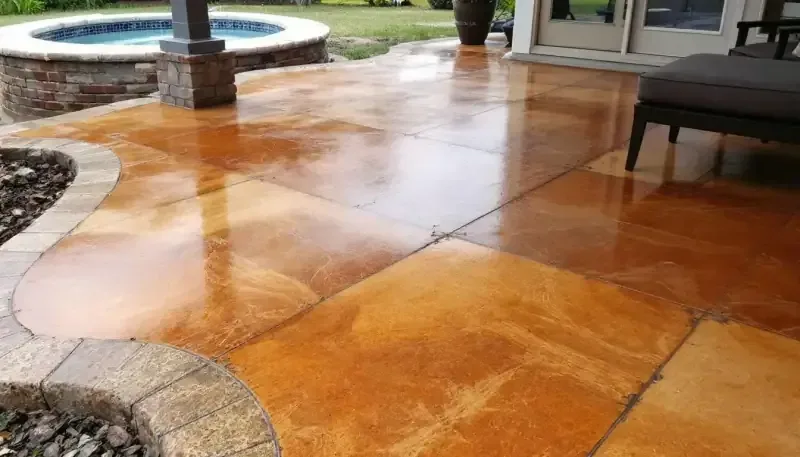
Stained & Colored Concrete in Lawrence, KS
Your Lawrence home deserves concrete that does more than just sit there. We turn gray slabs into rich, color-saturated surfaces that hold their own against Mass Street's best storefronts.
What Would a Splash of Color Do for Your Old West Lawrence Patio?
Walk down Louisiana Street in Old West Lawrence on a Saturday morning. You'll pass Craftsman porches, century-old limestone foundations, and gardens that look like they belong in a magazine. But then you see the concrete — plain, gray, cracked at the edges. It doesn't match the character around it. Stained and colored concrete changes that equation entirely. A warm walnut acid stain on a front porch suddenly ties into the woodwork. An earthy terracotta integral color on a new walkway echoes the brick.
Lawrence homeowners are particular about aesthetics, and rightfully so. This is a town that rallied to preserve Mass Street's historic storefronts. That same attention to detail extends to residential neighborhoods like Brook Creek, Indian Hills, and Sunset Hill. We've completed 377 projects since 2015, and a growing share of that work involves staining and coloring concrete for homeowners who want their outdoor surfaces to feel intentional rather than industrial.
Colored concrete isn't just decorative. It protects the slab surface, resists UV fading better than paint, and pairs with a quality sealer to extend the life of your pour by years. In a town where freeze-thaw cycles crack cheap work fast, the right coloring approach matters. We work with both acid-based reactive stains and water-based stains, plus integral pigments mixed directly into new pours. Each method gives a different look, and each has a sweet spot depending on your slab's age and condition.
How Stained & Colored Concrete Actually Works in Lawrence
Acid stains penetrate the concrete surface and react chemically with the lime content in the slab. The result is a mottled, translucent color that looks organic rather than painted on. This works beautifully on older patios in neighborhoods like Deerfield and Sunset Hill where slabs poured in the 1980s and 1990s have developed natural character. Water-based stains offer more uniform color and a wider palette — ideal if you want a specific shade to match your home's exterior paint or landscaping.
Integral color is mixed directly into the concrete before it's poured. This means the pigment runs through the entire depth of the slab, not just the surface. If the concrete chips or wears over decades, the color remains consistent underneath. We recommend integral color for new driveways, walkways, and patios where long-term durability matters more than the variegated artisan look of a reactive stain. It's especially popular for new construction along the K-10 corridor and in newer subdivisions south of 31st Street.
Sealing is the final step and arguably the most important. Lawrence gets around 38 inches of rain annually, and the Wakarusa valley areas hold moisture longer than hilltop neighborhoods near KU's campus. Without a proper sealer matched to the stain type, moisture intrusion will cloud the color and eventually cause flaking. We apply penetrating sealers for driveways exposed to road salt and film-forming sealers for covered porches and interior garage floors. Every project gets a sealer recommendation based on the specific exposure conditions at your property.
Lawrence-Specific Stained & Colored Concrete Considerations
Wakarusa Valley Moisture and Your Slab's Condition
Homes near the Wakarusa River and the low-lying areas south of 6th Street often sit on slabs that have absorbed more ground moisture over the years. This affects stain absorption rates and adhesion. Before we quote any staining work in these areas, we test the slab's moisture vapor emission rate. If it's too high, we address it with a moisture-mitigating primer before staining. Skipping this step leads to cloudy, peeling results within a year. We've seen it on slabs near Clinton Lake Parkway more times than we'd like.
KU Game Day Traffic and Driveway Durability
If you live anywhere near Memorial Stadium or along Iowa Street, your driveway handles more vehicle traffic than most suburban driveways ever will. Game days bring bumper-to-bumper parking, guests pulling in and out, and the occasional delivery truck. A stained driveway in Indian Hills or along 23rd Street needs a harder sealer and a stain that won't show tire marks easily. We use darker earth tones and high-build sealers for driveways in high-traffic zones. Lighter stains look stunning but require more frequent resealing near these corridors.
Matching Lawrence's Historic and Eclectic Home Styles
Lawrence isn't a cookie-cutter subdivision town. Old West Lawrence has Victorian-era homes next to mid-century ranches. Brook Creek mixes bungalows with modern infill construction. A concrete stain color that looks perfect on a 1920s Craftsman porch might clash with a 1970s split-level next door. We bring physical stain samples to your property and test small areas before committing to the full application. Natural light, surrounding landscaping, and your home's siding color all affect how the stain reads once it cures. We don't rely on digital mockups alone.
What to Expect During Your Staining Project in Lawrence
Your project starts with a site visit where we evaluate the existing slab or discuss the scope of a new pour. We check for surface scaling, old sealers, paint, adhesive residue, and moisture issues. For homes on narrow streets in Old West Lawrence or Brook Creek, we also figure out equipment access and where the concrete truck or our work trailer will park without blocking your neighbors. Most residential staining projects don't require a Douglas County permit, but if we're pouring new colored concrete that changes drainage or footprint, we'll handle the permit application for you.
On the first day of work, our crew arrives with grinders, sprayers, and protective sheeting. If we're staining an existing slab, you'll hear diamond grinding as we prep the surface — it sounds like a loud vacuum and takes one to three hours depending on patio size. We tape off adjacent surfaces, cover landscaping beds, and mask your siding. Acid stains have a mild vinegar-like smell that dissipates within hours. Water-based stains are nearly odorless. You don't need to leave your home, but we recommend keeping pets and kids off the work area.
Stain application itself is surprisingly quick. Most residential patios take two to four hours for the stain coats. Then we wait. Acid stains need 12 to 24 hours to fully react before we neutralize and rinse the surface. Water-based stains dry faster, typically four to six hours. During this cure window, the surface cannot get wet. We monitor Lawrence weather forecasts obsessively during project scheduling — a surprise storm rolling in from the Flint Hills can ruin an uncured stain job. We build weather buffer days into every project timeline.
Sealing happens last, usually the following day. Two coats go down with drying time between them. You'll be able to walk on the surface within 24 hours and park on a driveway within 72 hours. We leave you with a maintenance card that lists the specific products used, recommended resealing intervals, and cleaning instructions tailored to your stain and sealer combination. Most Lawrence homeowners reseal every two to three years for outdoor surfaces and every four to five years for covered areas.
A Brook Creek Bungalow Gets the Patio It Deserved
A homeowner on Brook Street reached out in late spring 2023. Their 1950s bungalow had a 320-square-foot backyard patio that was structurally solid but cosmetically exhausted. Years of bare concrete had left it stained with rust marks from old furniture legs, faded spots from a removed grill pad, and a general gray dullness that clashed with their recently painted sage-green siding. They wanted color but not anything that looked artificial against the neighborhood's mature trees and limestone retaining walls.
We ground the surface to remove the rust stains and open the concrete pores. After testing moisture levels — the lot slopes toward the brook, so we needed to verify — we applied a two-tone acid stain. The main field got a cola brown that settled into a rich coffee tone after neutralizing. The border, about 18 inches wide, received an English red stain that dried to a warm brick hue. The color variation between the two tones was subtle enough to look cohesive but distinct enough to frame the patio like a rug.
Two coats of a semi-gloss acrylic sealer brought the colors to life and gave the surface a gentle sheen that catches the light filtering through the backyard oaks. The homeowner told us their neighbors on the next block walked over to ask about it within a week. Total project time was three and a half days. The patio went from an eyesore they avoided to the spot where they eat dinner most evenings through October.
How Much Does Stained & Colored Concrete Cost in Lawrence?
| Type | Cost / Sq Ft | Typical 300 Sq Ft |
|---|---|---|
| Acid Stain (Existing Concrete) | $4–8 | $1,200–$2,400 |
| Water-Based Stain (Existing) | $3–6 | $900–$1,800 |
| Integral Color (New Pour) | $10–15 | $3,000–$4,500 |
Stained concrete in Lawrence typically runs $4 to $10 per square foot for existing slabs, depending on surface prep needs and stain type. New integral colored pours cost $8 to $14 per square foot. Homes in the Wakarusa valley areas or near Clinton Lake Parkway sometimes require additional moisture prep, which adds $1 to $2 per square foot.
Stained & Colored Concrete FAQ for Lawrence, KS
How long does a staining project take from start to finish for a typical Lawrence patio?
Most residential patios in Lawrence take three to four days from surface prep through final sealer application. That includes grinding, staining, cure time, and two sealer coats. Larger projects like a combined patio and walkway may stretch to five days. We always build in a weather buffer day because storms can roll across Douglas County with little warning during spring and fall. New colored concrete pours require additional cure time — typically seven days before the slab is ready for sealer.
Will freeze-thaw cycles near the Wakarusa valley damage my stained concrete?
Freeze-thaw cycles are the biggest threat to any concrete surface in Lawrence, and stained concrete is no exception. The stain itself won't crack — concrete cracks because trapped moisture expands when it freezes. A quality sealer prevents moisture from penetrating the surface and causing spalling. We use penetrating silane-siloxane sealers for driveways and exposed patios in low-lying Wakarusa areas where ground moisture is higher. Resealing every two to three years keeps the protection intact. We've maintained stained patios near the river since 2016 that still look sharp.
Can you stain a patio that already has a broom finish texture?
Absolutely. Broom-finished concrete is one of the most common surfaces we stain in Lawrence. The texture actually enhances stain absorption and creates subtle color variation in the grooves that looks intentional and natural. We diamond grind lightly to open the pores without removing the texture entirely. Acid stains look especially rich on broom-finished slabs because the chemical reaction varies with surface density. The result is a leather-like mottled appearance that plain smooth-troweled concrete can't achieve.
I live in Indian Hills and my patio gets full afternoon sun. Will the stain fade?
Acid stains resist UV fading better than almost any concrete coloring method because the color is a chemical reaction within the slab, not a coating sitting on top. Water-based stains can fade slightly faster under intense sun exposure but hold up well with a UV-resistant sealer. For south- and west-facing patios in Indian Hills and Sunset Hill that bake in afternoon Kansas sun, we recommend acid stain with a UV-stable acrylic sealer. Resealing on schedule is the key factor. A well-maintained acid-stained patio in full sun will hold its color for a decade or longer.
Do I need to do anything special to maintain stained concrete through a Lawrence winter?
Avoid using rock salt or calcium chloride deicers directly on stained and sealed concrete. These chemicals break down sealers prematurely and can cause surface scaling. Use sand for traction or a magnesium chloride product, which is gentler on sealed surfaces. Shovel snow promptly so melt water doesn't pool and refreeze on the surface. In spring, rinse the slab with a garden hose and check for any sealer wear. If water stops beading on the surface, it's time for a reseal. We offer maintenance resealing for existing clients throughout Douglas County.
Other Concrete Services in Lawrence, KS
Schedule Your On-Site Color Consultation in Lawrence
We'll visit your property, evaluate your existing slab or discuss a new pour, and bring physical stain samples so you can see real colors against your home's exterior — not just a screen. Most consultations in Douglas County take about 30 minutes and include a written estimate within 48 hours.