
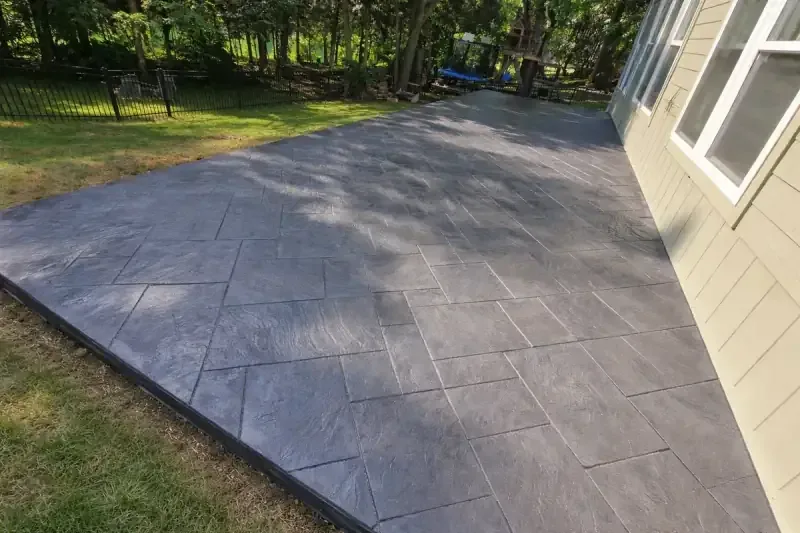
Stamped Concrete in Lawrence, KS
Your neighbors on Sunset Hill already replaced that plain gray slab. Now their patio looks like hand-laid flagstone — and yours still looks like a parking lot.
What's that white haze doing on your concrete patio?
You spent good money on that backyard slab a few years ago. Now it's got efflorescence streaks, hairline cracks from Douglas County's freeze-thaw cycles, and a surface that screams 'builder-grade.' Every time you walk out back, you see it. Every time you host friends after a KU game, you feel it. Plain concrete ages hard and fast in Lawrence — especially in Wakarusa valley neighborhoods where soil moisture fluctuates all year long.
Stamped concrete solves the ugly slab problem without ripping everything out and starting from scratch. We pour a reinforced surface with integral color and hand-pressed patterns that mimic natural stone, brick, or slate. The result looks like premium hardscape at a fraction of the cost. And unlike pavers that shift on Lawrence's expansive clay, a monolithic stamped pour stays locked in place for decades.
What Stamped Concrete Actually Looks Like in Lawrence
Most of our Lawrence projects fall into three categories: backyard patios, front walkways, and pool decks. Patios are the big one. Homeowners in Old West Lawrence and Indian Hills want outdoor living space that matches their home's character. We pour ashlar slate patterns for Craftsman-style homes and wood-plank stamps for the newer builds out in Deerfield. Every pour gets fiber reinforcement and control joints placed to follow the stamp pattern — so they disappear into the design.
Driveways along 6th Street and the Brook Creek neighborhood see real abuse. KU game traffic, delivery trucks, and Kansas weather put serious stress on a surface. We pour stamped driveways at a minimum of five inches with rebar on 18-inch centers. That handles your F-150 and your spouse's SUV without cracking under pressure. Color hardener on top gives you a denser surface layer that resists tire marks and salt damage.
The finish matters as much as the pour. We apply a high-solids acrylic sealer that brings out the color depth and provides a slight texture for slip resistance. Lawrence gets roughly 36 inches of rain annually, and a sealed stamped surface sheds water instead of absorbing it. That means no spalling, no freeze-pop damage, and a patio that looks the same in year eight as it did in week one.
Lawrence-Specific Stamped Concrete Considerations
Expansive Clay Soils Near the Wakarusa Valley
If your property sits south of 31st Street or near the Wakarusa River corridor, you're dealing with high-plasticity clay that swells when wet and shrinks when dry. This seasonal movement cracks ordinary slabs. We excavate to a minimum of six inches below grade and install a compacted aggregate base that acts as a buffer between the clay and your stamped surface. On properties in Deerfield and along the Wakarusa floodplain fringe, we add a vapor barrier and increase rebar density. The extra prep adds half a day to the project but prevents the heaving we see on 1990s-era slabs throughout the area.
KU Event Weekends and Scheduling Access
Lawrence isn't a normal town on Saturdays in the fall. Memorial Stadium draws 50,000 people, and traffic on Iowa Street and 23rd Street grinds to a halt. If your property is anywhere near campus or a major corridor, we schedule concrete deliveries and equipment drops on weekday mornings when streets are clear. Our ready-mix trucks come from facilities along K-10 and I-70, so we route around game-day closures entirely. We also avoid pouring the week of big events like the Wakarusa Festival to protect your fresh surface from vibration and unexpected foot traffic.
What Your Stamped Concrete Timeline Looks Like in Lawrence
Day 1: Site prep. Our crew arrives early, usually by 7 AM, and starts excavation. We remove existing sod, old concrete, or gravel down to stable subgrade. For most Lawrence patios, that means digging 8 to 10 inches deep to accommodate the aggregate base and a 4- to 5-inch slab. Forms go in the same day. If you're in a neighborhood with an HOA — like parts of Indian Hills — we've already handled the design approval before this point. Your yard will be blocked off with caution tape, and we'll mark a clear path to your back door so daily life stays normal.
Day 2: Base and reinforcement. We spread and compact Class 5 aggregate in two lifts, then set rebar or welded wire mesh. Douglas County's building codes don't require a permit for most residential patios under 200 square feet, but anything attached to your house or near a property line may trigger a review. We pull permits when needed — typical turnaround from the City of Lawrence is 3 to 5 business days, which we handle before Day 1 ever starts.
Day 3: The pour. This is the main event. Ready-mix trucks arrive on a tight schedule because stamped concrete has a narrow working window — about 90 minutes in Lawrence's summer heat before the surface sets too hard to stamp. We apply color hardener by broadcast, then press the stamp mats by hand across the entire surface. Release agent keeps the stamps from sticking. Your patio takes shape in a single morning. By afternoon, we're detailing edges and cutting control joints.
Days 4-5: Cure time. Nobody walks on it. We wash off the release agent on Day 4, which reveals the final color contrast between the base tone and the grout lines. Lawrence's average humidity helps the cure, but we keep the surface protected from rain with plastic sheeting if storms roll through. On Day 5, we apply the first coat of acrylic sealer.
Day 7: Walkable. By the end of the week, you can place lightweight furniture. We ask that you keep vehicles off stamped driveways for a full 14 days. That means parking on the street or in the garage — not ideal, but it gives the slab time to reach full strength. After two weeks, it's yours to use however you want.
How Much Does Stamped Concrete Cost in Lawrence?
| Type | Cost / Sq Ft | Typical 300 Sq Ft |
|---|---|---|
| Basic Patterns (1 color) | $12–15 | $3,600–$4,500 |
| Premium Patterns (2 colors) | $15–18 | $4,500–$5,400 |
| Multi-Color / Custom | $16–20 | $4,800–$6,000 |
Most stamped concrete patios in Lawrence run between $12 and $18 per square foot installed, depending on pattern complexity and site conditions. Properties near the Wakarusa valley that need extra subgrade work typically land on the higher end of that range due to clay mitigation.
Stamped Concrete FAQ for Lawrence, KS
Does Lawrence require a permit for a stamped concrete patio?
It depends on the scope. The City of Lawrence generally does not require a permit for a basic backyard patio that's detached from your home and under 200 square feet. Anything larger, attached to the house, or within setback lines typically needs a building permit. If your property falls within Old West Lawrence's historic overlay district, you may also need design review from the Historic Resources Commission. We handle all permit applications and approvals before work begins, so there's no guesswork on your end. Turnaround from the city usually takes 3 to 5 business days.
How do Lawrence's freeze-thaw cycles affect stamped concrete?
Douglas County averages around 100 freeze-thaw cycles per winter. That's brutal on any concrete surface. Stamped concrete survives it because of two things: proper air entrainment in the mix and a quality acrylic sealer. We specify a 4,000 PSI mix with 6 percent air entrainment — the air pockets give expanding ice room to move without cracking the slab. The sealer blocks water from penetrating the surface in the first place. Resealing every two to three years keeps that protection intact. Skip the sealer, and you'll see surface scaling within a few winters.
What stamp patterns work best with the Craftsman and bungalow homes in Old West Lawrence?
Ashlar slate is our most popular pattern in that neighborhood. It has an irregular stone layout that complements the hand-built character of early 1900s homes without looking too formal. Running bond brick is another strong choice — it mirrors the historic brick sidewalks along Massachusetts Street. For color, we lean toward warm earth tones: sandstone, walnut, and terra cotta. These blend naturally with the aged brick and limestone foundations common in Old West Lawrence. We bring physical stamp samples to your consultation so you can see them against your home's exterior before committing.
Can I use rock salt on my stamped driveway in winter?
We strongly recommend against rock salt on any concrete surface, stamped or not. Sodium chloride accelerates freeze-thaw damage and can discolor the sealer. Instead, use calcium magnesium acetate or sand for traction. If a previous owner already used salt on your existing concrete, that's likely part of why the surface is spalling now. On new stamped driveways, we apply a penetrating sealer beneath the topical acrylic coat for an extra layer of chemical resistance. This double-seal approach handles the occasional salt exposure from boots or car tires without breaking down the finish.
Other Concrete Services in Lawrence, KS
Get Your Free Stamped Concrete Estimate in Lawrence
Tell us about your project and we'll schedule a site visit — most Lawrence consultations happen within the week. We'll measure, review your soil conditions, and show you stamp and color samples right there in your backyard.