
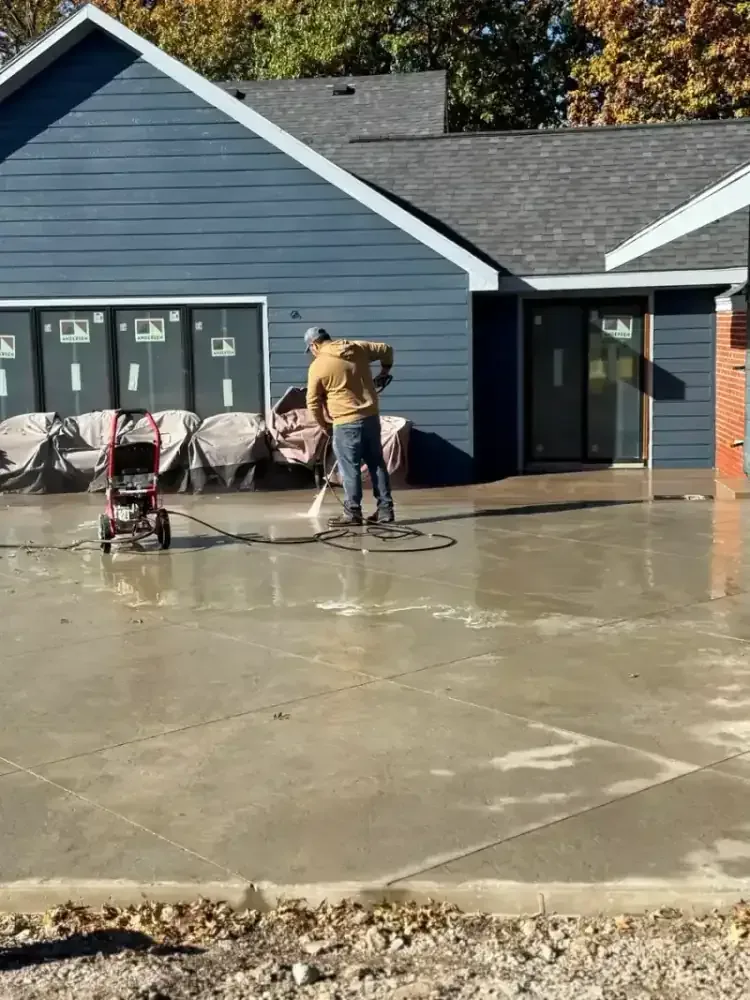
Concrete Patios in Lawrence, KS
Your Lawrence backyard deserves more than a patch of grass and good intentions. We build concrete patios that handle Jayhawk game-day crowds and quiet Tuesday evenings equally well.
Pavers or Poured Concrete — Which One Actually Makes Sense in Lawrence?
It's the most common debate we hear from Lawrence homeowners. Pavers look great in the showroom photos. Poured concrete seems simpler. Both have their fans. But after completing 377 projects since 2015, we can tell you what actually performs in Douglas County soil and weather. Poured concrete wins on longevity, maintenance, and total cost — especially in neighborhoods like Old West Lawrence and Indian Hills where expansive clay keeps shifting pavers out of alignment within three to five years.
Pavers require constant releveling. Sand washes out. Weeds find every joint. A concrete patio poured on properly prepared subgrade gives you a single, monolithic surface that handles Kansas freeze-thaw cycles without the ongoing headaches. You can still get the look of stone, brick, or tile through stamped and stained finishes. The difference is you won't be resetting individual pieces every spring.
Lawrence sits in a unique spot. The Wakarusa River valley creates pockets of silty clay soil that behave differently from the limestone-heavy ground up near 6th Street. A patio solution that works in Deerfield might need a completely different subbase approach in Brook Creek. That's local knowledge you only get from a crew that actually works these neighborhoods — not a franchise operating out of Topeka.
We've poured patios behind 1920s bungalows on Tennessee Street and brand-new builds in Sunset Hill. Each project starts with understanding your soil, your slope, and how you actually plan to use the space. That's what separates a patio that lasts twenty years from one that cracks in three.
What a Lawrence Concrete Patio Actually Involves
A residential patio in Lawrence typically ranges from 200 to 600 square feet. We pour at a minimum four-inch thickness for standard use, stepping up to five or six inches if you're planning a heavy outdoor kitchen setup, hot tub pad, or built-in fire pit. Reinforcement with fiber mesh or rebar depends on your specific soil conditions — something we determine during the site assessment, not from a one-size-fits-all spec sheet.
Finish options go well beyond basic broom texture. Stamped patterns that mimic flagstone or slate are popular among Lawrence homeowners, particularly in neighborhoods near Massachusetts Street where architectural character matters. Exposed aggregate gives a natural, textured look that hides minor wear and pairs well with the limestone aesthetic you see throughout KU's campus. Stained and sealed concrete opens up dozens of color options that hold up under Kansas UV exposure.
Every patio we pour includes proper slope for drainage — typically a quarter inch per foot away from your foundation. In areas near the Wakarusa valley where groundwater sits high, we may recommend a gravel subbase layer or French drain integration. The goal is a patio that sheds water quickly and doesn't create pooling problems against your home.
Lawrence-Specific Concrete Patios Considerations
Clay Soil Behavior Along the Wakarusa Valley
Properties south of 23rd Street and west toward Clinton Lake sit on expansive clay soils that swell when wet and shrink when dry. This seasonal movement can crack an improperly supported slab within a single year. We address this with compacted granular subbase, control joints spaced at intervals matched to slab thickness, and sometimes deeper excavation to remove the most reactive clay layers. Homes in Indian Hills and areas near the Wakarusa River corridor need this extra attention — it's non-negotiable for a patio that stays flat.
Backyard Access in Older Lawrence Neighborhoods
Old West Lawrence and Brook Creek homes often sit on narrow lots with mature landscaping, tight side yards, and no rear alley access. Getting a concrete truck close enough to pour matters. We use pump trucks and wheelbarrow crews when standard chute pours aren't possible. During your site visit, we map out exactly how materials and equipment reach your backyard — protecting your lawn, fencing, and garden beds in the process. This planning step prevents surprises on pour day.
University Event Scheduling and Project Timing
Lawrence traffic changes dramatically during KU football and basketball seasons. Streets near Memorial Stadium and along Iowa Street become gridlocked on game days. We schedule concrete deliveries and crew arrivals around these events so your project stays on timeline. Homes along US-59 or east of campus benefit from early-morning pours during event weekends. We also avoid scheduling during KU move-in week in August, when delivery trucks face major delays on 23rd Street and K-10 corridors.
From First Call to Your Finished Lawrence Patio
It starts with a phone call or online request. We ask a few quick questions — your address, rough patio size, how you plan to use the space. Within a few days, one of our contractors visits your Lawrence property. That site visit covers soil type, yard slope, drainage patterns, access for equipment, and proximity to your foundation or any utility lines. If you're in a neighborhood like Sunset Hill with newer construction, the soil data is often straightforward. Older areas near downtown require more investigation. Either way, you get a written estimate that reflects your actual conditions — not a ballpark guess.
Once you approve the scope, we pull any necessary permits through the City of Lawrence. We schedule your project based on weather windows and concrete plant availability, giving you a firm start date. Before our crew arrives, we mark the layout with stakes and string so you can see the exact footprint. This is when you finalize finish choices — broom, stamped, exposed aggregate, stained — and confirm any extras like steps, a fire pit pad, or seat walls.
Pour day moves fast. Our crew arrives early, completes final grading and compaction, sets forms, and places reinforcement. The concrete truck typically arrives mid-morning. We pour, screed, float, and apply your chosen finish in a single session. Control joints get cut within hours. For stamped finishes, we work the texture and color hardener while the concrete is still workable — there's no second chance on timing here. By late afternoon, your new patio has taken shape.
We return the next day to strip forms, inspect edges, and clean up. After a curing period of about seven days, we apply sealer if included in your scope. Then we walk the finished patio with you, answer any care questions, and hand over maintenance guidelines specific to Lawrence's climate. The whole process from first call to finished patio typically takes two to four weeks, depending on project complexity and weather.
How Much Does Concrete Patios Cost in Lawrence?
| Type | Cost / Sq Ft | Typical 300 Sq Ft |
|---|---|---|
| Standard Gray (Broom Finish) | $8–12 | $2,400–$3,600 |
| Stained / Colored | $10–15 | $3,000–$4,500 |
| Exposed Aggregate | $10–16 | $3,000–$4,800 |
| Stamped / Decorative | $12–18 | $3,600–$5,400 |
Most Lawrence residential patios fall between $8 and $16 per square foot installed, depending on size, finish, and soil preparation needs. Properties in the Wakarusa valley corridor often require additional subbase work, which can add $1 to $3 per square foot to account for clay mitigation.
Concrete Patios FAQ for Lawrence, KS
Does Lawrence require a permit for a backyard concrete patio?
In most cases, a standard backyard patio on grade does not require a building permit in Lawrence. However, if the patio involves electrical work for lighting, gas lines for a fire pit, or a structure like a pergola attached to your home, permits may apply. Elevated patios or anything within setback lines also trigger review. We check with the City of Lawrence planning office during your project setup so there are no surprises. If a permit is needed, we handle the application and inspections.
How do Kansas freeze-thaw cycles affect a patio poured in Douglas County?
Douglas County averages around 100 freeze-thaw cycles per year. Each cycle pushes moisture into microscopic pores in the concrete, where it expands as ice and contracts as it thaws. Over time, this causes surface scaling and can worsen cracks. We combat this with air-entrained concrete mixes that include tiny air bubbles to absorb expansion pressure. Proper curing and sealing add another layer of protection. Control joints placed at correct intervals give the slab room to move without random cracking. A well-built patio handles Lawrence winters for 20 to 30 years.
Can you add a stamped border with a different finish in the center?
Absolutely. Combining finishes is one of the best ways to add visual depth without the cost of stamping the entire surface. A popular approach in Lawrence is a stamped stone border around a broom-finished or exposed aggregate center field. This saves money while creating a custom look. We can also integrate colored bands or saw-cut geometric patterns. During your site visit, we bring finish samples so you can see how different combinations look against your home's exterior.
My Brook Creek lot slopes toward my neighbor's property — how do you handle that?
Slope is actually an advantage for drainage, as long as we direct water appropriately. We grade the patio surface to channel runoff away from both your foundation and your neighbor's property line. In Brook Creek, where lots are often narrow and grading is tight, we sometimes integrate a shallow swale or channel drain along the patio edge to collect and redirect water. Lawrence municipal code requires that you don't divert stormwater onto adjacent properties, and we design every project with that in mind.
What maintenance does a concrete patio need in Lawrence?
Annual maintenance is minimal. Resealing every two to three years protects against moisture penetration and UV fading — especially important for stamped or stained surfaces. Power washing once a year removes dirt and organic buildup. Avoid using rock salt for ice removal; calcium magnesium acetate or sand is safer for concrete surfaces. If you notice hairline cracks at control joints, that's normal and expected. Cracks that widen beyond a quarter inch should be evaluated. We provide a printed maintenance guide specific to Lawrence conditions with every completed project.
How close to my foundation can you pour the patio?
We can pour directly against your foundation wall using an isolation joint — a flexible material that separates the patio slab from the house structure. This allows both surfaces to move independently during freeze-thaw cycles and soil settling. The patio surface must slope away from the foundation at a minimum of one-quarter inch per foot. In areas near the Wakarusa valley where soil heaving is more aggressive, we sometimes recommend a slightly wider isolation gap. This detail prevents the patio from transferring pressure to your foundation during soil movement.
Other Concrete Services in Lawrence, KS
Schedule Your Free Lawrence Property Assessment
We'll evaluate your yard's soil conditions, drainage patterns, slope, and equipment access — then provide a detailed written estimate tailored to your specific Lawrence property.