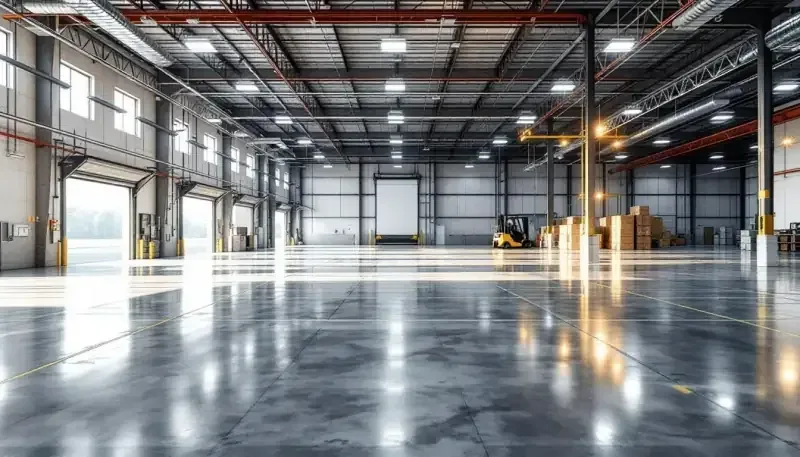
Warehouse & Industrial Floors in Lawrence, KS
Industrial floors in Lawrence aren't just concrete — they're the foundation your forklifts, pallet jacks, and entire operation depend on every single shift.
What Does a Warehouse Floor Actually Cost in Lawrence?
Let's talk numbers. A warehouse floor replacement in Lawrence typically runs $6 to $11 per square foot, depending on thickness, reinforcement, and subbase work. That range exists because Douglas County soil conditions vary wildly — a slab near the Wakarusa valley needs different prep than one at East Hills Business Park. Labor costs in Lawrence sit slightly below the KC metro average, but material trucking from regional batch plants adds a factor most contractors won't mention upfront. We always will.
The real cost driver is what's underneath your existing slab. Buildings along South Iowa Street from the 1980s and 90s often sit on poorly compacted fill that has settled over decades. Tearing out that old floor and properly stabilizing the subgrade can add 15 to 20 percent to the project. But skipping that step means your new floor starts failing within five years. Since 2015, we've completed 377 projects — and every one started with an honest conversation about what the job truly requires.
Heavy-Duty Floors Built for Lawrence's Industrial Demands
Lawrence supports a serious industrial corridor. Facilities serving Hallmark, Berry Global, and the distribution operations along K-10 and I-70 demand floors that handle constant heavy truck traffic and repetitive forklift loading. We pour 5,000 to 6,000 PSI concrete with fiber or rebar reinforcement designed for your specific load requirements. Every slab gets engineered joint spacing to prevent random cracking under stress.
VenturePark and East Hills Business Park represent Lawrence's newer industrial growth. These facilities need floors that meet modern flatness specs for automated guided vehicles and robotic systems. We achieve FF 35 to FF 50 flatness numbers as standard, with higher tolerances available for defined-traffic aisles. Our crew uses laser screeding equipment that delivers precision you can actually measure.
Older warehouse spaces along South Iowa and near downtown Lawrence face different challenges. Decades of settling, moisture infiltration, and surface deterioration mean a full tear-out and repour is often more cost-effective than patching. We install vapor barriers rated to 0.01 perms, apply proper curing compounds, and specify concrete mixes calibrated for Douglas County's freeze-thaw cycle. The result is a floor that performs for 25 to 30 years.
Lawrence-Specific Warehouse & Industrial Floors Considerations
Wakarusa Valley Soil Instability and Subgrade Prep
Warehouse sites near the Wakarusa River corridor sit on alluvial soils with high clay content and seasonal moisture fluctuation. Concrete heaving is a documented problem in this area. We conduct soil bearing tests before every project and specify compacted aggregate subbases — typically 6 to 8 inches of Class 5 limestone — to create a stable platform. Without this step, your slab will crack and settle unevenly within a few years. It's not optional work. It's the foundation of a floor that lasts.
Heavy Truck Traffic from K-10 and I-70 Corridors
Lawrence sits at the junction of K-10 and I-70, meaning your warehouse likely receives consistent heavy truck loads. Semi-trailer axle weights concentrate enormous force on dock areas and driving lanes. We design thickened edge sections at loading dock aprons and use doweled joints at high-traffic transitions. Facilities near the Kansas Turnpike interchange see some of the heaviest repetitive loading in Douglas County. Our floor designs account for real traffic patterns, not just theoretical loads from a spec sheet.
ADA Compliance and Lawrence's Sustainable Places Initiative
Lawrence's Sustainable Places initiative has raised the bar on accessibility and building compliance. Even interior warehouse floors must meet ADA slope requirements at pedestrian paths and office transitions. We build compliant slopes into every pour plan and coordinate with your architect or building inspector before concrete day. Douglas County permitting has gotten more thorough in recent years, and our crew knows exactly what inspectors look for. Getting this right the first time saves you expensive rework and project delays.
From First Call to Finished Warehouse Floor
Your first call usually starts with the same question — how much and how long? We ask about your building location, square footage, current floor condition, and what equipment runs on it daily. A facility at VenturePark with robotic pallet movers needs a completely different approach than a 1990s South Iowa Street warehouse running standard sit-down forklifts. Within 48 hours of that call, one of our contractors is on-site walking your floor, measuring deflections, checking for moisture, and noting every crack pattern that tells the story of what went wrong below.
The site visit drives the entire proposal. We probe the subgrade, test for vapor emissions, and photograph joint failures. In Lawrence, we pay special attention to signs of clay expansion — common in the Brook Creek and Deerfield areas — and check whether your building's structural columns align with a joint layout that actually works. You'll receive a detailed scope of work with line-item pricing, a pour schedule built around your operations calendar, and clear answers about what happens to the old concrete. No surprises.
Pour day is orchestrated down to the hour. Our crew arrives before your first shift, and the concrete trucks are timed from the batch plant to maintain consistent slump. Laser screeds run defined passes across each placement zone. In a 20,000-square-foot warehouse, we typically pour in two to three phases so part of your operation keeps moving. Curing compounds go on immediately, and we mark restricted zones clearly for your staff.
The reveal comes about seven days later when we pull the curing barriers and you walk a floor that's dead flat, joint-free where it matters, and ready for traffic. Within 28 days, full forklift operations resume on a slab that will outlast most of the equipment running on it. That's the moment 377 project owners have experienced since 2015 — and it never gets old for our crew either.
A South Iowa Street Warehouse Gets a Second Life
A distribution facility just south of 31st Street on South Iowa had been patching its original 1988 warehouse floor for over a decade. Forklift operators were dodging cracked joints, dock aprons had settled two inches, and moisture was blistering through a failing epoxy coating. The building owner called us after two other contractors recommended a surface overlay — a band-aid that would have failed within three years on that unstable subgrade.
Our site visit confirmed what we suspected. The original slab sat on poorly compacted fill with no vapor barrier. Moisture vapor emission tested at 8 pounds per 1,000 square feet — nearly triple the acceptable threshold. We proposed a full tear-out in three phases, allowing the client to shift inventory bay by bay. Each phase included subgrade excavation, 8 inches of compacted Class 5 limestone, a sealed 15-mil vapor barrier, and 6-inch 5,000 PSI concrete with welded wire reinforcement and fiber. Joint layout was redesigned to align with the building's existing column grid.
The project ran six weeks total, with weekend pours keeping weekday operations intact. The finished floor tested at FF 38 flatness — a massive upgrade from the original. Dock aprons are level, the surface densifier eliminated dusting on day one, and that moisture problem is permanently solved. Eighteen months later, zero cracks, zero callbacks. That's what a properly engineered warehouse floor looks like in Lawrence.
How Much Does Warehouse & Industrial Floors Cost in Lawrence?
| Type | Cost / Sq Ft | Project Dependent |
|---|---|---|
| Standard Industrial Slab | $3–6 | Varies by scope |
| Polished Concrete | $5–10 | Varies by scope |
| Epoxy / Coating System | $4–8 | Varies by scope |
Lawrence warehouse floor projects typically range from $6 to $11 per square foot installed. Sites near the Wakarusa valley or older South Iowa Street buildings often require additional subgrade stabilization, which can push costs toward the higher end of that range.
Warehouse & Industrial Floors FAQ for Lawrence, KS
Does Douglas County require permits for warehouse floor replacement inside an existing Lawrence building?
Yes. Douglas County requires a building permit for structural concrete work, even inside an existing structure. The permitting process typically takes 5 to 10 business days. We handle the application, structural drawings, and inspector coordination so you don't have to navigate the county office. Lawrence's Sustainable Places initiative has added some compliance checkpoints, particularly around drainage and ADA transitions, so permit review may take slightly longer for facilities near flood-prone zones like the Wakarusa corridor.
What PSI concrete do you recommend for Lawrence distribution centers?
We specify 5,000 PSI minimum for standard warehouse operations and 6,000 PSI for facilities with heavy forklift traffic or automated systems. Distribution centers along K-10 receiving daily semi loads need the higher spec, especially at dock aprons and driving lanes. We also add fiber reinforcement or rebar mats depending on your load profile. The mix design includes air entrainment calibrated for Douglas County's freeze-thaw cycles — even on interior slabs, temperature fluctuations near dock doors can cause surface scaling without proper mix design.
How do you handle moisture under Lawrence warehouse slabs?
Moisture is a major concern in Douglas County, especially near the Wakarusa valley where the water table fluctuates seasonally. We install a 15-mil vapor barrier rated to 0.01 perms directly beneath the slab, lapped and sealed at every seam. Before pouring, we test the existing subgrade for moisture vapor emission rates. If levels exceed 3 pounds per 1,000 square feet, we add a granular capillary break layer beneath the barrier. This system prevents moisture-related coating failures, white dusting, and mold growth under stored goods.
Can you work nights or weekends to minimize our downtime?
Absolutely. Many Lawrence warehouse operators run daytime shifts and can't afford full shutdowns. We regularly schedule demolition and pours during nights and weekends. Facilities near East Hills Business Park and VenturePark often coordinate weekend pours so Monday operations resume with minimal disruption. We plan noise-sensitive work around neighboring tenant schedules as well. Our phased approach means you never lose access to your entire floor at once.
What causes random cracking on our existing warehouse floor?
Random cracking usually means the original joints were spaced too far apart, the concrete was too wet at placement, or the subgrade has shifted. In Lawrence, clay soil movement is the most common culprit — especially for buildings built on uncompacted fill along South Iowa Street in the 1980s and 90s. Insufficient reinforcement accelerates the problem. When we repour, we design joint spacing based on slab thickness and anticipated shrinkage, and we stabilize the subgrade with compacted limestone aggregate. Random cracking becomes a non-issue.
Do you install surface hardeners or densifiers on new warehouse floors?
Yes, and we recommend them for almost every warehouse application. A lithium silicate densifier penetrates the concrete surface and reacts chemically to create a harder, dust-free finish. It's ideal for facilities where forklifts run constantly. For food-grade or chemical storage facilities, we may recommend an epoxy or polyurethane topcoat instead. The right choice depends on your traffic type, chemical exposure, and whether you need slip resistance. We'll walk through the options during your site assessment and match the finish to your actual operating conditions.
How long before heavy equipment can operate on the new floor?
Light foot traffic is safe after 24 to 48 hours. Standard forklift traffic can resume at 7 days. Full heavy operations — loaded semi-trailers, reach trucks, and heavy racking — should wait until the 28-day cure mark when concrete reaches design strength. We provide a detailed return-to-service schedule specific to your equipment weights. For phased pours, earlier sections are often ready for equipment before later sections are even poured, which keeps your Lawrence operation moving throughout the project.
Other Concrete Services in Lawrence, KS
Schedule Your Free Lawrence Warehouse Floor Assessment
We'll evaluate your existing slab condition, subgrade stability, moisture levels, and traffic patterns — then deliver a detailed scope and honest price for your Lawrence facility.