
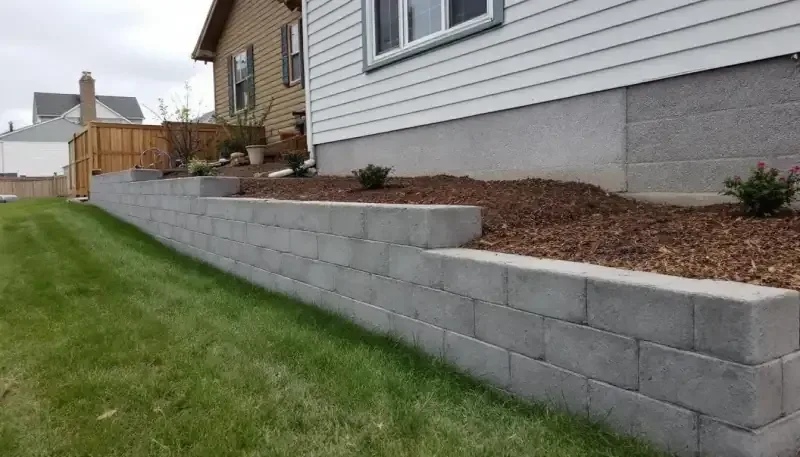
Retaining Walls in Raymore, MO
Raymore yards don't stay flat forever. We build retaining walls that hold ground, manage water, and turn sloped lots into usable space your family actually enjoys.
Patch the Old Wall or Start Fresh — Which Makes Sense for Your Raymore Yard?
It's the question we hear every week from Raymore homeowners. That leaning block wall behind your patio — do you patch the cracks and hope for another five years, or tear it out and build something engineered to last thirty? Patching sounds cheaper, but Cass County clay doesn't forgive half-measures. Hydrostatic pressure keeps building. Freeze-thaw cycles keep expanding those cracks. Most patched walls we inspect end up failing within two to four years.
Replacing gives you a clean slate. You get proper footings below frost line, engineered drainage behind the wall, and a structure designed for the actual soil load on your lot. We've completed 377 projects since 2015, and the majority of our Raymore work involves replacing walls that were under-built from the start. A new wall costs more upfront but eliminates the cycle of throwing money at temporary fixes.
What a Properly Built Retaining Wall Does for Raymore Properties
Raymore sits on heavy Cass County clay that swells when wet and shrinks when dry. That seasonal movement puts enormous lateral pressure on any retaining structure. Our walls are designed specifically for this soil behavior — reinforced concrete or engineered block systems with geogrid tiebacks where the load demands it. We size footings based on actual site conditions, not generic charts.
Many homes in Creekmoor, Good Ranch, and Stonegate were built on graded lots during Raymore's rapid growth over the past two decades. Builders often installed minimal retaining solutions to pass final inspection. Now those walls are showing their age — tilting, cracking at joints, or losing backfill through gaps. We see this pattern constantly along the developments east of I-49 where lot grading created artificial slopes.
A well-built retaining wall does more than hold dirt. It controls stormwater runoff, prevents foundation erosion, creates level planting areas, and can add functional yard space on sloped lots. For homeowners in neighborhoods like Silver Lake and The Meadows, where lots back up to drainage channels, a retaining wall with integrated French drain is often the only permanent fix for chronic erosion.
Raymore-Specific Retaining Walls Considerations
Raymore's Rapid Development Left Behind Undersized Walls
Between 2000 and 2020, Raymore's population nearly doubled. Subdivisions went up fast along Lucy Webb Rd and south of MO-58. Builders routinely installed landscape-block walls without proper engineering. Those walls were fine at four courses high on compacted fill. But Cass County clay shifts. Drainage wasn't always addressed. Now we see walls throughout Good Ranch and Stonegate bowing or separating at the base. Replacing these with reinforced concrete or geogrip-backed block walls stops the problem permanently.
Drainage Patterns Near I-49 Corridor Lots
Properties west of Dean Ave and close to the I-49 corridor sit in areas where highway grading altered natural drainage patterns decades ago. Water that used to sheet across open land now funnels toward residential lots. If your backyard catches runoff from higher ground after every storm, a retaining wall alone won't fix it — you need a wall with an integrated drainage system. We install perforated pipe and gravel backfill behind every wall, but lots near I-49 often need additional swale work to redirect volume before it reaches the structure.
What Your Retaining Wall Timeline Looks Like in Raymore
Day 1-2: Site Assessment and Design. We visit your property, measure grades, identify underground utilities, and assess soil conditions. For walls over four feet, we coordinate with a structural engineer. We submit permit applications to the City of Raymore — typical turnaround is 5 to 10 business days, though spring backlogs can push that closer to two weeks.
Day 3-7 (Permit Wait Window): While permits process, we finalize material orders and schedule delivery. This is a good time to relocate patio furniture, potted plants, or anything within 10 feet of the wall footprint. We'll mark the exact work zone so you know what stays and what moves. If you have sprinkler lines in the area, we'll flag those for rerouting.
Day 8-10: Excavation and Footing. Our crew excavates the trench, compacts the subgrade, and pours reinforced concrete footings. In Raymore's clay soil, we dig footings a minimum of 36 inches deep to get below the frost line and into stable material. Expect equipment noise from about 7:30 AM to 5:00 PM. Your driveway will be the staging area — we lay plywood to protect it.
Day 11-14: Wall Construction. Block walls go up in courses with rebar and grout cores. Poured walls get formed, reinforced, and placed in a single pour. Drainage aggregate and perforated pipe are installed behind the wall as we build. This phase moves fast once footings are cured. Most residential walls in the 30- to 60-foot range are structurally complete within three to four days.
Day 15-18: Backfill, Grading, and Cleanup. We backfill with clean drainage stone, then cap with topsoil and grade the surrounding area. Concrete needs about 7 days of cure time before heavy soil loads. We'll return for a final check after curing. Total project duration for a typical Raymore residential wall: roughly three weeks from permit to final walkthrough, weather permitting. Spring and fall are the best build windows — summer heat above 95°F requires special curing procedures that can add a day or two.
Stopping a 10-Year Slide on Good Ranch Drive
A homeowner on Good Ranch Drive called us about a retaining wall that had been slowly leaning for years. The original wall — a dry-stacked landscape block system — was installed by the builder around 2008. It stood about three and a half feet tall and ran 45 feet along the back property line. Over a decade of Cass County clay expansion had pushed the top course nearly 6 inches out of plumb. Mortar-free joints had opened up, and backfill soil was spilling through gaps onto the lower patio area after every rain.
We removed the existing wall down to bare soil and discovered the original footing was just a 4-inch gravel pad — no concrete, no reinforcement. The clay beneath had turned to slick paste from years of unmanaged water. We excavated 36 inches deep, installed compacted base rock, and poured a reinforced concrete footing. The new wall used split-face concrete block with grouted rebar cores every 32 inches and two courses of geogrid extending 6 feet back into the hillside. Behind the wall, we placed a full French drain system that daylighted into the side-yard swale.
Total project took 14 days including a week of permit processing. The homeowner kept full use of the front driveway and garage throughout construction. The finished wall stands straight, drains clean, and gave back about 180 square feet of usable patio space that had been lost to the sliding slope. Eighteen months later, zero movement — even after the heavy spring rains of 2024.
How Much Does Retaining Walls Cost in Raymore?
| Type | Cost / Sq Ft Face | Typical 200 Sq Ft |
|---|---|---|
| Poured Concrete (Structural) | $20–35 | $4,000–$7,000 |
| Decorative Block / Segmental | $25–45 | $5,000–$9,000 |
| Short Wall (Under 3 ft) | $15–25 | $1,500–$3,000 |
Most residential retaining walls in Raymore run between $4,500 and $14,000 depending on height, length, and drainage complexity. Cass County clay often requires deeper footings and more drainage stone than standard estimates assume — we account for that upfront so your price doesn't change mid-project.
Retaining Walls FAQ for Raymore, MO
What type of retaining wall works best in Creekmoor and other Raymore subdivisions built on graded fill?
Reinforced concrete block with geogrid tiebacks performs best on graded fill lots. These subdivisions were built on compacted clay that settles unevenly over time. Geogrid extends horizontally into the retained soil and distributes lateral pressure across a wider zone. This prevents the tilting and base blowout common with gravity-only walls. For walls under three feet on stable ground, a standard reinforced block wall without geogrid may be sufficient. We assess each lot individually because fill depth and compaction quality vary — even between neighboring homes in the same development.
Does Raymore require a permit for retaining walls?
Yes. The City of Raymore requires a building permit for retaining walls over four feet in exposed height. Walls that retain a surcharge — like a driveway, patio, or structure near the top — may trigger permit requirements at lower heights. Walls over four feet also require stamped engineered drawings. We handle the entire permit process, including engineering coordination. Permit fees typically run $75 to $200 depending on wall size. Expect 5 to 10 business days for approval, longer during peak building season in spring.
Can you build a terraced wall system on my Stonegate lot instead of one tall wall?
Absolutely. Terracing splits a tall grade change into two or more shorter walls with level planting beds between them. This approach reduces the lateral pressure on each individual wall, which often means lighter engineering requirements and lower material costs. It also looks great — those planting terraces become usable garden space. On Stonegate lots where slopes run 6 to 10 feet, we typically recommend two terraced walls spaced 4 to 6 feet apart rather than a single tall structure. Each terrace gets its own drainage system.
How soon after my new-construction home is finished should I install a retaining wall?
We recommend waiting at least one full year after construction. New-build lots in Raymore — especially in developments along MO-58 — settle significantly during the first 12 months as compacted fill adjusts to moisture cycles. Building a wall too soon means building on unstable ground. That said, if you have active erosion threatening your foundation or a neighbor's property, we can install a temporary erosion control measure and then build the permanent wall once settling stabilizes. One year of settlement data gives us a much more accurate design.
Will a retaining wall solve the washout along the back of my Silver Lake property?
In most cases, yes — but the wall needs to be paired with proper drainage. Silver Lake lots that back up to low areas or drainage channels deal with concentrated runoff during heavy rain. A retaining wall holds the soil in place, but without a French drain behind it and surface grading in front, water just finds a new path. We install 4-inch perforated drain pipe wrapped in filter fabric, backed by 12 inches of clean drainage stone, on every wall. For Silver Lake properties with severe runoff, we may also add a surface swale or daylight the drain pipe to a lower discharge point.
Other Concrete Services in Raymore, MO
Retaining Walls in Nearby Cities
Get Your Free Retaining Wall Estimate in Raymore
We'll visit your property, measure the slope, check soil conditions, and give you a detailed written estimate — typically within 48 hours. Raymore homeowners from Creekmoor to The Meadows trust our 377+ completed projects and 13 five-star Google reviews. Call today or fill out the form below.