
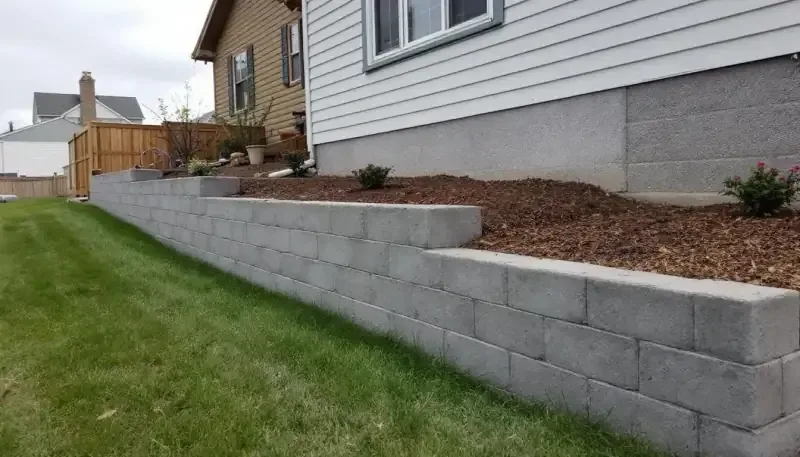
Retaining Walls in Lee's Summit, MO
Your Lee's Summit yard shouldn't slide downhill every time it rains. We build retaining walls that hold ground, redirect water, and turn problem slopes into usable outdoor space.
Patch That Old Wall or Start Fresh — Which One Actually Saves You Money?
It's the question we hear every week from homeowners in Raintree Lake and Lakewood: should I repair my crumbling retaining wall or tear it out and build new? The answer depends on what's failing. A few cracked blocks with intact footing can often be salvaged. But if the wall is leaning more than two inches off plumb or the base has shifted, you're throwing money at a structure that's already lost its fight with gravity.
Lee's Summit sits on heavy Jackson County clay that swells when wet and shrinks when dry. That seasonal push-and-pull is brutal on retaining walls. We've pulled apart walls in Winterset Valley that looked fine on the surface but had completely compromised drainage behind them. Water pressure had been building for years. No amount of patching fixes hydrostatic failure.
A full replacement gives you modern engineering — proper geogrid reinforcement, crushed stone backfill, perforated drain tile at the footing, and materials rated for Missouri's freeze-thaw cycles. The upfront cost is higher, but the 30-to-50-year lifespan makes it the better investment for most Lee's Summit properties we evaluate.
Since 2015, we've completed 377+ concrete projects across the Kansas City metro. Thirteen five-star Google reviews back up the work. If you're staring at a failing wall on your Bent Tree or Longview Farm property, let's figure out together whether a repair or a rebuild is the right call for your specific situation.
How Retaining Walls Solve Real Problems on Lee's Summit Properties
Lee's Summit's rolling terrain creates natural grade changes that look beautiful until water starts moving the wrong direction. Homes along Lakewood Lakes and the neighborhoods off Colbern Road often sit on lots with three to six feet of elevation change from front to back. A properly engineered retaining wall converts that slope into level tiers you can actually use — flat yards, expanded patios, garden beds with real depth.
We build with segmental concrete block, poured-in-place reinforced concrete, and natural stone depending on the application. For walls over four feet in Lee's Summit, Jackson County requires engineered drawings and a building permit. We handle the engineering specs, the permit application, and the inspection scheduling so you don't have to chase paperwork between city hall and your mailbox.
Drainage design matters as much as the wall itself. Every retaining wall we install includes a gravel drainage zone behind the face and a perforated pipe system at the base that routes water to a controlled outlet. In a city where spring storms can dump three inches overnight, that drainage layer is the difference between a wall that lasts decades and one that blows out in five years.
Lee's Summit-Specific Retaining Walls Considerations
Jackson County Clay and What It Does to Wall Footings
The expansive clay soil across Lee's Summit has a plasticity index that causes significant seasonal movement. When summer heat dries the clay, it contracts and pulls away from footings. When fall rains saturate it, the clay expands and pushes laterally against wall faces. We excavate below the active zone and install compacted Class 5 aggregate beneath every footing. This isolates the wall structure from the clay's expansion cycle and prevents the tilting we regularly see on older walls throughout Raintree Lake and Longview Farm neighborhoods.
Lot Grading in Newer Lee's Summit Developments
Subdivisions built in the 2000s and 2010s along Ward Road and south of US-50 often have aggressive lot grading that directs runoff toward rear property lines. Original builder-grade timber walls and cheap block walls in these neighborhoods are now failing at a predictable rate. The subbase settlement that's already causing curb failures in these developments affects retaining walls the same way. We see this pattern constantly and design replacements with deeper footings and better compaction to outlast the original construction by decades.
Setback and Easement Rules Specific to Lee's Summit
Lee's Summit has specific setback requirements that differ from other Jackson County municipalities. Utility easements along rear and side property lines — especially common near Lakewood Lakes — can restrict where a retaining wall sits. Before we pour anything, we pull your plat survey and confirm easement locations with the city. This avoids the nightmare scenario of building a wall that encroaches on a drainage or utility easement and having to tear it out later. We've saved more than a few homeowners from that expensive mistake.
What to Expect During Your Retaining Wall Project
Your project starts with a site visit where we measure grade changes, probe soil conditions, and mark utility locations. If your wall will exceed four feet, we bring in a licensed structural engineer to produce stamped drawings. We then submit the permit application to Lee's Summit's Community Development Department and typically receive approval within ten to fifteen business days. You won't need to visit city hall — we handle the submission and follow-up.
On build day, expect a small excavator and a dump truck on your property. If you're in a neighborhood like Bent Tree or Winterset Valley with narrower driveways, we'll coordinate equipment staging in advance so nothing blocks your garage. Excavation usually takes one day. The crew removes soil, sets compacted aggregate base, and installs drain tile. Noise levels are comparable to a lawn mower for most of the day, louder during initial digging.
Block or concrete placement follows over the next two to five days depending on wall length and height. If we're pouring reinforced concrete, a concrete truck will park on your driveway or the nearest street section — we lay protective plywood under the chute to prevent driveway damage. For segmental block walls, materials arrive on a flatbed and get staged in your yard near the work zone.
Jackson County requires a footing inspection before we build above grade and a final inspection once the wall is complete. Our crew schedules both inspections directly with the county inspector. You'll receive a copy of the passed inspection report for your records. After final approval, we backfill, grade the surrounding soil, and clean up completely. Most residential retaining wall projects in Lee's Summit wrap up within one to two weeks from the start of excavation.
Concrete Block vs. Poured Concrete Retaining Walls: Which Holds Up Better in Lee's Summit?
Segmental concrete block walls are the most popular choice for Lee's Summit residential projects under six feet tall. They install faster, offer design flexibility with curves and corners, and don't require formwork. A well-built block wall with geogrid reinforcement handles Jackson County clay pressure effectively and lasts 30 to 50 years. Block also allows for easier future modification — you can extend a wall or add tiers without demolishing the original structure.
Poured-in-place reinforced concrete walls are stronger per linear foot and better suited for walls above six feet, retaining walls supporting driveways or garage pads, or situations with heavy surcharge loads. Properties along the steeper grades near M-291 and the hills south of US-50 sometimes require poured concrete for structural reasons. These walls cost 20-40% more than block but handle extreme lateral loads that block walls can't match.
For most Lee's Summit homeowners in neighborhoods like Lakewood, Bent Tree, and Winterset Valley, segmental block is the right balance of performance and cost. We'll recommend poured concrete only when engineering demands it. During your site evaluation, we'll explain exactly which approach fits your grade change, soil conditions, and budget — no upselling involved.
How Much Does Retaining Walls Cost in Lee's Summit?
| Type | Cost / Sq Ft Face | Typical 200 Sq Ft |
|---|---|---|
| Poured Concrete (Structural) | $20–35 | $4,000–$7,000 |
| Decorative Block / Segmental | $25–45 | $5,000–$9,000 |
| Short Wall (Under 3 ft) | $15–25 | $1,500–$3,000 |
Retaining wall costs in Lee's Summit typically range from $50 to $120 per square face foot depending on material, wall height, and drainage complexity. Properties off Colbern Road and in Lakewood often require deeper excavation due to clay density, which can add 10-15% to base pricing.
Retaining Walls FAQ for Lee's Summit, MO
Does Lee's Summit require a permit for retaining walls?
Yes. Lee's Summit requires a building permit for any retaining wall over four feet tall measured from the bottom of the footing to the top of the wall. Walls under four feet generally don't need a permit unless they support a surcharge like a driveway, patio, or structure above. We handle all permit applications through Lee's Summit's Community Development Department and schedule the required inspections. The permit fee is typically between $75 and $200 depending on project scope.
How deep do footings need to be for a retaining wall on Lee's Summit clay?
We typically excavate footings 24 to 36 inches below grade in Lee's Summit, which gets below the most active clay expansion zone. Jackson County clay has high plasticity, meaning it swells significantly when wet. A shallow footing will heave and shift with the clay. We place compacted crushed stone beneath the footing to create a stable, non-expansive base. For walls over four feet, our structural engineer specifies exact footing depth and width based on the soil conditions at your specific property.
What's the difference between a gravity wall and a reinforced wall?
A gravity wall relies on its own mass to resist soil pressure. These work well for walls under three feet. A reinforced wall uses geogrid — a high-strength polymer mesh — anchored into the soil behind the wall to distribute lateral earth pressure over a wider area. Most walls in Lee's Summit above three feet need geogrid reinforcement because of the heavy clay soil's lateral pressure. Reinforced walls cost slightly more but handle taller heights and heavier loads without increasing wall thickness dramatically.
Can you build a retaining wall next to my existing fence in Raintree Lake?
Usually, yes. We need at least 18 inches of clearance behind the wall face for drainage aggregate and geogrid installation. If your fence sits right on the property line, we may need to temporarily remove a section during construction and reinstall it afterward. In Raintree Lake, many lots have HOA guidelines about fence placement and wall aesthetics. We review these requirements before construction begins so the finished wall meets both Jackson County code and your neighborhood association standards.
Will heavy rain delay my retaining wall project?
It can. We won't compact base material or pour concrete footings when the soil is saturated — it compromises structural integrity. Lee's Summit averages about 42 inches of rain per year, with the heaviest months being May and June. We build weather contingency into every project timeline. Light rain doesn't stop block placement or backfill work. But if we get a three-inch storm overnight, we'll wait a day or two for the excavation to drain before resuming. We keep you updated with daily progress texts throughout the project.
My Longview Farm lot slopes toward my neighbor's yard — am I liable for runoff damage?
Missouri follows a modified civil law rule regarding surface water drainage. You generally cannot alter the natural drainage pattern on your property in a way that causes damage to an adjacent property. If grading or construction on your Longview Farm lot redirects water onto your neighbor's yard, you could face liability. A retaining wall with proper drainage engineering actually helps by controlling where water goes. We design every wall with outlet pipes that direct collected water to approved discharge points — street gutters, storm drains, or dry wells — so runoff stays managed and legal.
Other Concrete Services in Lee's Summit, MO
Retaining Walls in Nearby Cities
Schedule Your On-Site Retaining Wall Consultation
We'll walk your Lee's Summit property, measure the grade, assess soil and drainage conditions, and give you a detailed scope of work with transparent pricing. Most site visits take about 30 minutes — bring your questions and we'll bring real answers.