
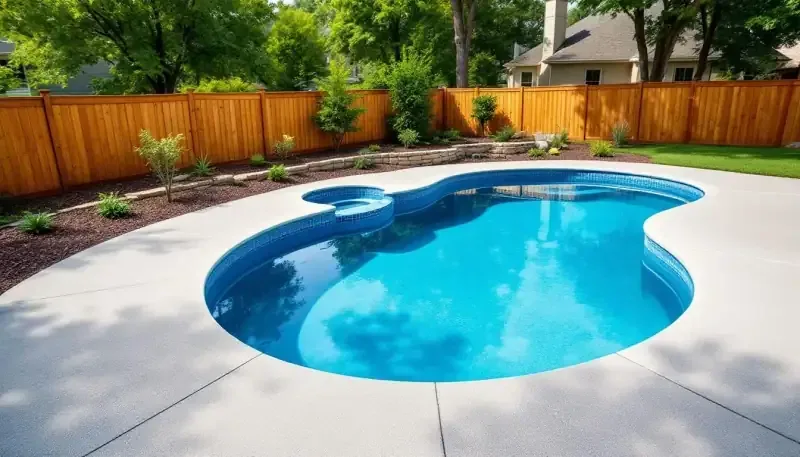
Pool Decks in Raymore, MO
Raymore homeowners are building pool decks that last — and it starts with understanding what Cass County soil demands from every square foot of concrete.
What Does a Pool Deck Actually Cost in Raymore?
Let's talk numbers first. A standard concrete pool deck in Raymore typically runs between $8 and $15 per square foot for a basic broom finish. Stamped or decorative options push that to $12–$20 per square foot. A typical 600-square-foot deck lands somewhere between $5,400 and $12,000 depending on finish, grading complexity, and access to your backyard. These aren't Kansas City metro averages — they reflect Cass County realities.
Why the range? Raymore sits on heavy clay soil that shifts seasonally. That means deeper excavation, thicker subbase prep, and more reinforcement than you'd need in sandy or loamy ground. Every one of those steps adds labor and material. Skipping them saves money upfront and costs you cracked concrete within three years. We'd rather give you the honest number now.
Material costs in southern Johnson and Cass County have climbed since 2022. Ready-mix concrete, rebar, and fiber mesh all come from suppliers off I-49. Fuel surcharges on delivery trucks hit Raymore harder than contractors working closer to downtown Kansas City batch plants. That freight cost shows up in your quote — and any contractor who ignores it is cutting corners somewhere else.
Here's the upside: Raymore's growth means concrete suppliers stay competitive. We source from multiple plants along the I-49 corridor and lock in pricing before your project starts. Since 2015, we've completed 377-plus projects across the metro, and our 13 five-star Google reviews reflect homeowners who got transparent pricing from day one. No surprise change orders. No inflated allowances.
Why Raymore Backyards Deserve Purpose-Built Pool Decks
Raymore's residential boom means thousands of homes built between 2005 and 2024 now feature in-ground pools. Neighborhoods like Creekmoor, Silver Lake, and Stonegate were designed with generous lot sizes and outdoor living in mind. But many builders installed minimal pool surrounds — narrow concrete aprons with basic finishes that crack, stain, and feel scorching hot by July. A purpose-built pool deck transforms that strip of concrete into usable living space.
Pool decks in Raymore need to handle freeze-thaw cycles from November through March, intense UV exposure from May through September, and constant chlorine or salt splash. We specify 4,500 PSI concrete with air entrainment as standard. That mix resists surface scaling when ice forms and holds up against chemical exposure from pool water. Every deck gets control joints placed at intervals matched to the slab dimensions — not just scored in random patterns.
Beyond durability, your pool deck should complement your home and yard. Raymore's newer subdivisions lean toward earth tones and natural stone aesthetics. Stamped concrete in ashlar slate or flagstone patterns gives you that look at a fraction of the cost. We also install exposed aggregate and colored broom finishes for homeowners who want something lower-maintenance. Each option handles Cass County conditions differently, and we walk you through the tradeoffs before you commit.
Raymore-Specific Pool Decks Considerations
Cass County Clay and What It Means for Your Slab
Raymore's soil is predominantly high-plasticity clay. It swells when wet and shrinks when dry, creating seasonal movement that cracks underprepared concrete. We excavate 6 to 8 inches below finished grade and install a compacted Class 5 limestone subbase. That buffer absorbs clay movement so your pool deck stays flat. Homes in Good Ranch and The Meadows sit on some of the most active clay in the area — we adjust our prep accordingly.
Backyard Access on Raymore's Newer Lots
Many Raymore homes built after 2010 have fenced backyards with narrow side gates. Getting a concrete truck close enough matters — every foot of chute extension or wheelbarrow distance adds labor time and affects pour consistency. We survey access before quoting. In subdivisions like Stonegate, we sometimes use line pumps to place concrete precisely without tearing up landscaping or removing fence sections. That planning keeps your yard intact and your cost predictable.
Pool Equipment Setups and Utility Routing
Your pool pump, filter, and heater need accessible pads and clearance. Many Raymore pools have equipment within a few feet of the deck edge. We form around equipment pads, maintain code-required clearances, and can embed PVC conduit for future lighting or electrical runs. If your pool uses a salt chlorine generator, we recommend a sealed or semi-sealed finish to resist salt residue buildup that accelerates surface erosion.
Drainage Toward Raymore's Storm Systems
Raymore's stormwater infrastructure is still catching up with growth. Flat lots in Silver Lake and parts of Creekmoor already deal with standing water after heavy rain. Your pool deck must slope away from the pool at a minimum of one-quarter inch per foot — but it also can't direct runoff toward your foundation or your neighbor's yard. We grade each deck to channel water toward established drainage paths or dry wells, keeping your backyard functional even during Missouri's heaviest storms.
How We Build Pool Decks in Raymore — A Craftsman's Walkthrough
Every project starts with a site visit where we measure the pool perimeter, check elevations with a laser level, and probe soil conditions. In Raymore, that soil test matters more than most places. If we find saturated clay within 4 inches of grade — common in spring around Creekmoor and Good Ranch — we schedule excavation after a dry window. Pouring on waterlogged clay is a recipe for settlement cracks within the first year. We'd rather wait three days than rebuild your deck in three years.
Excavation goes 6 to 8 inches deep depending on soil readings. Our crew removes all organic material and loose fill, then brings in Class 5 crushed limestone from suppliers off I-49. We compact in 2-inch lifts using a plate compactor, checking density between each pass. On Raymore's clay, this step takes twice as long as it would on stable ground — and it's the single most important part of the build. Rebar goes in on 18-inch centers, supported by chairs to keep it centered in the slab. For larger decks or decks with cantilever edges, we switch to 12-inch spacing.
We pour 4,500 PSI air-entrained concrete — sourced from batch plants along the I-49 corridor, typically delivered within 35 minutes of mixing. Timing matters because concrete starts setting the moment water hits cement. Our crew places, screeds, and bull-floats the slab in continuous passes. For stamped finishes, we apply color hardener by broadcast method, then stamp while the surface is still plastic. Broom finishes get timed to hit the right firmness — too early and the texture washes out, too late and the broom skips. We've poured enough decks in Cass County to read the conditions and get that window right.
After finishing, we apply a curing compound that locks in moisture for 7 days — critical for strength development in Raymore's summer heat, where surface temperatures can exceed 140 degrees on exposed concrete. We cut control joints the next morning at predetermined intervals to control where any shrinkage cracks occur. Final sealer goes on after 28 days of cure time. We schedule a return visit to apply it, which also gives us a chance to inspect the slab under real-world conditions before calling the project complete.
Pool Deck Conditions Across Raymore's Neighborhoods
Creekmoor features larger estate-style lots with mature landscaping and rolling terrain. Pool decks here often require multi-level designs to accommodate grade changes, and the clay content in this area tends to be especially dense. We frequently install French drains along deck perimeters in Creekmoor to manage runoff from sloped yards. Homes built in the early 2000s may have original pool aprons that are now showing surface scaling and joint failure — ideal candidates for full removal and replacement.
Silver Lake and Stonegate represent Raymore's mid-2010s building boom. Lots are tighter, backyards are flatter, and access is often restricted by vinyl fencing with single gates. Pool decks in these neighborhoods typically sit closer to the home's foundation, which makes drainage planning critical. We slope decks precisely to avoid directing water toward basement walls. The upside is that flat lots mean less excavation and simpler forming — which keeps costs lower than hillside neighborhoods.
Good Ranch and The Meadows include some of Raymore's newest construction, with homes built between 2018 and 2024. Many homeowners here are adding pools for the first time and want the deck installed simultaneously. The soil in these subdivisions was recently disturbed during home construction, so compaction testing is essential before we pour. We've seen fill dirt settle 2 to 3 inches in the first two years on newer lots. Waiting for that settlement — or over-excavating to compensate — prevents callbacks and keeps your deck level long-term.
How Much Does Pool Decks Cost in Raymore?
| Type | Cost / Sq Ft | Typical 400 Sq Ft |
|---|---|---|
| Standard Textured (Broom) | $8–12 | $3,200–$4,800 |
| Cool Deck Coating | $10–15 | $4,000–$6,000 |
| Stamped / Decorative | $12–18 | $4,800–$7,200 |
Pool deck pricing in Raymore reflects Cass County's heavy clay excavation requirements and the delivery distance from I-49 corridor batch plants. Expect to invest $8–$20 per square foot depending on finish, with most Raymore homeowners landing between $6,500 and $11,000 for a complete pool deck installation.
Pool Decks FAQ for Raymore, MO
Do Raymore homes need deeper footings for pool decks than other parts of the metro?
In many cases, yes. Cass County clay has a high plasticity index, which means it expands and contracts more than soils further north. We excavate 6 to 8 inches for subbase prep on most Raymore pool decks, compared to 4 to 6 inches in areas with more stable ground. Neighborhoods like Good Ranch and The Meadows tend to have the most active clay. Deeper excavation and a thicker crushed limestone subbase prevent the slab from heaving or settling as moisture levels change through the seasons.
What slip-resistant finishes do you recommend around pools?
Broom finish is the most slip-resistant and most affordable option. It creates fine linear ridges that grip wet feet reliably. Stamped concrete can also be slip-resistant when we apply a non-slip additive to the sealer — this embeds a fine aggregate texture into the surface coat. Exposed aggregate naturally provides traction because the stone particles sit slightly above the surface. We avoid smooth trowel finishes around pools entirely. For Raymore's climate, where decks go from pool-wet to frozen in a matter of months, traction is non-negotiable.
How far from the pool edge should the deck extend?
We recommend a minimum of 4 feet on all sides for safe walking and lounging space. Most Raymore homeowners prefer 6 to 8 feet on the entertaining side of the pool — enough room for chairs, a small table, and foot traffic behind seated guests. If your lot allows it, extending to 10 or 12 feet on one side creates a true outdoor living area. We design the layout based on your yard dimensions, fence locations, and how you actually plan to use the space.
Can you pour my pool deck in phases to spread out the cost?
Yes, and we do this regularly for Raymore homeowners managing a budget. The most common approach is pouring the main pool surround first — the 4-to-6-foot apron around the entire pool — and then adding an expanded entertaining area or walkway connection in a second phase. We install dowel bars or keyway joints at the phase boundary so the two pours lock together structurally. The key is planning both phases upfront so drainage, grading, and joint placement work as one system.
How does pool salt affect concrete over time in this climate?
Salt chlorine generators are popular in Raymore and they do affect concrete surfaces. Saltwater splash deposits sodium chloride on the deck, which accelerates scaling — especially through freeze-thaw cycles. We mitigate this two ways: first, by using air-entrained concrete that resists internal frost damage, and second, by applying a penetrating sealer that blocks salt from absorbing into the pore structure. We recommend resealing every 2 to 3 years for salt pools versus every 3 to 4 years for traditional chlorine setups.
What happens if my pool deck cracks — is that covered?
Hairline shrinkage cracks under one-sixteenth of an inch are normal in concrete and don't affect structural performance. We place control joints specifically to direct those cracks to planned locations where they're nearly invisible. Structural cracks — wider than one-eighth inch or showing vertical displacement — indicate a subbase or soil issue. Our workmanship warranty covers structural cracking caused by installation defects. We'll walk through warranty details during your estimate so you know exactly what's covered before we start.
Other Concrete Services in Raymore, MO
Request a Callback From Our Raymore Crew
Drop your info and we'll call you back within one business day. We serve all of Raymore from Creekmoor to The Meadows — and we'll bring real pricing to your first conversation.