
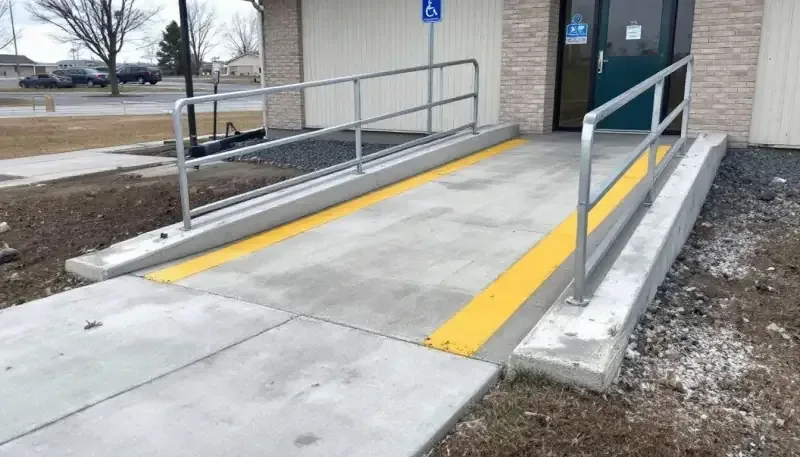
ADA Ramps & Compliance in Independence, MO
Older retail strips along Noland Road and around Independence Square are facing ADA compliance deadlines. We build ramps, curb cuts, and accessible routes that pass inspection the first time.
How Long Can Your Noland Road Storefront Dodge an ADA Complaint?
Walk along Noland Road between 23rd Street and 39th Street on any weekday morning. You'll see busy parking lots, heavy foot traffic, and storefronts that haven't changed much since the 1980s. What you'll also see — if you look with a compliance eye — are crumbling curb ramps, slopes that exceed the 1:12 ratio, and entrances missing detectable warning surfaces entirely. These aren't cosmetic problems. They're lawsuit triggers.
Independence has a retail footprint that punches well above its population of 121,000. That commercial density means more public-facing entrances, more parking lots, and more opportunities for ADA violations. The Independence Center District, Noland Fashion Square, and the shops circling historic Independence Square all have properties built before the 2010 ADA Standards took effect. If your facility hasn't been assessed since then, you're likely out of compliance.
We've completed 377 concrete projects since 2015, and a growing share of that work is ADA-specific. Ramps, accessible parking stalls, van-accessible aisles, compliant curb cuts, and sidewalk transitions. In Independence, this isn't optional maintenance — it's a legal and financial priority for every commercial property owner along those aging corridors.
What ADA Ramp Compliance Actually Looks Like in Independence
ADA compliance isn't one ramp at your front door. It's the entire accessible route — from the parking stall striping to the curb cut, across the sidewalk, through the entrance, and into the building. In Independence, many of these routes cross concrete that was poured 35 to 45 years ago. Scaling, spalling, and settlement have knocked slopes out of spec. Our crew surveys the full path of travel, identifies every deficiency, and builds a scope that addresses them all in a single mobilization.
Curb ramps are the most visible element. The 2010 ADA Standards require a maximum running slope of 8.33 percent, a minimum 48-inch landing at the top, and truncated dome detectable warning surfaces. Most of the ramps along Noland Road and in the Carefree Industrial Park area predate these requirements. We remove the old ramp, set new forms to precise grade, pour 4,000 PSI concrete with fiber reinforcement, and install cast-in-place truncated domes that won't peel off after two Missouri winters.
For medical campuses and larger retail properties near I-70, we also handle accessible parking lot upgrades. That includes correct stall dimensions, van-accessible signage, compliant aisle slopes under two percent in all directions, and smooth transitions to the accessible route. Every project gets a final slope verification using a digital smart level, and we document everything for your records in case of a future complaint or audit.
Independence-Specific ADA Ramps & Compliance Considerations
Aging 1970s–80s Commercial Infrastructure Along Noland Road
Most retail properties along the Noland Road corridor were built or expanded during the 1970s and 1980s. That means the original concrete was poured decades before current ADA standards existed. Subgrade settlement, freeze-thaw scaling, and root intrusion have further degraded these surfaces. Patching an old ramp rarely brings it into compliance. In most cases, full removal and replacement is the only path to a code-passing accessible route. We see this repeatedly at strip centers between Noland Fashion Square and the US-40 intersection.
Jackson County Permitting and Inspection Requirements
ADA ramp work in Independence falls under Jackson County and City of Independence building permit jurisdiction. Commercial concrete work that modifies an accessible route typically requires a permit, a plan review, and a post-pour inspection. Our crew handles the permit application, provides engineered slope drawings when required, and schedules the inspection so there's no gap between pour and sign-off. We know the inspectors, we know the turnaround times, and we build to pass — not to hope.
High Truck Traffic and Load Considerations Near I-70
Properties near the I-70 corridor and Carefree Industrial Park see consistent Class 8 truck traffic. That heavy axle loading causes adjacent concrete to settle unevenly, which throws ramp slopes out of compliance over time. We specify thicker slabs — typically six inches — and use compacted aggregate subbase in these high-traffic zones. For curb ramps near truck routes, we also install thickened edges and doweled joints to resist the lateral forces that crack standard four-inch pours within a few years.
What to Expect During Your ADA Ramp Project in Independence
It starts with a site visit. One of our contractors walks your property with a digital smart level and a measuring wheel. We check every curb ramp, parking stall, sidewalk transition, and entrance threshold. You'll get a written report listing each deficiency, the ADA standard it violates, and our recommended fix. For properties on Noland Road or around Independence Square, this assessment often reveals six to twelve separate issues that property owners didn't know existed.
Once you approve the scope, we pull permits through the City of Independence and schedule the work. On pour day, our concrete truck typically stages on the street or in your parking lot — for Noland Road properties, we coordinate delivery during off-peak hours to avoid blocking customer access. You'll hear saw-cutting as we remove old concrete, then the compactor running as we prep the subgrade. Most single-ramp pours take one day. Multi-ramp projects across a parking lot usually run two to three days.
After the pour, we set barricades and cure the concrete for a minimum of 72 hours before allowing foot traffic. We install truncated dome panels during the pour so they're monolithic with the slab — no adhesive-applied tiles that pop off in Missouri freeze-thaw cycles. Once cured, we take final slope readings at every ramp and landing, photograph everything, and submit for the Jackson County inspection.
You'll receive a compliance documentation packet that includes before-and-after photos, slope measurements, permit records, and the inspection result. This packet is your protection against future ADA complaints. If a complaint is ever filed, you'll have timestamped evidence that your property meets or exceeds the 2010 ADA Standards for Accessible Design.
Bringing a Noland Road Medical Office Into Full ADA Compliance
A medical office near the intersection of Noland Road and Gudgell Avenue had received a demand letter from an ADA plaintiff's attorney. The building was constructed in 1978, and the two curb ramps serving the front parking lot had running slopes measured at 10.2 and 11.6 percent — well above the 8.33 percent maximum. The truncated dome panels had delaminated completely. The van-accessible parking aisle had a cross slope exceeding four percent due to decades of subgrade settlement. The property owner needed a fast, documented fix.
Our crew mobilized within two weeks of the assessment. We saw-cut and removed both existing ramps and excavated the subbase down to stable clay. After re-compacting with six inches of crushed limestone aggregate, we formed new ramps at a 7.8 percent running slope — intentionally below the 8.33 maximum to provide a compliance buffer against any future settlement. Cast-in-place truncated domes went in during the pour. We also milled and re-graded the van-accessible aisle to bring the cross slope under two percent.
The Jackson County inspector signed off on the first visit. We delivered a full compliance documentation packet to the property owner's attorney within 48 hours of inspection. The demand letter was resolved without litigation. Total project time from first phone call to final documentation: 19 days. The property owner has since referred us to two neighboring businesses on Noland Road for similar work.
How Much Does ADA Ramps & Compliance Cost in Independence?
| Type | Cost / Range | Per Installation |
|---|---|---|
| Standard ADA Ramp | $2,000–5,000 | Per Installation |
| Curb Cut / Curb Ramp | $1,500–3,000 | Per Installation |
| Complex / Multi-Level | $5,000–8,000 | Per Installation |
ADA ramp costs in Independence typically range from $2,800 to $6,500 per ramp depending on demolition scope and subgrade condition. Properties along the older Noland Road retail strips often require full subbase replacement, which adds cost but eliminates future settlement issues.
ADA Ramps & Compliance FAQ for Independence, MO
What ADA violations are most common at Independence retail properties?
The most frequent violations we find are excessive curb ramp slopes, missing or deteriorated truncated dome detectable warnings, and non-compliant cross slopes in accessible parking aisles. Properties along Noland Road and near Independence Center are especially prone because their original concrete predates the 2010 ADA Standards. Settlement over 35-plus years has also knocked many ramps out of the 8.33 percent maximum slope requirement. A single ramp that measured correctly in 1985 can easily exceed the limit today due to soil movement and subgrade compaction loss.
Can you bring my entire parking lot into ADA compliance at once?
Yes. We regularly handle full-site ADA upgrades for commercial properties in Independence. That includes curb ramps, accessible parking stalls, van-accessible aisles, sidewalk transitions, and entrance landings. We phase the work to keep portions of your lot open during construction. For larger properties near the I-70 corridor, we can stage the project over consecutive weekends to minimize business disruption. One scope, one mobilization, one inspection — that's the most cost-effective approach.
How do I know if my property is at risk for an ADA lawsuit?
If your building serves the public and your concrete was poured before 2010, there's a high probability that at least some element of your accessible route is non-compliant. Serial ADA plaintiffs actively target older retail strips in metro areas — and Independence's Noland Road corridor fits the profile exactly. High-visibility storefronts with obvious ramp deficiencies get noticed first. A proactive assessment costs a fraction of a single demand letter settlement, which typically runs $5,000 to $25,000 before any corrective work even begins.
Do truncated dome panels hold up in Missouri winters?
They do when installed correctly. We use cast-in-place truncated dome systems that bond directly to wet concrete during the pour. This creates a monolithic connection that resists freeze-thaw cycling far better than surface-applied adhesive panels. Adhesive-mounted domes are the number one failure point we see on older Independence properties — they delaminate within two to four winters, leaving the ramp non-compliant again. Our method costs slightly more upfront but eliminates the recurring replacement cycle.
What's the timeline from assessment to passing the Jackson County inspection?
For a standard one-to-three ramp project, expect about three to four weeks total. The site assessment takes one visit. Permit review through the City of Independence typically runs seven to ten business days. Concrete work takes one to two days depending on demolition scope. We then cure for 72 hours minimum before scheduling the final inspection. Larger multi-ramp projects across full parking lots may extend to six weeks. We provide a detailed schedule at the start so you can plan around customer access and business operations.
Other Concrete Services in Independence, MO
Schedule Your ADA Compliance Site Assessment
During a site visit, one of our contractors walks your Independence property with a digital level, measures every ramp and accessible route, and delivers a written deficiency report with clear pricing — so you know exactly where you stand before any concrete is poured.