
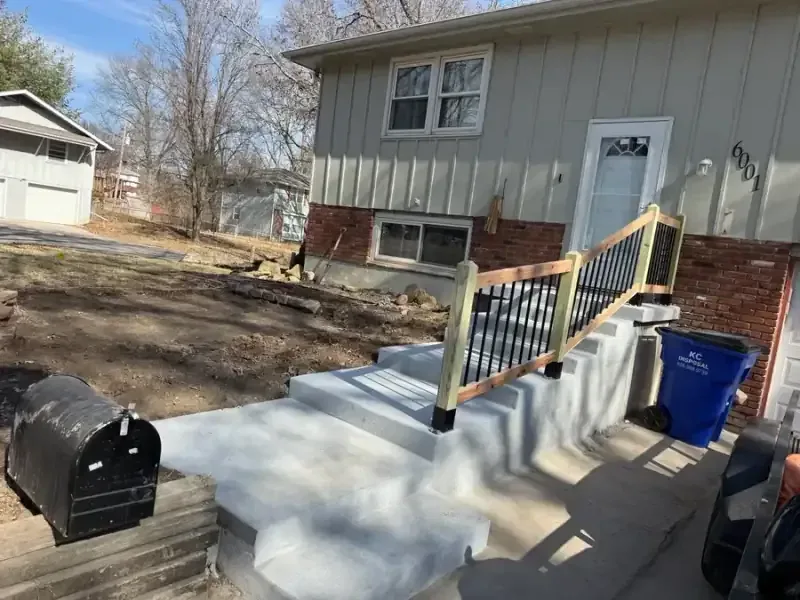
Sidewalks & Walkways in Independence, MO
Your front walkway is the first thing people notice — and in Independence, decades of freeze-thaw cycles have left a lot of them cracked, uneven, and past their prime.
What Does a New Sidewalk Actually Cost in Independence?
Let's talk numbers up front. A new residential sidewalk or walkway in Independence typically runs between $8 and $14 per square foot installed. That range depends on thickness, finish style, and how much demo work your old slab needs. The clay-heavy soils across neighborhoods like Glendale and Santa Fe Trail often require deeper subgrade prep, which adds labor hours. We'd rather give you the honest breakdown now than surprise you later.
Material costs in the KC metro have climbed about 12% since 2021, and Independence is no exception. Ready-mix concrete from local batch plants factors in fuel surcharges tied to delivery routes along I-70 and US-24. Labor rates in Jackson County reflect a tight skilled-trades market. These aren't hidden fees — they're the reality of building something that lasts 30 years in Missouri weather. Since 2015, we've completed 377+ projects with this same straight-talk approach.
Residential Sidewalk & Walkway Services Across Independence
We pour new sidewalks, replace crumbling walkways, and build custom paths connecting driveways to front doors, patios to detached garages, and everything between. Independence homes built in the 1950s through 1980s — especially in Susquehanna and Bingham Estates — often have original concrete that's spalling, heaving, or sinking at the joints. A full replacement gives you a clean, level surface with modern reinforcement and proper drainage slope.
Decorative walkways are one of our most requested upgrades near Independence Square and the Truman library district. Stamped patterns, exposed aggregate, and colored concrete let you match the character of older homes without settling for a plain gray slab. Every walkway we pour includes fiber mesh reinforcement and control joints spaced to minimize cracking in Jackson County's expansive clay soils.
For homeowners along Noland Road and the neighborhoods off M-291, we also handle sidewalk sections that connect to public right-of-way. Independence municipal code has specific requirements for width, thickness, and ADA-compliant slope at curb cuts. We pull the permits, coordinate with the city, and make sure your new concrete passes inspection the first time.
Independence-Specific Sidewalks & Walkways Considerations
Jackson County's Expansive Clay Soils
Independence sits on some of the most problematic clay soils in the metro. These soils swell when wet and shrink when dry, creating a push-pull cycle that cracks thin slabs fast. We compact a 4-inch granular base beneath every walkway to create a buffer between your concrete and the shifting ground. In areas like Rock Creek where drainage is especially poor, we sometimes recommend 6-inch French drain channels alongside the walkway to redirect water away from the slab edge.
Mature Tree Roots Along Established Streets
Many Independence neighborhoods have 50- to 70-year-old oaks and maples with root systems that run right under existing sidewalks. Roots are the number one cause of the buckled, uneven slabs you see all over the Santa Fe Trail and Glendale neighborhoods. When we demo old concrete, we assess root intrusion and work with a certified arborist if removal could damage a healthy tree. Root barriers and strategic rerouting keep your new walkway flat without killing the shade you love.
Winter Freeze-Thaw and Salt Exposure
Independence averages around 40 freeze-thaw cycles per winter. Each cycle forces water into tiny surface pores, expands, and chips away at the concrete — that's the scaling and flaking you see on older slabs. We use a minimum 4,000 PSI air-entrained mix for all walkways. The microscopic air bubbles give expanding water somewhere to go instead of blowing out the surface. We also recommend a penetrating sealer 30 days after pour to resist damage from deicing salts.
What to Expect During Your Walkway Project
On day one, our crew arrives and marks the layout with stakes and string lines so you can see exactly where your new walkway will go. If there's old concrete to remove, expect jackhammer noise for a few hours — we'll give your neighbors a heads-up the day before. Demo debris gets loaded into a trailer parked in your driveway or along the curb. In neighborhoods off US-40 or Noland Road where street parking is tight, we coordinate placement so your neighbors can still get in and out.
Subgrade prep takes up most of the first day. We excavate to the proper depth, compact the native soil, then spread and compact a crushed limestone base. If your property in Bingham Estates or Susquehanna has soft spots from poor drainage, we address those before any concrete goes down. Forms are set and double-checked for grade and alignment. This is when we confirm your finish choice — broom finish, stamped, or exposed aggregate.
Pour day is when things move fast. The concrete truck typically parks on the street closest to the work area. Our crew has about 90 minutes to place, screed, and finish the concrete before it begins to set. You'll want to keep kids and pets inside during this window. After finishing, we apply a curing compound that locks in moisture for proper hydration. The forms come off the next day, and we clean up all equipment and materials from your property.
Jackson County doesn't require a separate inspection for most residential walkways under 200 square feet. Larger projects or any work within the public right-of-way triggers a city permit, and we schedule the inspection with Independence's building division so you don't have to. Final walkability is usually 48 to 72 hours after pour, but we ask you to keep vehicles and heavy loads off for a full seven days. We'll leave you with specific care instructions for the first 30 days.
Repair the Old Slab or Start Fresh? Making the Right Call in Independence
If your walkway has a single cracked section or minor settling at one joint, a targeted repair might be all you need. Mudjacking or polyurethane foam injection can lift a sunken panel back to grade for $300 to $600 per section. Surface cracks under a quarter inch can be sealed and overlaid with a resurfacing compound. These fixes buy you another 5 to 10 years if the subbase is still intact underneath.
But here's the reality for most Independence homes built before the 1990s: the original subgrade was never properly prepared for our clay soils. Patching one section often just shifts the stress to the next panel. If more than 30% of your walkway panels are cracked, heaving, or flaking, a full replacement is the smarter investment. You get a modern mix design, proper base compaction, and a 30-year expected lifespan instead of chasing repairs every few seasons.
We'll be honest during your consultation about which approach makes financial sense. Sometimes a $500 repair is the right answer. Other times, spending $3,000 on a full replacement saves you $1,500 in cumulative patch jobs over the next decade. We've seen both scenarios play out hundreds of times across Jackson County since 2015.
How Much Does Sidewalks & Walkways Cost in Independence?
| Type | Cost / Sq Ft | Typical 300 Sq Ft |
|---|---|---|
| Standard Sidewalk | $6–10 | $1,800–$3,000 |
| Decorative Walkway | $10–16 | $3,000–$4,800 |
| Trip Hazard Repair (per section) | $200–500 | $200–$500 |
Most Independence walkway projects land between $1,800 and $5,500 depending on length, width, and finish. Clay soil remediation and old-slab demo along established neighborhoods like Glendale can add $400 to $800 to the base price.
Sidewalks & Walkways FAQ for Independence, MO
How thick should a residential sidewalk be in Independence?
We pour residential sidewalks at a minimum of 4 inches over a 4-inch compacted base. That's the standard for foot traffic and light loads like a wheelbarrow or bicycle. If your walkway crosses a driveway apron where vehicles will drive over it, we increase thickness to 6 inches with rebar reinforcement. Independence's clay soils make a solid subbase just as important as slab thickness — skipping that step is how you end up with cracked concrete in three years.
Will a new walkway increase my home's value?
Yes, and it's one of the highest-return exterior improvements you can make. A clean, well-designed front walkway improves curb appeal instantly. Real estate agents in the Independence market consistently report that buyers notice cracked or uneven sidewalks during showings. A stamped or decorative walkway near the Truman library district or Independence Square adds even more perceived value because it matches the historic character buyers are looking for in those areas.
Do you handle the city permit process?
We handle everything. If your project requires a permit from the City of Independence — typically for right-of-way work or larger pours — we submit the application, pay the fee upfront, and schedule the inspection with Jackson County's building division. You sign the contract and we take it from there. Most standard residential walkway permits in Independence are processed within five to seven business days.
What happens if tree roots damaged my old sidewalk?
We see this constantly in Susquehanna and the older sections of Glendale where large trees line the streets. After removing the old slab, we evaluate the root system. Small surface roots can be trimmed without harming the tree. Larger structural roots may need a root barrier — a rigid plastic shield that redirects growth away from the new slab. In rare cases, rerouting the walkway path by even 12 inches avoids the root zone entirely. We always prioritize saving healthy trees while protecting your investment.
Can I get a curved walkway instead of a straight one?
Absolutely. Curved walkways require flexible forming materials and more labor to set, so they cost roughly 15-20% more than a straight pour of the same square footage. The result is worth it — a gently curving path through your front yard or leading to a backyard patio feels more inviting and works well with landscaping. We use bendable metal forms that hold precise curves during the pour for a clean, professional edge.
How soon after pouring can I walk on my new sidewalk?
Light foot traffic is safe after 48 hours in normal weather conditions. Full cure takes 28 days, but your sidewalk reaches about 70% of its final strength within the first week. We ask that you avoid dragging heavy furniture or equipment across the surface for at least seven days. During hot Independence summers, we may wet-cure the slab to prevent surface cracking from rapid moisture loss. We leave printed care instructions so you know exactly what to do and when.
What's the difference between broom finish and stamped concrete for walkways?
Broom finish is the standard textured surface you see on most sidewalks. It provides excellent slip resistance and costs the least. Stamped concrete uses rubber mats pressed into the wet surface to create patterns that mimic stone, brick, or slate. Stamped walkways typically add $3 to $5 per square foot over a broom finish. Both options hold up well in Independence weather when properly sealed. Stamped concrete does require resealing every two to three years to maintain its color and protect the pattern from freeze-thaw damage.
Other Concrete Services in Independence, MO
Schedule Your Free On-Site Walkway Consultation
During a 20-minute visit to your Independence property, we measure the project area, evaluate your soil and drainage conditions, and walk you through finish options and pricing — all before you spend a dollar.