
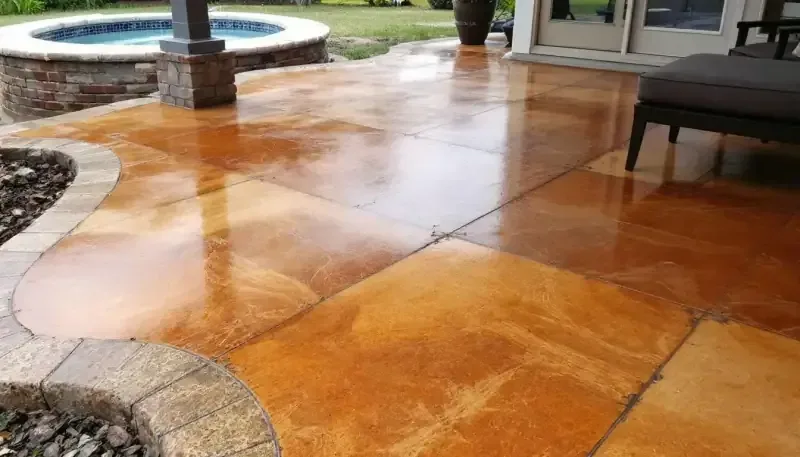
Stained & Colored Concrete in Independence, MO
Your Independence home deserves more than plain gray concrete. We turn driveways, patios, and basement floors into rich, layered surfaces that look like natural stone or polished tile — without the price tag.
Should You Paint It or Stain It? The Difference Matters More Than You Think.
Homeowners across Independence face this choice every spring. Paint sits on top of concrete like a shell. It peels, chips, and fades — sometimes within a single Missouri winter. Stain penetrates the surface and bonds chemically with the slab. The color becomes part of the concrete itself. That means no flaking on your Bingham Estates driveway and no bubbling on your Glendale patio. One option fights the concrete. The other works with it.
We've completed 377+ projects since 2015, and a big chunk of those involved stripping failed paint jobs and replacing them with proper concrete stain. Homeowners along Noland Road and throughout the Santa Fe Trail neighborhood call us after watching their painted garage floors deteriorate in two seasons. Staining costs roughly the same upfront but lasts years longer. It's not even close once you factor in maintenance.
What Stained & Colored Concrete Actually Looks Like in Independence Homes
Stained concrete isn't one-dimensional. Acid-based stains react with the minerals in your slab, creating translucent, variegated tones — think warm ambers, deep terra cottas, and mottled earth greens. Water-based stains give you a wider color palette with more consistent coverage. We use both, sometimes on the same project. A Susquehanna homeowner recently had us acid-stain their back patio in a walnut brown and water-stain their front walkway in a slate gray to match their siding.
Integral color is the other option. We mix pigment directly into the concrete before it's poured, so the color runs all the way through. This works best for new flatwork — driveways, pool decks, sidewalks. If your existing slab is in solid shape, staining is the move. If you're pouring fresh, integral color gives you uniform results that won't fade for decades.
Independence has some of the most architecturally diverse residential streets in Jackson County. Homes near the Vaile Mansion and Independence Square range from Victorian to mid-century to modern builds. Colored concrete lets you match any era. We've done warm sandstone tones for Craftsman bungalows and cool charcoal finishes for contemporary ranch homes off M-291. The surface adapts to whatever your home demands.
Independence-Specific Stained & Colored Concrete Considerations
Existing Slab Condition on Older Independence Homes
Most homes in Independence's established neighborhoods — Glendale, Rock Creek, Santa Fe Trail — sit on slabs poured between the 1950s and 1980s. Older concrete absorbs stain differently than fresh pours. Surface scaling, hairline cracks, and previous sealers all affect how color takes. We grind and profile every slab before staining to create a clean canvas. If your concrete has deep spalling or structural cracks, we'll tell you honestly whether staining makes sense or if a new pour with integral color is the smarter investment.
Jackson County's Expansive Clay and Moisture Migration
The heavy clay soils across Jackson County trap moisture beneath slabs. That moisture migrates upward through the concrete as vapor. If you seal a stained surface without accounting for moisture vapor transmission, the sealer blisters and lifts — taking your color with it. We test every slab with a calcium chloride moisture kit before selecting a sealer. Breathable topical sealers or penetrating sealers handle Independence's clay-driven moisture far better than film-forming products.
UV Exposure on South-Facing Patios and Driveways
Independence gets over 200 sunny days a year. South-facing flatwork along US-24 and US-40 corridors takes serious UV punishment. Cheaper water-based stains can fade noticeably within three to four years under that kind of exposure. We use UV-stable stain formulations and pair them with UV-resistant sealers rated for Missouri's solar load. On heavily exposed driveways and patios, we recommend resealing every two to three years to maintain color depth.
Freeze-Thaw Cycles and Sealer Selection
Independence typically sees 80 to 100 freeze-thaw cycles per winter. Each cycle pushes moisture into the concrete surface and back out. A poorly chosen sealer traps that moisture and causes delamination — white patches, flaking, and color loss. We apply sealers that allow the concrete to breathe while still protecting the stain. For driveways exposed to road salt runoff, we add a sacrificial wax coat that takes the chemical abuse instead of your colored surface.
How We Build Stained & Colored Concrete in Independence, MO
Every staining project starts with surface prep, and in Independence that means dealing with decades of wear. Our crew arrives with diamond grinders and shot blasters — not rental-grade floor buffers. We grind the surface to a CSP-3 profile, which opens the concrete pores enough for deep stain penetration. On slabs with old paint, epoxy coatings, or heavy efflorescence, we'll run two grinding passes. This step alone takes a full day on most patios and driveways. Skipping it is why DIY stain jobs fail within a year.
After grinding, we test the slab's moisture content and check for alkalinity. Jackson County's clay soils push a lot of moisture upward, and concrete with a pH above 9 reacts unpredictably with acid stains. If the numbers are off, we neutralize the surface and let it dry before moving forward. We source our acid stains from a regional supplier in the Kansas City metro — shorter supply chains mean fresher product with more reactive metallic salts. Water-based stains come from a manufacturer we've used since 2016 with proven color consistency across Missouri's temperature swings.
Application is where craft matters most. We spray acid stain in overlapping, randomized passes using a low-pressure HVLP sprayer. This creates the natural mottling that makes acid-stained concrete look like aged leather or natural stone. We never roll acid stain — rollers leave visible lap marks and kill the organic pattern. For water-based stains, we use a combination of spraying and light back-rolling to build even color. We typically apply two coats, letting each coat react or dry for four to six hours depending on temperature and humidity.
Final sealing happens 24 hours after the last stain coat. We apply a two-coat sealer system: a penetrating primer that locks color into the concrete matrix, followed by a topical sealer that adds sheen and surface protection. On exterior surfaces like driveways and patios, we use a non-slip additive broadcast into the wet topcoat. Our crew hand-finishes edges and saw-cut joints with small brushes to ensure full sealer coverage in every groove and corner. The entire process — prep through final seal — runs three to four days for a standard Independence driveway or patio.
How Much Does Stained & Colored Concrete Cost in Independence?
| Type | Cost / Sq Ft | Typical 300 Sq Ft |
|---|---|---|
| Acid Stain (Existing Concrete) | $4–8 | $1,200–$2,400 |
| Water-Based Stain (Existing) | $3–6 | $900–$1,800 |
| Integral Color (New Pour) | $10–15 | $3,000–$4,500 |
Stained concrete in Independence typically runs $4 to $10 per square foot depending on stain type, number of colors, and existing slab condition. Older slabs in neighborhoods like Rock Creek and Glendale often require extra grinding and surface repair, which adds $1 to $2 per square foot to the prep costs.
Stained & Colored Concrete FAQ for Independence, MO
What colors work best on Independence homes with brick exteriors?
Most homes in Independence's older neighborhoods feature red or brown brick. We recommend warm earth tones — walnut, cola, coffee brown, or desert amber — that complement brick without competing with it. Cool grays and charcoals work well on homes with painted brick or lighter stone facades. During your estimate, we bring physical stain samples and hold them against your brick, siding, and trim so you can see the pairing in natural light before choosing.
How do I maintain stained concrete through an Independence winter?
Avoid rock salt and magnesium chloride deicers. Both attack sealers and can discolor stained surfaces. Use sand or calcium magnesium acetate for traction instead. Shovel snow promptly so standing water doesn't freeze and thaw on the surface repeatedly. In spring, wash the slab with a garden hose and mild detergent to remove winter grime. We recommend resealing every two to three years for exterior surfaces — our crew can handle that in a single afternoon visit.
Can you match the stain color on my patio to my interior floors?
Yes, but it requires careful planning. Interior and exterior concrete respond differently to stain because of UV exposure, moisture levels, and surface porosity. We do test patches on both surfaces using the same stain batch. Acid stains will always produce slightly different results on different slabs because they react with the unique mineral content in each pour. Water-based stains give us more control over color matching. If exact consistency matters to you, water-based is the way to go for both surfaces.
Is stained concrete slippery when wet?
Unsealed stained concrete has decent traction, similar to a standard broom-finished slab. The sealer is what can make it slick. We add a polymer grit or aluminum oxide broadcast into the final sealer coat on all exterior surfaces. This creates a textured finish that stays grippy even in rain. It's invisible to the eye but noticeable underfoot. For pool decks and covered porches, we can also apply a heavier non-slip texture that meets commercial slip-resistance ratings.
My garage floor has oil stains from years of parking — can it still be stained?
Oil contamination is one of the most common issues we see in Independence garages, especially in homes built along the US-24 corridor in the 1970s and 80s. Oil blocks stain penetration and creates blotchy, uneven color. We degrease the surface with a commercial alkaline cleaner and then diamond-grind past the contaminated layer. In most cases, we can get a clean surface for staining. Deep oil penetration sometimes requires a full skim coat of polymer-modified overlay before staining. We'll test the slab during your estimate and give you an honest assessment.
Other Concrete Services in Independence, MO
Stained & Colored Concrete in Nearby Cities
Request a Callback About Your Staining Project
Leave your name and number, and we'll call you back within one business day. We serve all of Independence — from Bingham Estates to Susquehanna and everywhere in between.