Warehouse & Industrial Floors in Harrisonville, MO
Harrisonville's I-49 corridor is booming with logistics growth. Your warehouse floor needs to keep pace with every loaded pallet and forklift that crosses it.
Is your Harrisonville warehouse floor costing you more than it should?
Summer in Cass County means one thing for warehouse operators: it's pour season. Warm, stable temperatures through June, July, and August give us the ideal curing window for high-performance industrial slabs. If your facility near the Harrisonville Industrial Park has crumbling joints or uneven surfaces, now is when you lock in your spot. Our summer schedule fills fast, and waiting until fall means gambling with early cold snaps that slow cure times and complicate finishing.
Harrisonville sits at a crossroads. The I-49 corridor keeps growing as a logistics hub for southern Cass County, and that means heavier loads, more forklift traffic, and higher expectations for floor performance. A warehouse floor poured twenty years ago wasn't designed for today's racking density or automated equipment. If your slab is spalling near dock doors or your joints are blowing out under daily abuse, you're losing money in maintenance and downtime every single month.
We've completed 377+ concrete projects since 2015, and our 13 five-star Google reviews reflect what Harrisonville business owners already know: we show up, we pour right, and we get out of your way. Our crew understands the specific demands of industrial floors in this market — from the clay-heavy subsoils to the tight timelines that distribution and manufacturing tenants require.
Industrial-Grade Floors Built for Harrisonville's Growing Logistics Demand
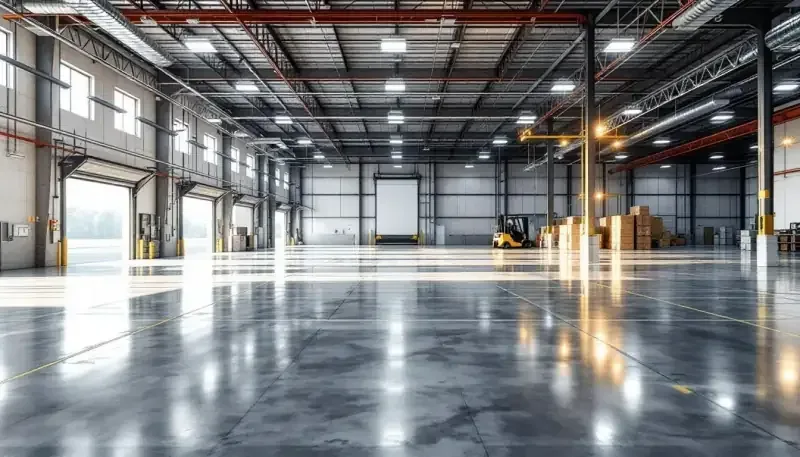
Warehouse floors in Harrisonville take a beating that standard commercial slabs can't handle. Facilities along the North 291 Retail Corridor and the Industrial Park see constant forklift traffic, heavy point loads from multi-tier racking, and chemical exposure from cleaning agents and hydraulic fluid. We design every slab to meet or exceed FF/FL flatness specifications, using fiber-reinforced concrete at 4,500 PSI or higher depending on your loading requirements. Joint layout is engineered around your specific racking configuration to prevent cracks from forming under posts.
The Royal Street extension and the I-49/Commercial St interchange project rolling through 2025-2026 are drawing new tenants and expanding existing operations across Harrisonville. That means new construction slabs for speculative warehouse buildings and full-replacement floors for older facilities trying to attract modern logistics users. We handle both. Our crew pours slabs from 10,000 to 100,000 square feet, with vapor barriers, integrated drainage, and surface hardeners applied as part of a single mobilization.
Dock-door transitions, ADA-compliant thresholds, and trench drain integration are standard in our scope. We coordinate directly with your facility manager and general contractor to match floor elevations to existing dock levelers and loading infrastructure. Every pour includes laser-guided screed work for consistent flatness across the entire floor plate. That precision matters when you're running narrow-aisle forklifts at speed.
Harrisonville-Specific Warehouse & Industrial Floors Considerations
Heavy Clay Subsoils Near Harrisonville Industrial Park
Cass County sits on expansive clay that swells when wet and shrinks when dry. This movement can crack an improperly supported warehouse slab within two years. We excavate below the clay layer and install a compacted aggregate subbase — typically 6 to 8 inches of crushed limestone — tested to 95% modified Proctor density. Moisture conditioning the subgrade before the pour is critical here. We also install a 15-mil vapor barrier to prevent moisture migration from pushing through the slab and damaging coatings, adhesives, or stored inventory.
Pothole-Prone Access Roads and Staging Logistics
Industrial access roads near Harrisonville's rail spurs are rough. Concrete trucks and equipment haulers need a clear, navigable route to your building. We scout every project site before mobilization, identifying the best staging areas and truck routes to avoid damaging your property or getting bogged down on deteriorated asphalt. For facilities off Commercial St or near the Industrial Park, we coordinate delivery timing to avoid peak commuter traffic on I-49 and MO-291. This keeps your neighbors happy and our pour schedule on track.
What Your Warehouse & Industrial Floors Timeline Looks Like
Days 1-3: Demolition and removal. If we're replacing an existing slab, our crew uses hydraulic breakers and skid-steer loaders to remove old concrete in sections. We haul debris to a licensed Cass County recycling facility. For phased projects, we isolate the active work zone with barricades so your remaining operations stay running. Harrisonville building permits for interior work typically take 5-7 business days — we submit those before demo starts so there's zero gap.
Days 4-6: Subbase preparation. We excavate to the engineered depth, remove any unsuitable clay material, and import crushed limestone aggregate. Compaction testing happens in real time. Vapor barrier goes down, followed by rebar or welded wire fabric placement per the structural engineer's spec. Embedded items like floor drain bodies and conduit sleeves get set at this stage.
Days 7-9: The pour. We schedule concrete delivery from local batch plants to minimize transit time and maintain consistent slump. Laser screed equipment levels the slab to FF50/FL30 or higher flatness specs. Surface hardeners are broadcast into the wet concrete for abrasion resistance. Joints are saw-cut within 12 hours to control cracking. During summer pours, we start at dawn to avoid afternoon heat that accelerates set time.
Days 10-17: Curing and protection. The slab cures under wet-cure blankets or curing compound for a minimum of 7 days. Harrisonville's summer humidity actually helps here — it slows moisture loss and produces a stronger surface. We keep all traffic off the slab during this period. No exceptions.
Day 18+: Turnover. We verify flatness with a floor profiler, clean the surface, and walk the project with you. Most facilities can begin installing racking and moving equipment by day 21. Forklifts can operate on the slab at 28-day strength, which in summer typically hits full PSI right on schedule.
Rebuilding a Worn-Out Slab at Harrisonville Industrial Park
A packaging distributor near the south end of Harrisonville Industrial Park called us after their floor joints started crumbling under daily forklift traffic. The original slab was poured in the early 2000s with minimal reinforcement and no surface hardener. Twenty years of loaded pallet jacks and sit-down forklifts had ground the joint edges into gravel. Their biggest concern: they couldn't shut down the entire 35,000-square-foot facility without losing a week of shipments during peak season.
We designed a three-phase pour that kept two-thirds of the building operational at all times. Phase one covered the receiving area nearest the dock doors along the south wall. Our crew demolished and hauled 4 inches of old concrete, excavated compromised clay subsoil, and replaced it with 8 inches of compacted crushed limestone. The new 6-inch slab went down at 5,000 PSI with fiber reinforcement and a lithium-densifier finish. Joints were aligned precisely to the client's new racking layout.
The entire project wrapped in 26 days, including full cure time on the final phase. Flatness numbers came in at FF55/FL35 — well above the minimum for their narrow-aisle reach trucks. The client resumed full operations without missing a single shipment deadline. Six months later, not a single joint showed any wear. That's what a properly engineered slab looks like when it's built for real-world Harrisonville warehouse conditions.
How Much Does Warehouse & Industrial Floors Cost in Harrisonville?
| Type | Cost / Sq Ft | Project Dependent |
|---|---|---|
| Standard Industrial Slab | $3–6 | Varies by scope |
| Polished Concrete | $5–10 | Varies by scope |
| Epoxy / Coating System | $4–8 | Varies by scope |
Warehouse floor costs in Harrisonville typically range from $6 to $10 per square foot installed, depending on slab thickness, reinforcement, and surface treatment. The relatively low mobilization cost compared to downtown KC projects — thanks to easy access off I-49 and shorter haul distances from southern batch plants — keeps your total investment competitive.
Warehouse & Industrial Floors FAQ for Harrisonville, MO
Does Cass County require permits for a warehouse floor replacement inside my existing Harrisonville building?
Yes. Harrisonville requires a building permit for structural concrete work, even inside an existing shell. The city's building department on Pearl Street handles commercial permits, and typical turnaround is 5 to 7 business days for straightforward floor replacements. If your project involves plumbing modifications — like adding floor drains or relocating trench drains — a separate plumbing permit may be required. We handle the entire permit application process and include all structural documentation the city needs.
What PSI and reinforcement do you recommend for a Harrisonville distribution center floor?
For standard distribution operations with loaded forklifts and multi-tier racking, we pour 4,500 PSI concrete with number-four rebar on 18-inch centers both ways. If your facility handles point loads above 8,000 pounds per post — common in high-bay racking — we increase to 5,000 PSI and tighten rebar spacing. Fiber reinforcement gets added to the mix for additional crack resistance. We design every slab around your specific equipment loads and racking layout, not a one-size-fits-all approach.
How do Harrisonville's freeze-thaw cycles impact a new warehouse slab?
Harrisonville sees roughly 80 freeze-thaw cycles per year. For interior slabs, the biggest risk is at dock doors and overhead door openings where cold air meets the warm floor. We use air-entrained concrete at those transition zones to resist scaling and spalling. Properly cured interior slabs away from exterior openings are largely unaffected by freeze-thaw because the building envelope maintains stable temperatures. We also recommend applying a densifier or surface hardener at door transitions for added durability against salt and moisture tracked in by trucks.
Can you install expansion joints that align with our existing building columns?
Absolutely. Column isolation joints are standard practice on every warehouse floor we pour. We install diamond-shaped isolation details around each column to allow independent movement between the slab and the structural columns. Construction joints and contraction joints are laid out on a grid that respects both your column spacing and your racking layout. This prevents random cracking and keeps joint maintenance predictable. We provide a detailed joint layout drawing before the pour so you can verify alignment with your operations plan.
What kind of warranty do you provide on Harrisonville warehouse floor projects?
We provide a written warranty covering structural integrity, flatness specifications, and surface hardener performance. The specific warranty term depends on project scope, but our standard coverage runs 2 years on workmanship and materials. Joint sealant and surface coatings carry their manufacturer's warranty, which we pass through to you with full documentation. We also provide a post-pour inspection report with flatness profiler data, concrete batch tickets, and compaction test results — everything your insurance carrier or landlord might require.
Other Concrete Services in Harrisonville, MO
Get Your Free Warehouse Floor Estimate in Harrisonville
Send us your facility address and square footage, and we'll schedule a site visit within the week. Harrisonville projects benefit from easy I-49 access and competitive batch-plant pricing — let's put real numbers in front of you.