
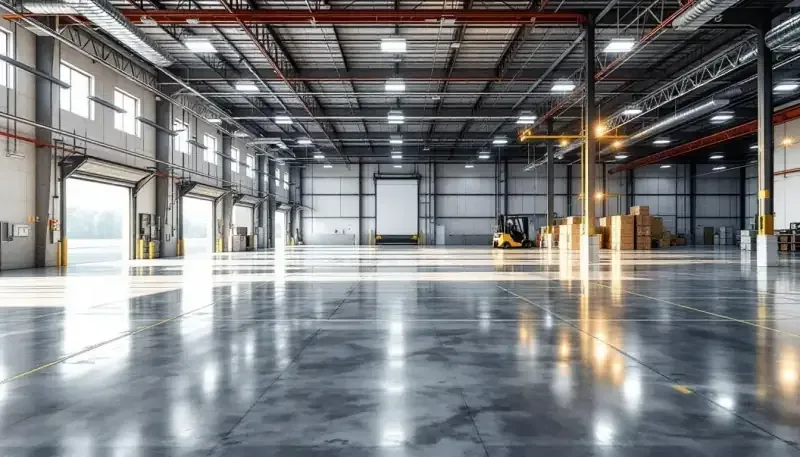
Warehouse & Industrial Floors in Grandview, MO
Grandview's logistics corridors demand floors that handle constant forklift traffic and heavy racking loads without flinching. We build them to last decades, not just survive them.
Patch It Again or Pour It Right This Time?
We see it every month in the Port of Grandview and along Blue Ridge Industrial. Warehouse operators spend thousands patching the same joints and spalled sections year after year. The original slabs from the Richards-Gebaur era were never designed for today's forklift weights and pallet loads. At some point, patching stops being maintenance and starts being money down a drain. A full-depth replacement with modern joint design and fiber reinforcement costs less over five years than the repair cycle you're stuck in.
The alternative—epoxy overlays or asphalt conversions—sounds cheaper upfront. But neither holds up under 10,000-pound point loads from modern racking systems. Concrete remains the only material that delivers the flatness, load capacity, and chemical resistance a working warehouse demands. If your operation runs forklifts, stores heavy product, or moves freight through dock doors daily, a properly engineered concrete slab is the only real answer.
Industrial-Grade Floors Built for Grandview's Logistics Demands
Grandview sits at a critical junction where I-49 meets MO-150, making it one of the busiest logistics nodes in the southern Kansas City metro. Your warehouse floor absorbs that pressure every single day. We design slabs from 6 inches to 12 inches thick depending on your load requirements, using 4,500 to 6,000 PSI concrete with steel fiber or rebar reinforcement. Every floor plan accounts for your specific rack layout, forklift paths, and dock door elevations.
Most of the industrial buildings along the I-49 frontage road and Port of Grandview corridor are on their third or fourth pavement lifecycle. That means existing subbase conditions vary wildly from one bay to the next. We perform full geotechnical evaluation before every pour, identifying areas of compromised fill, old utility trenches, and soil inconsistencies that would cause differential settlement under heavy loads.
Our crew handles everything from saw-cut joint design to integral floor hardeners and vapor barriers. We install trench drains, recessed dock areas, and ADA transitions as part of a single scope. After 377 completed projects since 2015, we understand that a warehouse floor isn't just concrete—it's the foundation your entire operation runs on.
Grandview-Specific Warehouse & Industrial Floors Considerations
Legacy Subbase Conditions from the Richards-Gebaur Era
Grandview's industrial zones grew rapidly during the 1960s and 70s around Richards-Gebaur Air Force Base. Many warehouse slabs sit on compacted fill from that period, and decades of loading have compressed or shifted those subbases unevenly. When we demolish an existing floor in the Blue Ridge Industrial area or Truman's Marketplace corridor, we frequently find 4 to 8 inches of settlement in the original subgrade. We recompact and proof-roll every square foot before pouring, adding structural fill where testing shows less than 95% compaction. Skipping this step is why so many Grandview floors crack within five years of a repour.
High-Load Forklift and Trailer Traffic Patterns
The logistics-to-highway flow along I-49 means Grandview warehouses see heavy trailer traffic at dock doors and constant forklift movement across interior aisles. Standard residential-grade concrete fails quickly under these conditions. We specify a minimum 5,000 PSI mix with synthetic macro-fiber reinforcement for most Grandview projects. At dock aprons and drive lanes, we increase the slab thickness and add doweled joints to transfer loads between panels. This prevents the joint spalling and corner cracking that plagues older floors in the Port of Grandview industrial park.
What Your Warehouse Floor Timeline Looks Like in Grandview
Days 1-3: Demolition and Subbase Prep. Our crew removes the existing slab in controlled sections, hauling debris to local recycling facilities. We excavate soft spots, proof-roll the subgrade with a loaded truck, and place compacted aggregate base. For a typical 15,000 to 25,000 square foot Grandview warehouse, demolition takes two to three days. If your operation needs to stay partially open, we barrier off active zones and work in phased sections.
Days 4-5: Forming, Reinforcement, and Utilities. We set steel forms to laser-verified elevations, tie rebar mats or place fiber mesh, and rough in any trench drains, floor drains, or embedded conduit. Dock transitions and ADA ramps get formed at this stage. Jackson County building inspections typically schedule within 24 to 48 hours of our permit request, so we build that window into the schedule.
Days 6-8: Concrete Placement and Finishing. We pour in alternating checkerboard bays so each section cures independently. Laser screeds achieve FF50/FL30 flatness or higher for narrow-aisle operations. Curing compound goes down immediately. In Grandview's summer heat, we schedule pours for early morning to control surface evaporation. Winter pours get insulated blankets within 30 minutes of finishing.
Days 9-14: Curing and Joint Cutting. Saw cuts happen within 12 to 18 hours of placement. The slab needs a minimum of seven days before light foot traffic and ten to fourteen days before forklift loads. We coordinate this curing window with your operations manager so staging areas stay accessible throughout.
Days 15-21: Hardener Application and Turnover. After the initial cure, we apply lithium-silicate densifier or dry-shake hardener depending on your wear requirements. Final joint sealing happens at day 21. We walk the floor with your crew, verify flatness readings, and hand over all mix design documentation and warranty paperwork. Most Grandview warehouse floors go from demolition to full operation in three weeks.
How Much Does Warehouse & Industrial Floors Cost in Grandview?
| Type | Cost / Sq Ft | Project Dependent |
|---|---|---|
| Standard Industrial Slab | $3–6 | Varies by scope |
| Polished Concrete | $5–10 | Varies by scope |
| Epoxy / Coating System | $4–8 | Varies by scope |
Grandview industrial floor projects typically range from $6 to $12 per square foot depending on slab thickness, reinforcement, and subbase remediation. Buildings in the Port of Grandview area often require additional subgrade work due to legacy fill conditions, which can add 10-15% to the base cost.
Warehouse & Industrial Floors FAQ for Grandview, MO
What flatness specs should I expect for my Grandview distribution center floor?
We pour to a minimum FF35/FL25 for standard warehouse operations with sit-down forklifts. If your facility runs narrow-aisle turret trucks or automated guided vehicles, we hit FF50/FL30 or higher using laser screed technology. These numbers get verified with a Dipstick floor profiler before we hand over the slab. Every reading is documented and included in your closeout package. The flatness spec directly impacts your racking installation tolerances, so we coordinate with your racking vendor early in the design phase.
How do you deal with Grandview's expansive clay soils under a warehouse slab?
Jackson County clay expands and contracts significantly with moisture changes. We start with geotechnical boring to measure plasticity index and moisture content at your specific site. If the PI exceeds 25, we over-excavate and replace with engineered fill—usually 8 to 12 inches of compacted crushed limestone. A moisture barrier goes between the aggregate base and the slab to prevent upward vapor transmission. This approach prevents the heaving and settlement cracks that destroy floors poured directly on untreated Grandview clay.
Can you install a vapor barrier under the slab?
Absolutely, and for most Grandview warehouse applications we strongly recommend it. We install 15-mil polyethylene vapor retarder directly beneath the slab per ASTM E1745 standards. This prevents moisture vapor from migrating up through the concrete, which causes adhesion failure in coatings and damages moisture-sensitive inventory. The barrier also protects against the high water tables common near Longview Lake. All seams get taped with manufacturer-specified tape, and we run the barrier 6 inches up foundation walls before trimming at finish grade.
What's the cost difference between repairing my existing floor and full replacement?
For a typical 20,000-square-foot Grandview warehouse, extensive joint repair and resurfacing runs $40,000 to $60,000. That repair lasts three to five years under heavy forklift traffic before you're back to square one. A full replacement on the same footprint runs $120,000 to $240,000 depending on thickness and reinforcement—but delivers a 20 to 30 year service life. Over a ten-year window, replacement costs roughly 40% less than the repair cycle. We run these numbers for every client during the estimate so you can make a clear financial decision.
Do you coordinate with our fire marshal and insurance carrier on floor specifications?
Yes. Grandview commercial buildings fall under Jackson County fire code, which can require specific floor drain locations, fire lane markings, and hazmat containment details depending on your stored materials. We've worked with local inspectors on dozens of projects and understand their requirements. We also provide mix design certifications, compaction test results, and as-built drawings that your insurance carrier may need for policy compliance. Having this documentation ready upfront prevents delays during your next insurance audit or occupancy review.
Other Concrete Services in Grandview, MO
Get a Free Estimate for Your Grandview Warehouse Floor
Tell us your square footage, current floor condition, and operational constraints. We'll visit your site near the Port of Grandview, Blue Ridge Industrial, or anywhere in the 64030 zip and deliver a detailed proposal within 48 hours.