
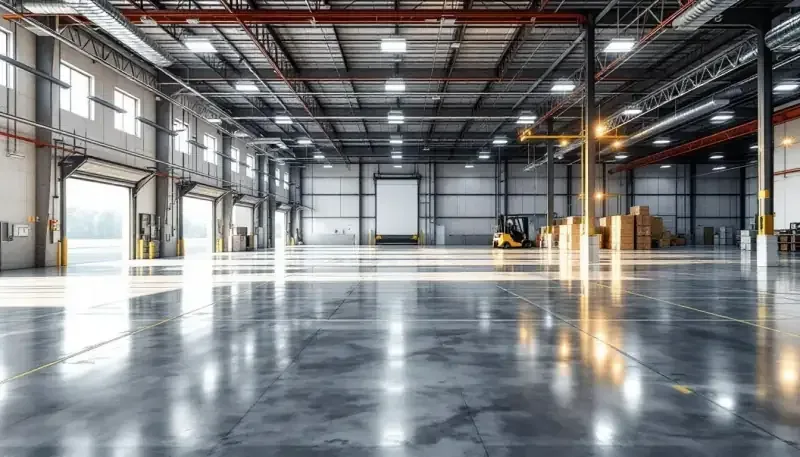
Warehouse & Industrial Floors in Belton, MO
Belton's industrial boom along I-49 demands floors that can handle Class 8 truck traffic and heavy racking without cracking, spalling, or joint failure within five years.
Is your Belton warehouse floor already showing signs of failure?
You walk into your warehouse off Southview Commerce Center and feel it before you see it. The forklift bounces slightly at every control joint. Cracks radiate from column bases like spider webs. Chunks of concrete have popped loose near the dock doors, and your operators are dodging the rough spots instead of running efficient routes. That floor was supposed to last decades. It barely made it through seven years.
This is a pattern we see throughout Belton's newer industrial corridors. Buildings constructed during the I-49 boom between 2015 and 2022 often sit on subbase material that wasn't adequately compacted for the loads these facilities actually handle. The result is premature joint deterioration, structural rutting, and slab curl that worsens every winter. Patch jobs buy you months, not years.
Belton's rapid growth as a logistics hub means your floor endures punishment that mid-century designs never anticipated. Class 8 truck volume along I-49 keeps climbing. Distribution centers near Belton Gateway run three shifts. Forklift traffic is relentless. A warehouse floor in this market needs to be engineered for real-world abuse, not just minimum code compliance.
We've poured and replaced industrial floors across Cass County since 2015 — over 377 projects and counting. Our 13 five-star Google reviews reflect the kind of results Belton business owners actually notice: flat floors, tight joints, zero callbacks. If your slab is fighting you instead of working for you, it's time for a conversation.
Industrial-Grade Concrete Floors Built for Belton's Logistics Demands
Warehouse floors in Belton need to handle a specific combination of challenges: heavy point loads from tall racking systems, constant forklift wheel traffic, and the thermal cycling that Cass County's climate delivers every year. We design slabs with reinforced doweled joints, fiber-mesh reinforcement, and concrete mix designs rated at 4,500 PSI or higher. Every project starts with a thorough subbase evaluation because soil conditions along the I-49 corridor vary dramatically — even within a single commercial park.
Our industrial floor installations cover facilities throughout Belton's commercial zones, from Southview Commerce Center to Skyview Commerce Center and the expanding logistics properties along Mullen Road. We handle full tear-out and replacement, new construction pours, and phased renovation projects that keep your operation running. Joint layout is engineered specifically for your traffic patterns and racking configuration, not copied from a generic template.
Surface finishing options include burnished hard-trowel finishes for standard warehouse use, densifier and hardener applications for high-abrasion environments, and polyurea or epoxy coatings for chemical resistance. We also install saw-cut control joints at precise spacing calculated for your slab thickness and load requirements, which directly addresses the joint failure issues plaguing many of Belton's newer industrial pads.
Belton-Specific Warehouse & Industrial Floors Considerations
Class 8 Truck Loading and Dock Apron Engineering
Belton's role as a regional distribution hub means most warehouse facilities see daily semi-trailer traffic. The dock apron areas along I-49 corridor properties endure extreme repetitive loads. We pour dock approaches with thickened edges, reinforced transition zones, and concrete rated for heavy axle weights. Standard 4-inch residential-grade slabs fail here within two years. Our dock apron designs typically call for 7- to 8-inch slabs with welded wire reinforcement and load-transfer dowels at every joint.
Subbase Instability in Belton's I-49 Boom Properties
Many commercial properties built between 2015 and 2022 in Belton were constructed on fill material that wasn't given adequate consolidation time. We see the evidence in structural rutting and differential settlement across warehouse floors in Southview and Skyview Commerce Centers. Before any pour, our crew performs subbase compaction testing and moisture evaluation. If existing subbase material fails, we remove and replace it with properly graded and compacted aggregate. Skipping this step is exactly how Belton's newest slabs ended up cracking prematurely.
Freeze-Thaw Cycling in Cass County's Unheated Zones
Not every Belton warehouse is climate-controlled. Cold storage facilities, open dock bays, and unheated overflow buildings experience dramatic temperature swings from November through March. Freeze-thaw cycling drives moisture into micro-cracks and blows them open from the inside. We specify air-entrained concrete with proper finishing techniques for these environments. Joint sealant selection also matters — we use flexible polyurethane sealants that accommodate thermal expansion without pulling loose.
From First Call to Finished Warehouse Floor — Your Belton Project Journey
It starts with a phone call. You describe the cracking near your racking bays, the forklift operators complaining about rough joints, or the new building shell that needs its first slab. We schedule a site visit — usually within three business days — and one of our contractors walks your facility with a straightedge, a moisture meter, and a camera. If your property is in Skyview Commerce Center, we already know the subbase history there. If it's an older building closer to North Ave, we know what mid-century construction typically hides under the surface.
After the walkthrough, we deliver a detailed scope of work. This includes slab thickness, mix design, joint layout, reinforcement specifications, and a realistic timeline built around your operation. We discuss phasing options if your warehouse can't shut down entirely. Many Belton distribution centers pour in sections — one bay at a time — so forklifts and inventory keep moving. We map out a sequence that minimizes disruption and protects freshly poured sections from early traffic.
Pour day is methodical. Concrete trucks stage on your lot in a planned sequence. Our crew places, screeds, and finishes each section with laser-guided screed equipment to hit FF/FL flatness numbers your racking installer and forklift operators will appreciate. Saw-cutting happens within the precise window — too early and you get raveling, too late and you get random cracking. We handle this timing based on ambient temperature and mix behavior, not guesswork.
Within days, your new slab is curing under protective compound or wet-cure blankets. We return to install joint sealant, apply any hardener or coating specified in the scope, and do a final flatness check. You get documentation of everything — mix tickets, compaction results, flatness readings, and warranty details. Your floor is ready to carry the load.
Replacing 18,000 Square Feet of Failed Slab at Southview Commerce Center
A distribution company operating out of a 2017-built warehouse near 163rd Street and Southview Commerce Center called us about widespread joint failure. Forklifts were catching on curled slab edges, and the control joints had disintegrated across roughly 60 percent of the floor. Their racking system was showing signs of uneven settlement. Product was falling during picks. The original contractor had poured a 5-inch slab on minimally compacted fill — adequate for light storage, but this facility had transitioned to heavy pallet racking with point loads exceeding 8,000 pounds per upright.
We phased the project into four sections, keeping two-thirds of the warehouse operational at all times. Demolition revealed subbase material that was still loose 18 inches below grade. We excavated and replaced it with 8 inches of compacted Class 5 aggregate, verified to 95 percent Modified Proctor density. The new 7-inch slab used 4,500 PSI concrete with fiber reinforcement and doweled joints engineered around the racking layout. Pour days ran from 5 AM to early afternoon to manage summer heat and concrete set times.
The finished floor hit FF 42 / FL 28 across all four sections. Joint sealant was installed within two weeks of each pour. The facility was back to full operation in under six weeks. Six months later, the operations manager reported zero joint issues and a measurable improvement in forklift cycle times. That's the difference between a floor designed for a spreadsheet and a floor designed for what actually rolls across it.
How Much Does Warehouse & Industrial Floors Cost in Belton?
| Type | Cost / Sq Ft | Project Dependent |
|---|---|---|
| Standard Industrial Slab | $3–6 | Varies by scope |
| Polished Concrete | $5–10 | Varies by scope |
| Epoxy / Coating System | $4–8 | Varies by scope |
Industrial floor pricing in Belton typically runs between $6 and $12 per square foot depending on slab thickness, subbase condition, and surface treatment. Properties along the I-49 corridor sometimes require deeper subbase remediation, which adds cost but prevents the premature failures common in this area's newer pads.
Warehouse & Industrial Floors FAQ for Belton, MO
What subbase preparation does a Belton warehouse floor need?
Belton's I-49 corridor properties often sit on fill material that hasn't fully consolidated. We test compaction density before any pour. If the existing subbase doesn't meet spec — which happens frequently in Southview and Skyview Commerce Centers — we excavate and replace with properly graded, compacted aggregate. Typical subbase depth is 6 to 8 inches of compacted stone. We also verify drainage slope to prevent water from pooling under the slab, which accelerates deterioration from below.
How do you handle joint layout for our specific racking configuration?
We coordinate directly with your racking installer or review your layout drawings before cutting a single joint. Control joints should never run directly under rack uprights or in forklift wheel paths between narrow aisles. We calculate joint spacing based on slab thickness, aggregate size, and reinforcement type. For a typical 6-inch Belton warehouse slab, joints land at roughly 12- to 15-foot intervals. Every joint gets sealed with flexible polyurethane to prevent debris infiltration and edge spalling.
Will my Belton facility need a building permit for floor replacement?
Yes. Cass County and the City of Belton require permits for structural concrete work in commercial buildings. We handle the permit application and coordinate any required inspections. If your project involves changes to floor drains, dock elevations, or structural load capacity, additional engineering documentation may be required. We prepare or source these documents as part of the project scope so there are no delays.
What flatness tolerances do you achieve?
We pour to FF 35 / FL 25 minimum for standard warehouse applications. For narrow-aisle forklift operations with wire guidance, we hit FF 50 / FL 30 or higher. These numbers are verified with a Dipstick floor profiler after curing. Flatness matters more than most people realize — a wavy floor reduces forklift speed, damages pallet loads, and creates safety hazards. We use laser-guided screeding equipment to maintain consistency across large pours.
Can you pour during winter months in Belton?
We pour year-round. Winter pours require heated mix water, insulated blankets during curing, and adjusted set times. Cass County winters regularly dip below 25 degrees overnight from December through February. We monitor slab temperatures during the critical first 72 hours. Cold-weather pours cost slightly more due to materials and labor, but waiting until spring often costs more in lost productivity and continued damage to a failing floor.
Do you remove and dispose of the old concrete?
Yes. Full tear-out is included in our scope when replacing an existing slab. We saw-cut the old floor into manageable sections, break it out with skid-steer hydraulic hammers, and haul everything to a licensed recycling facility. Old reinforcement steel is separated and recycled. We inspect the exposed subbase during demolition — this is often when we discover the compaction issues or moisture problems that caused the original floor to fail. Disposal costs are itemized in your proposal so there are no surprises.
Other Concrete Services in Belton, MO
Warehouse & Industrial Floors in Nearby Cities
Schedule Your Free Belton Warehouse Floor Assessment
We'll evaluate your slab condition, subbase integrity, joint performance, and traffic patterns at your Belton facility — then deliver a detailed scope and honest cost estimate tailored to your operation.