
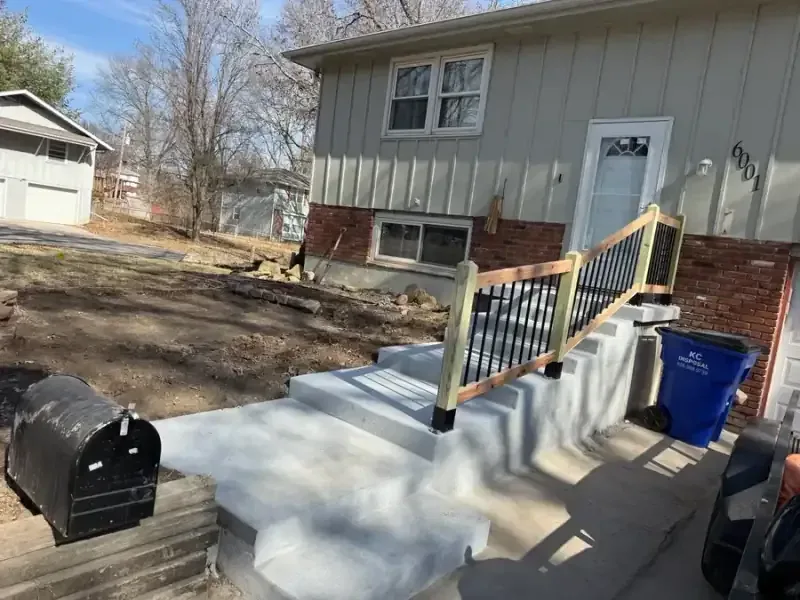
Sidewalks & Walkways in Belton, MO
Belton homeowners deserve straight talk about what a new sidewalk or walkway actually costs — and why cutting corners on Cass County clay soil always costs more later.
So what does a new sidewalk really cost in Belton?
Let's skip the runaround. A standard 4-inch residential sidewalk in Belton runs between $8 and $12 per square foot installed. A 40-foot front walkway at 4 feet wide lands somewhere around $1,280 to $1,920. Stamped or colored concrete pushes that closer to $14 to $18 per square foot. These numbers reflect 2024 material costs, Cass County labor rates, and the prep work Belton's soil demands.
Why does the price range vary? Belton sits on heavy clay that shifts with every wet-dry cycle. Homes in Autumn Ridge and Eagle Glen built after 2015 often have compacted fill that still hasn't fully settled. That means we sometimes need to over-excavate and bring in Class 5 limestone base — an added cost that prevents your new walkway from cracking within three years.
Older neighborhoods closer to downtown Belton and North Ave have a different problem. Mid-century sidewalks there were poured on minimal base over native soil. Tear-out and haul-off of that old concrete adds $2 to $3 per square foot. Tree roots from decades-old maples and oaks complicate removal further. We price each project after seeing the site because these variables matter more than square footage alone.
Here's the honest bottom line: cheap concrete work in Belton doesn't stay cheap. We've replaced sidewalks that were poured just five years ago by contractors who skimped on base prep. A proper pour with fiber mesh reinforcement, adequate control joints, and a compacted aggregate base lasts 25 to 30 years. That math works out to pennies per day for something you walk on every single morning.
What Goes Into a Belton Sidewalk That Actually Lasts
Every walkway we pour in Belton starts with soil assessment. Cass County clay has a plasticity index that makes it one of the more problematic subgrades in the southern KC metro. We excavate 6 to 8 inches below finished grade and compact a 4-inch limestone base before forming. This buffer absorbs moisture fluctuations so your slab doesn't heave or sink during freeze-thaw cycles — something Belton sees roughly 80 times per winter.
We pour residential sidewalks at 4 inches minimum with fiber mesh reinforcement throughout. Control joints are cut every 4 to 5 feet to direct cracking where it won't show. For walkways along slopes — common in neighborhoods like Traditions where the terrain rolls toward creek beds — we adjust the grade and add thickened edges for stability. Every pour gets a broom finish for traction unless you opt for exposed aggregate or stamped patterns.
Belton's growth along the I-49 corridor means concrete suppliers are nearby, keeping material delivery costs lower than in more remote parts of Cass County. We source from local batch plants and schedule pours for morning delivery when mix consistency is most reliable. After finishing, we apply a quality cure-and-seal compound and protect the slab for a minimum of 48 hours before foot traffic.
Belton-Specific Sidewalks & Walkways Considerations
Cass County Clay and Seasonal Ground Movement
Belton's expansive clay soil swells when wet and shrinks when dry. This creates a cycle that destroys sidewalks poured directly on native ground. We've seen walkways in Eagle Glen buckle after just two summers because the original contractor skipped base preparation. Our approach uses compacted limestone aggregate that acts as a stable platform regardless of moisture content. It adds cost upfront but eliminates the cracking and settlement that leads to early replacement.
Belton's Rapid Growth Means New Grading Challenges
Many Belton subdivisions built between 2015 and 2022 have yards where builder fill hasn't fully consolidated. Homeowners in Autumn Ridge and along 163rd Street often notice their original builder-grade stoops and walks settling unevenly. Before pouring a new walkway on a newer lot, we probe the fill depth and compact in lifts if needed. This extra step prevents the walkway from separating from the front stoop or garage apron — a problem we see on nearly every newer Belton street.
What Your Sidewalk Timeline Looks Like in Belton
Day 1 — Site Prep and Forming: Our crew arrives early, typically by 7:30 a.m. We mark utility lines, excavate the path, haul off soil and any old concrete, then compact the limestone base. Forms go in by afternoon. Your driveway stays accessible. We stage materials along the yard edge and protect landscaping beds with plywood sheeting. Most homeowners barely notice we're there by dinnertime.
Day 2 — The Pour: Concrete trucks arrive from a local Cass County batch plant between 7 and 8 a.m. We pour, screed, float, and broom-finish your walkway in a single session. A typical 150-square-foot front walkway takes about three hours from first truck to final finish. We cut control joints before the surface sets and apply cure-and-seal compound immediately. Your front door remains accessible via a temporary path we set up beforehand.
Days 3-4 — Initial Cure and Form Removal: We pull forms on day 3 and backfill edges with topsoil. The concrete needs 48 hours minimum before foot traffic. We place caution tape and barricades so delivery drivers and guests know to use the alternate path. If Belton temperatures drop below 50°F overnight, we lay insulating blankets to keep the cure on track.
Days 5-7 — Final Curing and Cleanup: By day 5, light foot traffic is fine. We return to inspect the surface, clean up any remaining debris, and spread grass seed along disturbed edges. Full vehicle-weight loading — if the walkway connects to a driveway apron — takes 7 days. We walk you through simple maintenance steps and leave you with a written care guide. Start to finish, most Belton sidewalk projects wrap in under a week with zero surprises.
From Crumbling Path to Curb Appeal on Mulberry Lane
A homeowner in Autumn Ridge off 163rd Street called us about a front walkway that had cracked into five separate pieces. The original builder had poured 3.5 inches of concrete directly on fill dirt back in 2016. After just six Belton winters, the sections had shifted in different directions — one piece sat an inch higher than its neighbor, creating a trip hazard right at the front steps.
We removed the entire 48-foot walkway, excavated 8 inches down, and discovered the fill beneath was still soft and unconsolidated. Our crew compacted it in 3-inch lifts with a plate compactor, then laid 4 inches of Class 5 limestone base. We poured a full 4-inch slab with fiber mesh and cut control joints every 4.5 feet. The homeowner chose a light sandstone integral color to complement their stone veneer.
The finished walkway tied cleanly into the existing front stoop and curved gently toward the driveway. Three weeks later, the homeowner sent us a photo — their new walkway looked sharp against fresh mulch beds, and two neighbors had already asked for our number. That project cost $2,400 installed, and it will still look great in 2045.
How Much Does Sidewalks & Walkways Cost in Belton?
| Type | Cost / Sq Ft | Typical 300 Sq Ft |
|---|---|---|
| Standard Sidewalk | $6–10 | $1,800–$3,000 |
| Decorative Walkway | $10–16 | $3,000–$4,800 |
| Trip Hazard Repair (per section) | $200–500 | $200–$500 |
Belton's proximity to I-49 concrete suppliers keeps material delivery surcharges lower than outlying Cass County towns. However, older lots near North Ave and downtown often require extra tear-out and grading work that can add 15-20% to the base price.
Sidewalks & Walkways FAQ for Belton, MO
Do I need a permit for a residential sidewalk in Belton?
Belton typically requires a building permit for new concrete flatwork that connects to city right-of-way, like a sidewalk running from your front door to the public sidewalk along the street. Private backyard walkways usually don't require a permit unless they alter drainage patterns. We check with Belton's Community Development department before every project and handle the application if one is needed. Permit fees in Belton are modest — usually under $75 for residential flatwork. We factor this into your estimate so there are no hidden costs.
How do you deal with the slope in my Traditions neighborhood yard?
Traditions and several Belton subdivisions have moderate grades that require careful walkway design. We use a stepped approach on slopes steeper than 5%, pouring individual flat sections with small risers between them. Each section drains to one side so water doesn't pool on the walking surface. On gentler slopes, we pour a continuous walkway with a controlled grade and textured broom finish for traction. We laser-level every form to ensure consistent slope and proper drainage away from your foundation.
What's the cost difference between plain concrete and stamped for a Belton walkway?
Plain broom-finish concrete runs $8 to $12 per square foot in Belton. Stamped concrete — which mimics flagstone, brick, or slate — costs $14 to $18 per square foot depending on pattern complexity and color choices. The difference comes from the additional labor, stamping tools, integral color, and release agent required. Stamped walkways also need resealing every 2 to 3 years to maintain their appearance. For homeowners who want something between the two, exposed aggregate is a great middle ground at $10 to $14 per square foot.
Can you build a walkway that connects my front porch to the backyard without tearing up my garden beds along the side of the house?
Yes. We plan the route during the estimate visit and work with you to identify the least disruptive path. Our crew hand-excavates near established plantings and uses narrow forms to minimize the footprint. We protect root zones with plywood and avoid driving equipment over garden beds. If a shrub needs temporary relocation, we dig it out carefully and replant after the pour. We've done several side-yard walkways in Belton where the homeowner's landscaping looked untouched a month later.
How do Belton's freeze-thaw cycles affect a new walkway?
Belton averages around 80 freeze-thaw cycles per winter. Each cycle forces moisture into micro-pores in the concrete surface, and when it freezes, it expands. Over time this causes spalling — the surface flaking you see on older sidewalks around downtown Belton. We combat this by using air-entrained concrete with a 6% air content, which creates tiny internal bubbles that absorb expansion pressure. Combined with a quality cure-and-seal coat, your walkway resists freeze-thaw damage for decades.
My house is near Belton Memorial Park and the old sidewalk has settled 2 inches — repair or replace?
A 2-inch settlement usually means the base has failed, which is common on older lots near Belton Memorial Park where native clay was the original subgrade. Mudjacking can lift a settled slab, but it doesn't fix the underlying base problem. For a 2-inch drop, we typically recommend full removal and replacement with proper limestone base preparation. The cost is higher upfront, but you avoid paying for mudjacking now and replacement in 3 to 5 years anyway. We'll evaluate both options during your estimate visit and give you honest numbers for each.
Other Concrete Services in Belton, MO
Get Your Free Belton Sidewalk Estimate This Week
We'll visit your Belton property, assess your soil and grade conditions, and hand you an honest quote — usually within 48 hours. Most Cass County projects can be scheduled within two to three weeks of approval.